Food costs spiked in December while gas prices cooled. Here's the latest look at consumer expenses
Published in Business News
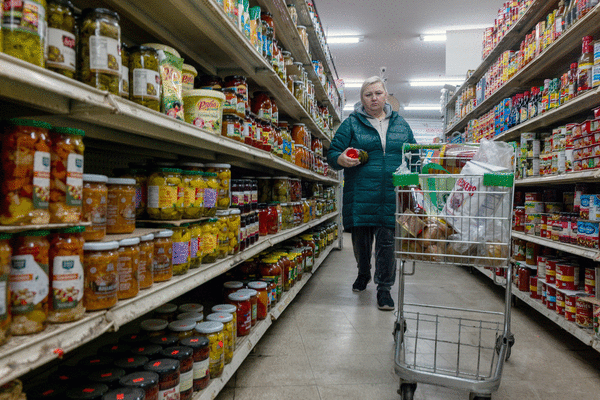
The U.S. Bureau of Labor Statistics released its latest consumer price report last week, providing a closer look at how energy costs, grocery prices and other everyday expenses have shifted in the nearly 12 months since President Donald Trump assumed office.
Across the board, inflation accelerated last month, with prices rising 0.3% from November to December. Consumer costs are also 2.7% higher than they were a year ago, an increase driven largely by surging food prices, which saw a 3.1% hike year-over-year.
Grocery staples like milk, bread, tomatoes and ground beef all went up in December. Meanwhile, gas prices dipped 5.5%, representing the biggest percent decrease in the average nationwide cost going back at least two years.
The Tribune is tracking 11 everyday costs for Americans — eggs, milk, bread, bananas, oranges, tomatoes, chicken, ground beef, gasoline, electricity and natural gas — and how they are changing, or not, under the second Trump administration. This tracker is updated monthly using CPI data from the U.S. Bureau of Labor Statistics.
To see the average U.S. price of a specific good, click on the dropdown arrow below and select the item you wish to view.
Eggs
Egg prices have fallen for an eighth month, down another 15 cents from November to land at $2.71 for a dozen large Grade A eggs.
The continued drop-off in prices is the result of a declining number of bird flu cases in commercial and backyard flocks — particularly among egg-laying hens. From the beginning of December through the first half of January, roughly 1.8 million birds were affected by highly pathogenic avian influenza in the United States, with less than 150,000 of the birds being table egg-layers, according to U.S. Department of Agriculture data. By comparison, in January 2025, during the height of the outbreak, there were nearly 19 million cases among egg-layers alone.
The cost of eggs is currently about 35% less than it was in December 2024, before Trump’s swearing-in, and prices have plummeted 56% since March, when the nationwide average was a record-breaking $6.23 per dozen.
Milk
The cost of milk, meanwhile, jumped 5 cents month-over-month.
A gallon of fresh, fortified whole milk is now priced at $4.05 — a 1% decrease in price from this time last year.
Bread
The cost of white bread also ticked up by a few cents in December. Even so, at $1.83 per pound, the national average is 10 cents less than it was when Trump started his second term.
Bananas
Banana prices were unchanged in December, remaining at $0.66 per pound. That average is just 1 cent off the all-time high recorded in September and is nearly 7% more than it was 12 months ago.
Recent price inflation is likely a byproduct of the president’s trade war, with 10% reciprocal tariffs imposed on Guatemala, Ecuador, Costa Rica, Colombia and Honduras, and a 25% “fentanyl tariff” levied against Mexico — all of which are among the top suppliers of bananas to the U.S.
But in mid-November, Trump took action to combat rising grocery costs, announcing that some agricultural products would be exempt from reciprocal tariffs due to “current domestic demand for certain products” and “current domestic capacity to produce certain products.”
Both fresh and dried bananas were among the listed exemptions.
Oranges
It’s cold and flu season, which means stocking up on citrus. Luckily, you won’t have to pay as much for your daily dose of Vitamin C the next time you visit the grocery store.
The average price of navel oranges was $1.57 per pound in December — a 23 cent drop from September, the next most recent month of data.
This sharp decrease in cost is standard for the fruit market this time of year: Oranges are cheapest in the winter months, then increasing in price throughout the late spring and summer and eventually peaking in September or October each year.
Additionally, as with bananas, oranges are now exempt from most reciprocal tariffs, bringing down costs for foreign growers like Chile, South Africa and Australia.
Tomatoes
As of December, the cost of field-grown tomatoes was $1.84 per pound, a slight increase from the previous month but still lower than August and September.
This change is somewhat of an abnormality given the harvesting season. Typically, tomato prices spike in the fall and peak in the early winter months, but according to the USDA, softer market conditions domestically have driven cheaper retail costs — particularly for this time of year.
Prices for fresh tomatoes are down roughly 10% since Trump took power.
Chicken
After months of moderately raised prices, the cost of chicken seems to be on the decline.
Prices fell slightly for a fifth month, with a pound of fresh, whole chicken now costing an average of $2.02 nationwide. Even so, grocery store prices have stayed fairly stagnant, continuing to hover around the $2 mark for more than two years.
As a reliably cheap source of protein, there’s a reason chicken remains a staple in so many Americans’ diets.
Ground Beef
A notably less cheap source of protein? Ground beef.
Prices have been steadily climbing since last January, with ground beef costs ballooning by more than 18% — or about $1 per pound.
This can be attributed to a confluence of factors. The U.S. cattle inventory is the lowest it’s been in almost 75 years, and severe drought in parts of the country has further reduced the feed supply, per the USDA. Steep tariff rates on top beef importers have also played a part in higher prices stateside, but as of Nov. 13, high-quality cuts, processed beef and live cattle are exempt from most countries’ levies. Similarly, a 50% tariff on beef products from Brazil was lifted in late November, a huge win given the U.S. imported more beef from the South American nation than anywhere else in the world outside Australia last year.
Still, beef prices are so high that the president has taken to accusing foreign-owned meat packers of intentionally inflating costs and requested that the Department of Justice investigate the matter.
As of December, a pound of 100% ground beef chuck would set you back about $6.52.
Electricity
Electric costs are also hovering around all-time highs at approximately 19 cents per kilowatt-hour.
With the average American household using roughly 899 kWh every four weeks, that translates to a monthly bill of about $170.
Increased energy demand as a result of power-hungry data centers is a growing issue for many states — Illinois included. A recent report released jointly by three state agencies said Illinois could be five years away from chronic electricity shortages and higher monthly bills. As for Chicago, the Illinois Commerce Commission recently approved a $243 million rate reconciliation request for ComEd, the city’s primary electric utility. That hike will be passed along to customers, with a delivery charge increase of $3.10 per month starting in January.
To offset these rising costs, Gov. JB Pritzker earlier this month signed the Clean and Reliable Grid Affordability Act, and ComEd is offering state-mandated nuclear energy credits.
Still, for many Americans, relief is needed. Since last year, the average price of electricity per kilowatt-hour has risen by 7%.
Gasoline
The price at the pump saw a noticeable decrease month-over-month.
Dropping 18 cents, the average nationwide cost of gasoline registered at $3.05 per gallon of regular unleaded. Fill-ups were considerably cheaper in Chicago, too. From November to December, prices dropped by 22 cents a gallon, landing at $3.07, according to data from the U.S. Energy Information Administration.
Declining gas costs have become an oft-cited accomplishment from White House officials. In his presidential address last month, Trump highlighted the work his administration has done to lower prices, and last week, the White House X account shared a post claiming that 43 states now boast averages under $3 a gallon.
In truth, from January to December, the cost of gasoline has fallen by 5% nationwide. In that same 12-month window under President Joe Biden, prices spiked by more than 46%.
Natural Gas
Piped utility gas, or natural gas, is another expense that’s creeping up.
On average, Americans are paying nearly 12% more to heat their homes, ovens and stovetops than when Biden left office. Average prices nationwide sit at $1.70 per therm — the highest they’ve been in three years.
What’s more, both Chicago-area gas utilities, Peoples Gas and Nicor Gas, are seeking rate increases upward of $200 million. If approved, Chicagoans and suburban residents alike will see higher charges on their monthly bills.
©2026 Chicago Tribune. Visit at chicagotribune.com. Distributed by Tribune Content Agency, LLC.










Comments