Car dealers worry prices are getting out of hand as the economy wavers
Published in Business News
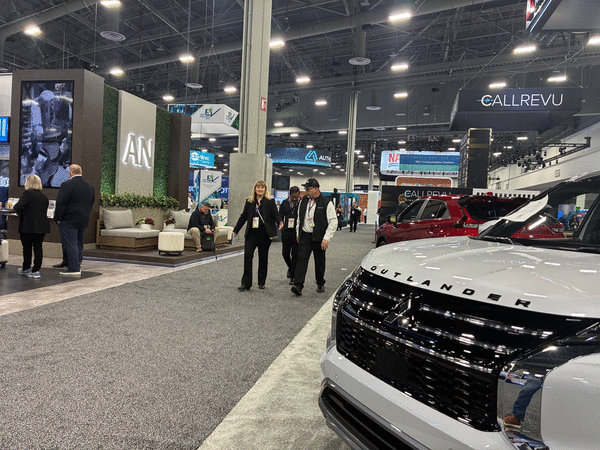
LAS VEGAS — America's car dealers are coming to a stark realization: The new vehicles on their lots too often cost too much, and that could create trouble for their businesses in 2026.
As the economy enters a moment of uncertainty, attendees of the annual National Automobile Dealers Association convention in Las Vegas last week kept mentioning the intensifying need for affordable vehicles. In response, dealers are set to stock their lots this year with cheaper models and trims — and top off on used cars.
"Car prices continue to rise," Tom Castriota, a Florida Chevrolet dealer and NADA's outgoing chairman, told conference attendees, later underscoring the need to stock a "full range of products at prices customers can afford."
Dealers, experts and other attendees painted a mixed picture of what they see on the horizon. On one hand, higher earners are doing just fine. Many have watched their disposable income grow of late amid a largely robust stock market, with the Dow Jones Industrial Average closing above 50,000 for the first time Friday. Consumers also are expected to have some more cash in their pocket in the coming months thanks to new tax breaks enacted as part of the One Big Beautiful Bill Act last year.
And yet concerning indicators have popped up. Job and wage growth has recently slowed and is expected to stagnate this year. Consumer confidence fell through much of late 2025, and in January, slumped to its lowest level in more than 11 years.
These worrisome economic trends come as new car prices keep pushing higher, currently averaging around $50,000 and forcing many buyers to increasingly stretch out loan lengths. The typical monthly payment is now $750, with buyers signing up to pay on average for 70 months.
Other car-related costs have already been stressing consumers, such as skyrocketing insurance rates. When tallying up loan payments, insurance, fuel and maintenance, the average monthly price tag for a new or used car has escalated from about $750 per month in 2019 to over $1,000 today, said Jeremy Robb, Cox Automotive Inc.'s chief economist.
The conflicting economic indicators have many experts projecting a slight drop-off in new car sales for 2026: Cox anticipates 15.8 million units to be sold, a 2.4% decline.
Some see potential for a significantly rockier year for the nation's car dealers as consumers increasingly fret over their finances.
"We think that 2026 is going to be a tough year — maybe the toughest in like 15 years to sell a car," said Rick Wainschel, vice president of data science and analytics at Catalyst IQ, which provides data and marketing for dealers and automakers.
"And it's not to say that sales are going to drop through the floor or anything," he said. "It's just a harder, much harder sales environment, because of macroeconomic effects, consumer confidence."
A new report from Catalyst flagged that vehicle discounting has recently gotten more aggressive but sales haven't followed and inventories are now creeping up.
Automakers and dealers, the report said, will need to be especially precise and disciplined about monitoring what models, trims and prices are most appealing. It underscored that the "margin of error has narrowed."
Another report timed with the NADA show also highlighted growing concerns over consumer sentiment and how it could lead to rippling problems for the car market this year.
And yet that report, from Dave Cantin Group, a dealer mergers and acquisitions adviser, also pointed out that luxury car brands are set to "buck the trend as America’s wealthiest consumers will experience a different economy than most of Main Street, USA."
"If sentiment crashes, it's gonna begin affecting automotive in a very different way," said Brian Gordon, president of Dave Cantin Group. "And there is a historical correlation between sentiment and vehicle purchase, and service, and all these sorts of things."
The NADA, a hugely powerful lobbying force in statehouses and in Washington, secured a slew of policy wins in the last year under President Donald Trump and the Republican-controlled Congress. It got the tax relief legislation it wanted, the end of stricter emissions regulations in California and other states, its preferred gradual phaseout of the $7,500 electric vehicle tax credit, and a court win halting a federal rule that would've required more transparency in the car buying process.
One area where NADA didn't get everything it wanted: Trump's heightened tariffs. Paul Metrey, the group's executive vice president for public policy, said NADA wants to see more relief on Trump's tariff rates as it worries that they will continue to push new vehicle prices higher this year.
"We want to make sure that affordability challenges are not compounded," he said.
Elevated interest rates also are set to keep hurting vehicle affordability. Mark Strand, Cox's deputy chief economist, said that interest rates for cars — despite three recent rate cuts by the Federal Reserve — aren't expected to decline much in coming months.
"There's no cavalry coming immediately this year to really juice affordability on the new vehicle side," he said.
Patrick Manzi, NADA's chief economist, says for dealers it will be critical to offer the right mix of affordable cars in 2026 — including late-model used vehicles to provide more options for the financially pressed, entry-level customer.
"Everybody is happy to sell these big SUVs and trucks that help the dealership pretty well," Manzi said. "But they would love more entry-level product to advertise to people, at least to try and get them in the store."
He added: "If you don't have a lot of options at the bottom, I would be thinking about busting out that COVID playbook, figuring out how you can get those used cars that you need."
The used car market is an area where Ralph Mahalak Jr., who owns Chrysler, Dodge, Jeep and Ram dealerships in Michigan, Ohio and Florida, plans to put more emphasis in 2026 as many lower earners receive hefty tax refund checks, he said at the conference.
"I think all these tax cuts — no tax on tips, bigger tax refunds — I think you're going to see a big-time comeback in the used car business this spring," he said. "I really do."
©2026 www.detroitnews.com. Visit at detroitnews.com. Distributed by Tribune Content Agency, LLC.








Comments