'Nobody told us it was dangerous': Quartz countertop boom linked to incurable lung disease among Bay Area workers
Published in Business News
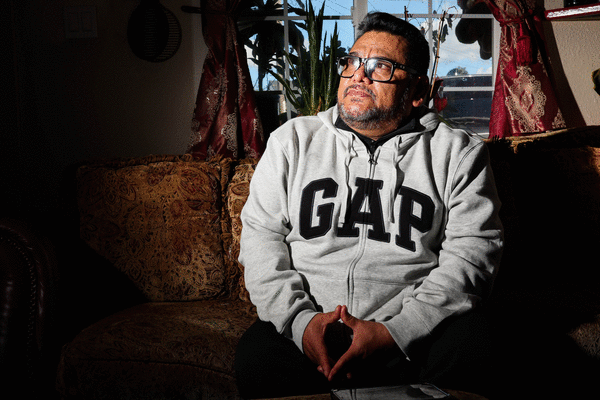
Until two years ago, Oakland, California, father of five Jose Peña could tote a 60-pound slab of countertop with ease. Now, a walk down the block with his kids leaves him gasping for breath and reaching for his oxygen tank.
The aggressive, incurable disease, silicosis, that doctors believe he acquired from cutting, shaping and polishing quartz countertops for homes from San Jose to San Francisco, is getting worse. Fibrous masses in his lungs keep growing.
“Nobody told us it was dangerous,” Peña said in Spanish. He began working with quartz slabs to make countertops in 2005.
He is probably headed for a lung transplant, a procedure that, according to California’s workplace health regulator Cal/OSHA, leaves 2 of every 5 recipients receiving it for any reason dead within five years.
“I’m scared,” said Peña, 54. “My kids are very sad.”
Because he can no longer work, and his wife had to take a job stocking shelves for a clothing chain, he now sees himself as “un estorbo” — a nuisance.
California’s public health department, and hundreds of doctors, say processing of quartz-based slabs into the hugely popular engineered-stone countertops is causing a hidden epidemic of the disease silicosis. Medical experts say the deadly malady can strike victims after as little as two years of working with the material.
Quartz countertops have been banned in Australia, led to a criminal conviction in Spain and a multimillion-dollar jury verdict in California. Retailers, including IKEA, have discontinued them. Meanwhile, the U.S. and state governments allow unrestricted sales, even in California, despite the government’s own findings of an epidemic.
More than 500 Californians who work with the material have, like Peña, contracted the disease, at a median age of 46, according to the department’s Engineered Stone Silicosis Dashboard launched last year. More than 50 needed lung transplants, and 29 have died. Underdiagnosis means the numbers are probably higher, the department said. So far this year, four dozen workers have been diagnosed.
“Every person on the dashboard is one more failure of the public-health worker-safety system,” said Dr. Sheiphali Gandhi, an occupational-disease specialist at UC San Francisco who has treated about 30 of the workers. “I see people with an incurable lung disease that was preventable. It’s frustrating. At the end of the day, sometimes I’m just in tears.”
State public health officials estimated in 2023 that of the 4,000 people working in stone-fabrication shops throughout the state, up to 850 — one in five workers — would get silicosis, with as many as 160 dying.
“Most of the time when we see patients in clinic who have this, the damage has already been done,” said Dr. Ann Schraufnagel, a pulmonologist at Highland Hospital in Oakland. “You can’t undo that exposure that you’ve had to the silica particles.”
Although many manufacturers have started rolling out alternatives containing less of the dangerous silica, the industry rejects assertions that the high-silica products can’t be handled safely.
Quartz countertops have grown into an $18.4 billion global market — with nearly half of slab sales occurring in North America — thanks to durability, ease of maintenance and varied color options, according to Market Research Future.
In California courts, sick and dying workers are suing quartz slab makers and countertop vendors — including several Bay Area shops, along with Home Depot, Lowe’s and Costco.
“A good analogy is asbestos,” said lawyer James Nevin, whose Novato-based firm Brayton Purcell has filed nearly 400 worker lawsuits, including by Peña, and expects to file hundreds more. “We’re terrible at banning things in this country.”
Brayton Purcell has 111 Bay Area clients with silicosis allegedly contracted by working with engineered stone. The firm’s research found that more than 300 shops in the Bay Area fabricate products using the material.
Makers and vendors of quartz countertops targeted in legal actions are responding with their own lawsuits against fabrication shops that employed the workers.
Cal/OSHA, the state’s workplace health regulator, imposed temporary “emergency” rules in late 2023, expanding tasks requiring respirator masks for workers and water-added processing to catch dust. The agency is working on a permanent version.
Controversy over silicosis has exposed divisions in Cal/OSHA over who’s responsible for the epidemic and how to stop it. During a 2023 hearing on the proposal for the rules, Cal/OSHA Deputy Chief Eric Berg fingered “unscrupulous employers” of fabrication workers as the culprits behind the epidemic, and said the new rules would lead to “much safer conditions for workers.” However, a Cal/OSHA staff report on the rule proposal noted that small fabricators “do not often have the capacity” to prevent silica exposure, and that processing quartz “may be so hazardous that even properly designed engineering controls and work practices may be unable to prevent … silicosis.”
Natural stone contains 3% to 30% silica — too little to cause silicosis, medical experts say — but artificial versions are about 90%.
When workers saw, grind or polish quartz slabs, their tools can spew plumes of fine dust that billow into thick, pale clouds. Even when water is used to catch dust, dried splashes on surfaces and workers’ clothes can let the tiny particles take flight when disturbed, doctors said. Silica particles in the dust lodge in narrow air passages in workers’ lungs, leading to inflammation and scarring.
“As your lungs get more and more scarred, you can’t absorb oxygen into your bloodstream,” Gandhi said. Patients, she added, “feel like they’re drowning.”
Workers have contracted silicosis after working with quartz slabs for as little as two years, Gandhi said.
Still, anyone can buy quartz countertops from Costco, Home Depot or Lowe’s, which will have them installed by a third party. Smaller retailers around the Bay Area sell and install the countertops, which often cost around the same as granite, and less than marble. Health experts say there’s no danger from installed countertops, just from breathing dust made during processing.
A group representing more than 600 doctors and other health professionals, the Western Occupational and Environmental Medicine Association, claims silica dust is so dangerous that people can’t safely process quartz slabs, even if masked and using equipment that includes water to combat dust. California’s processing rules are not enough, so the state must ban it, the group said.
Prominent quartz slab makers acknowledge that processing produces dangerous dust, but claim risks are avoidable. The International Surface Fabricators Association, representing countertop vendors, has pushed back against calls to ban quartz countertops, proposing instead the certification and licensing of fabrication shops.
The chief lawyer for American quartz slab maker Cambria testified before Congress in January that fault for workers’ silicosis rests not on “the stone slabs or manufacturers and distributors” of the product, but instead on “bad actor” fabrication shops “who violate the regulations and requirements.”
Even sophisticated shops are seeing silicosis cases, attorney Nevin said.
Fabrication workers are almost exclusively Latino men, many in the United States without legal status. They are highly skilled but highly specialized, making it hard to leave their trade for alternative employment, Highland Hospital’s Schraufnagel said.
Home Depot declined to comment. Costco and Lowe’s did not respond to inquiries. IKEA, a defendant in many lawsuits, stopped offering quartz countertops sometime after August 2024. “We regularly update our range to improve our offer, stay relevant, and meet changing market and customer needs,” IKEA said.
For some patients, the disease doesn’t progress past “simple silicosis,” which shows up as small dots during a CT scan. For perhaps a third, including Peña, the disease becomes “progressive massive fibrosis.”
“I think of those patients as having maybe a couple of years as a life expectancy,” Schraufnagel said. “If you have simple silicosis it can be much, much longer.”
Peña’s lawsuit, like most others by workers with silicosis, seeks unspecified damages and compensation for medical expenses and lost income.
The countertop material — typically the mineral quartz crushed and cooked with plastic resins, dyes and glass into slabs — was pioneered in 1987 by Israel’s Caesarstone, which still makes it and is named in hundreds of lawsuits, including Peña’s.
In 1997, the first case of artificial stone-induced silicosis was diagnosed in Israel. The first known California victim was a man who worked with quartz slabs from 2004 to 2013 and died of silicosis in 2018 at age 38.
Caesarstone in 2010 began affixing warning labels to its slabs. In 2023, it launched low-silica countertop materials, but continues to sell high-silica versions. The company declined to comment on the lawsuits’ allegations.
The owner of Cosentino, a Spanish quartz-slab giant being sued by Peña and many workers, received a six-month prison sentence for gross negligence in 2023. A judge in Spain found that the company knew the health risks of its flagship product Silestone — currently sold at Home Depot, Lowe’s, Costco and many Bay Area shops — but failed to provide adequate warning labels, Reuters reported.
Cosentino told this news organization it “has always actively communicated the risks of working with these materials.” The company said that in 2020, it launched a lower-silica product, and late last year, one with zero silica.
Australia banned the sale and use of quartz countertops in 2024.
A 2024 jury decision in Los Angeles County Superior Court awarded $52.4 million to Brayton Purcell client Gustavo Reyes-Gonzalez in a lawsuit against Caesarstone and two other engineered stone slab makers. The matter is under appeal.
In Peña’s case and others, U.S. subsidiaries of Caesarstone and Cosentino responded by suing small shops that employed the workers, alleging those businesses are responsible for any liability over silicosis.
Quartz slab vendor All Natural Stone of Burlingame, in a court filing in Peña’s case, claimed it “had no reason to know or believe its product could be hazardous,” and alleged Peña “and/or others” were negligent.
Peña said once he started working with quartz, after eight years of processing natural stone, he switched from paper masks to more protective ventilator masks, but the work left him covered in silica dust. Even when using water while cutting, “there was still a lot of dust,” he said.
Gandhi believes high-silica countertops should be banned, since even tiny lapses in protective measures put workers at risk of silicosis, and natural and low-silica alternatives are available.
“There’s no reason,” she said, “to keep allowing this product to kill people.”
(Mercury News staff photographer Ray Chavez contributed to this article.)
©2026 MediaNews Group, Inc. Visit at mercurynews.com. Distributed by Tribune Content Agency, LLC.







Comments