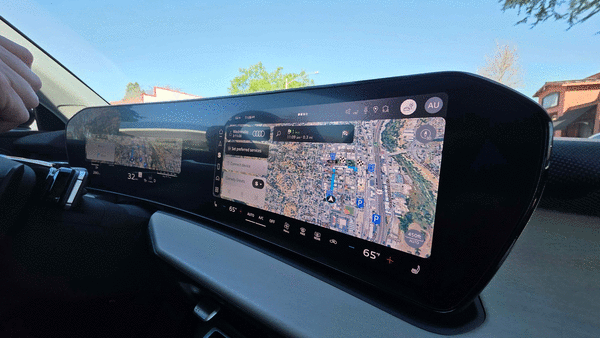
As carmakers shift to digital dashboard, lawmakers push to keep AM radio
Published in Business News
Randy Brooks will never forget the day he had to break the news — live on the air — to a woman that her husband had perished in a tornado.
The KIXQ country music radio host had been tapped to help with 24-hour news coverage in the wake of a massive tornado that decimated Joplin, Missouri, in 2011. With electricity and communication grids down, the local AM radio station was the only source of information that locals could receive for days.
Members of the town, with a population of about 50,000, tuned into KIXQ from their parked cars and battery-powered radios, and called the station for information on the whereabouts of loved ones. When the wife of a local Pizza Hut employee rang the show about her missing husband, Brooks scanned the latest Red Cross list of victims and, seeing the man’s name, recalled eyewitness accounts from first responders who said he’d died a hero. Brooks shared the story on the air of how the employee had been swept away while barring the door of a walk-in cooler, saving the lives of 10 people inside.
“We got to mourn with her there. I was crying. She was crying,” Brooks said of the broadcast. “It was like nothing I’ve experienced before.”
In hindsight, Brooks realizes the role that car radio played in spreading crucial information during the emergency can’t be taken for granted. “That was just proof of the way that radio was the communication hub,” he said.
Today, that hub faces a lot more competition from the likes of satellite radio, streaming music and podcasts. Automakers have long tried to eliminate AM radio capabilities from new vehicles. But after years of tussling between Detroit and Washington, lawmakers appear poised to pass legislation this year that would mandate automakers keep AM receivers in cars. Massachusetts Democratic Senator Ed Markey and Texas Republican Senator Ted Cruz are leading the charge.
Markey considers himself “a latter-day Paul Revere,” he told members of the National Association of Broadcasters in early March, warning that “Elon Musk is coming, Elon Musk is coming for AM radio in his Tesla vehicles and we must protect against it.”
Some 47 million Americans tune into AM radio every week, Markey said. He also called the airwaves “an irreplaceable platform for diverse voices, including hundreds of foreign-language stations serving immigrant communities.”
Over the last decade, Tesla Inc., Mazda and Ford started to phase out AM radios in new electric vehicle models. This was mainly due to interference from equipment in electric vehicles that could create more static in AM broadcasts, rendering them hard to hear. In 2023, Ford reversed its decision and said it would restore access to AM radios in all of its Ford and Lincoln vehicles.
Dashboards have become increasingly crowded with services like mobile applications that often require a subscription, and also offer an opportunity for carmakers to recoup a bit more money. Then there’s the public’s changing media preferences and the perception that AM radio is a medium of yesteryear. In a cost-saving move, Paramount Skydance Corp. said last week that it would shut down CBS News’ radio network after nearly 100 years in business.
“Nobody under the age of 40 would know to go to AM radio in an emergency,” said Shane Tews, a senior fellow at the American Enterprise Institute focused on the digital economy. Broadcasters are “holding onto an origin story that was good at the time. But it doesn’t hold now.”
As digital infrastructure shifts to fiber networks that are typically buried underground, consumer-grade internet becomes less likely to be disrupted by natural disasters, Tews said. Mobile networks are also more easily patched with temporary solutions like satellite, drones, or even high-altitude balloons that can beam internet to disaster areas below. These advances render radio less of a crucial emergency channel and more of a nostalgic technology backed by passionate fans, according to Tews.
The Alliance for Automotive Innovation, a trade group that represents major vehicle manufacturers, has said that the mandate is really aimed at propping up a “particular business model – in this case advertising-supported analog AM broadcasting.” The group, which opposes the bill, has more recently suggested it should be paired with another measure to shift radio advertising dollars to musical artists that stations carry for free, indicating a compromise could be struck.
According to broadcasters and supporters of the legislation, AM radio still wins in extreme emergencies. AM radio waves travel close to the ground and over extremely long distances. Without any interference, the signals can travel indefinitely. FM radio, the more populated part of the dial today, requires bigger towers that are susceptible to the same destructive forces that take down cell towers and power lines.
There are still more than 4,000 AM radio stations on air today, according to the Congressional Research Service. It continues to be the home of many music, sports, news and talk radio programs, as well as hosts who’ve gained a cult following, like conservative commentator Sean Hannity and conspiracy-theory investigator George Noory on Coast to Coast AM.
Such stations are also the initial distribution point for the government’s emergency alerts broadcast system. In many cases, AM radio stations uniquely combine local reporting and on-the-ground knowledge with direct communications from public safety agencies, said Jeff Federman, regional president for the audio network Audacy’s West Coast stations.
When the Hollywood Hills went up in smoke early last year in blazes that destroyed large swaths of Los Angeles, the local AM station KNX gave residents driving directions on how to safely flee the area under ordered evacuations.
“The only way that those people in those cars knew where to go or what to do was by listening to KNX AM,” Federman said.
The legislation to keep these stations available to drivers is “a really good thing both from a public safety perspective in terms of the role that AM radio plays, but also in terms of just making sure that we continue to have quality local news and reporting,” according to Brendan Carr, the chairman of the Federal Communications Commission, the agency that regulates use of the broadcast airwaves.
Markey initially introduced the AM Radio for Every Vehicle Act in 2023, but the bill fizzled out. This time around, the Markey and Cruz-backed bill has picked up 60 co-sponsors in the Senate while a companion measure in the House has gained more than 300 co-sponsors and is being considered for a floor vote, according to the office of its sponsor, Florida Republican Representative Gus Bilirakis.
The measure could also be wrapped into a broader, must-pass transportation package later this year, ensuring its delivery.
It also helps that President Donald Trump has the legislation on his radar. “I like that. I’m in favor of it,” Trump said on the Hugh Hewitt radio show in January. “A lot of people don’t know about that, but it’s actually a very big subject.”
©2026 Bloomberg L.P. Visit bloomberg.com. Distributed by Tribune Content Agency, LLC.







Comments