Silicon Valley is booming. So why does the system feel like it's breaking?
Published in Business News
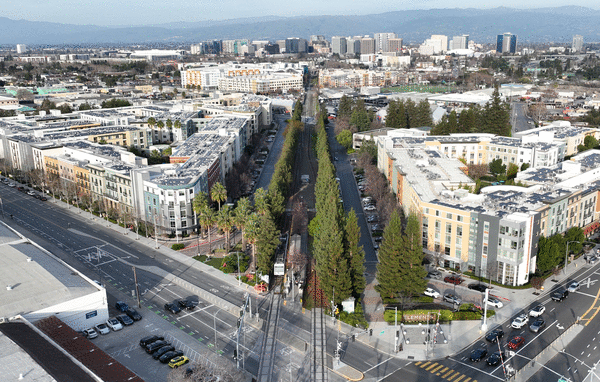
Silicon Valley remains the global center of technological innovation, drawing billions in investment, producing breakthrough technologies and powering the artificial intelligence boom.
But beneath that dominance, the conditions that have long sustained the region’s success — a steady influx of workers, accessible pathways into the economy and functioning public systems — are showing signs of strain.
The result is a growing tension at the heart of the Bay Area economy. Even as Silicon Valley continues to generate extraordinary wealth and innovation, the system supporting that success is under increasing pressure.
“The Bay Area is a punishing place to live, which is causing stress for the economy,” said Russell Hancock, president of San Jose-based think tank Joint Venture Silicon Valley. “So far, Silicon Valley is withstanding the stress.”
Joint Venture’s 2026 Silicon Valley Index — a closely watched annual report that tracks economic, demographic and industry trends across the region — describes the Valley as a “hot engine” that continues to produce outsized growth, even as it faces what the report calls the risk of “stalled growth.”
That engine is fueled by a deep concentration of talent and capital — allowing Silicon Valley to reinvent itself repeatedly, from semiconductors to software to AI.
“If you could just move the braintrust of Silicon Valley to another state, that would have been done decades ago,” said Bob Staedler, principal executive with land-use consultancy Silicon Valley Synergy. “This is a major knowledge base.”
In 2025, the region attracted $92 billion in venture capital and generated more than 23,000 patents, reinforcing its central role in emerging technologies, according to the Index.
“Silicon Valley invents something, sells it, makes a profit,” Hancock said. “Then Silicon Valley creates something else, and everyone moves up higher on the value chain.”
Yet even as that cycle continues, cracks are emerging in the broader ecosystem that supports it.
A system under strain
Bay Area population growth has slowed markedly in recent years, a shift that economists say carries long-term consequences for the region’s economy.
“Not only are lower- and middle-income people leaving California, but you see a lot of higher-earning, highly educated people leaving to have a much higher quality of life in places like Texas,” said Jason Ward, economist and director of the RAND Housing Center. “It’s going to create a brain and service drain.”
For a region that has long relied on a constant influx of talent to sustain its innovation economy, that shift raises concerns about whether Silicon Valley can continue to replenish its workforce.
Without population growth, tax revenues are likely to stagnate even as demand for public services grows, forcing difficult trade-offs for local governments.
“Those holes are just going to get bigger,” he said. “And the plugs are going to become greater.”
The effects are already visible across the region.
School districts are shrinking. In San Jose Unified, enrollment has fallen roughly 20% over the past eight years, prompting officials to consider closing nine of its 41 schools next year. They ultimately settled on five.
Public transit systems face mounting financial pressure. BART ridership remains about half of its pre-pandemic levels, leaving the agency with a projected $375 million budget shortfall and raising questions about future service.
At the same time, declining values for office buildings, hotels and retail properties are eroding a key source of tax revenue for cities and counties, further tightening public budgets.
Taken together, those trends reveal a growing imbalance: Silicon Valley’s private-sector growth is accelerating, while many of the public systems that support the region are struggling to keep pace.
Those pressures don’t just shape budgets and policy, they influence who can afford to live, work and build a future in Silicon Valley.
The limits of prosperity
That imbalance is also showing up in the growing demand for basic services.
Second Harvest Food Bank, which serves Santa Clara and San Mateo counties, now provides food to about 500,000 people each month — roughly double the number it served before the pandemic.
“A generation ago, people who were going to the food bank were people unemployed or disabled or didn’t have an income,” said Shobana Gubbi, Second Harvest’s director of philanthropy. “But that’s not the case now.”
Many of those seeking assistance are working, often holding multiple jobs, she said, a reflection of the region’s high cost of living.
The Silicon Valley Index underscores that pressure, finding that a significant share of households cannot meet basic needs without some form of assistance.
Providing a stronger safety net will be critical as the region navigates the economic effects of AI and other shifts, said Sujata Srivastava, chief policy officer at SPUR, a regional policy think tank.
“How do you capture some of that value that’s being generated in the region to be able to provide public services and housing and all of that?” she said. “It’s even more critical now.”
A durable model
Despite those challenges, many economists and industry observers say Silicon Valley’s core advantages remain intact.
The region continues to attract capital, produce cutting-edge technologies and serve as a global hub for talent. Its economy is anchored by some of the world’s most influential companies and a network of universities and institutions that feed the innovation pipeline.
“The mantra in tech is now the bottom line, and to focus on AI and the infrastructure around it,” said Jeff Bellisario, executive director of the Bay Area Council Economic Institute.
Even so, Silicon Valley’s capacity to innovate and reinvent itself has proven durable over decades of economic cycles.
“Silicon Valley is not going away,” said Tim Bajarin, principal executive with Campbell-based Creative Strategies, which tracks the tech industry. “We are seeing more breakthroughs in technology in Silicon Valley than we’ve seen in a decade.”
Even emerging risks — including uncertainty around federal policy, research funding and the long-term impact of AI — are unlikely to fundamentally displace the region’s dominance, some experts say.
“I’m not here saying doom and gloom,” said Paul Saffo, a Bay Area-based technology forecaster and futurist. “What I’m saying is that our upper growth — we’re bumping up against a political class ceiling.”
The question ahead
Silicon Valley has faced existential questions before, from the dot-com bust to the Great Recession. Each time, it has adapted, reshaped itself and emerged with renewed strength.
That pattern has reinforced a widely held belief that the region’s innovation engine is uniquely resilient, capable of weathering disruption and generating the next wave of economic growth.
But the challenges facing Silicon Valley today are less about any single downturn than about the durability of the system itself.
A shrinking population, strained infrastructure, rising costs and growing demands on public services all point to a central question: whether the region can continue to support the people and institutions that make its success possible.
Silicon Valley’s dominance has never depended solely on technology. It has depended on an ecosystem that connects talent, capital, public investment and opportunity.
That ecosystem remains powerful. But as pressures mount across the region, its long-term stability is no longer something experts take for granted.
©2026 MediaNews Group, Inc. Visit at mercurynews.com. Distributed by Tribune Content Agency, LLC.








Comments