Chevron CEO says patience pays off in Venezuela oil deal
Published in Business News
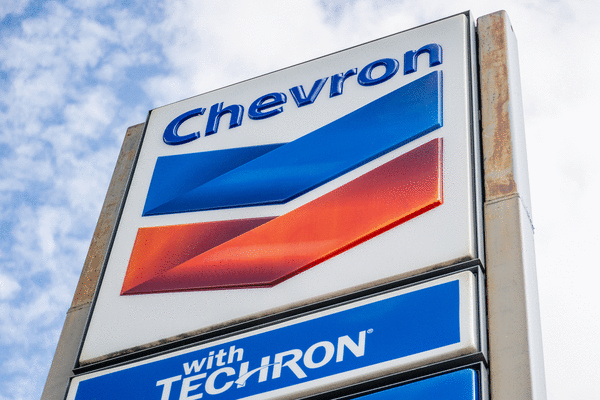
Big Oil has often employed the “hang around” playbook: secure legal rights to a giant resource — and then, eventually, figure out how to produce it profitably. But few companies have taken it to the extremes of Chevron Corp.
For two decades, Chevron stayed in Venezuela while all its major peers quit after former President Hugo Chavez nationalized foreign assets atop the world’s largest oil reserves in the mid-2000s. The Houston-based company endured U.S. sanctions, accounting write-offs, arrests of its employees and accusations of collusion with a regime rife with corruption and human rights abuses.
The payoff came on Wednesday: a landmark deal that will provide Chevron with billions of barrels of reserves, enough to last into the 2040s — and perhaps beyond.
It still remains to be seen how easy it will be to boost output in a country where there are still significant political and legal questions. It’s unclear whether whoever succeeds President Donald Trump in the White House will stick to his strategy in Venezuela. And in Caracas, there’s no guarantee that whatever leader comes after acting Venezuelan President Delcy Rodriguez will remain as cooperative with the U.S.
But for now, at least, Chevron is encouraged by its long game.
“You have to have some patience and look at this out over time and not become discouraged. Not pick up and leave when things are difficult,” Chevron Chief Executive Officer Mike Wirth said in an interview. “You have to hang in there until all the conditions come together: the technology, the economics, the markets, the politics.”
The strategy had its costs.
Employees worked through hyperinflation, power cuts and frequent breakdowns in law and order, while executives spent countless hours and political goodwill in Caracas and Washington to keep the operations in good working order. Cash flow was minimal. Executives, including Wirth, typically met questions from analysts and reporters with terse, legally-worded answers. Rivals including ExxonMobil Holdings Corp. and ConocoPhillips instead chose to pursue compensation claims from the Chavez nationalization through international arbitration and court orders.
Chevron plans to invest $7 billion over the next five years through its joint venture partnerships in Venezuela.
The deal is part of a U.S. government-led push to revive the Latin American country’s oil industry. Executives from Chevron, GE Vernova Inc. and Eni SpA on Wednesday joined U.S. Energy Secretary Chris Wright and Rodriguez to unveil a wave of energy deals aimed at boosting the nation’s crude production. Wright said the deals represented “tens of billions” worth of investments.
Within five years, Chevron estimates it will be producing 600,000 barrels of Venezuelan crude per day at a cost of less than $20 a barrel. Brent crude closed near $95 a barrel on Wednesday.
At current prices, Chevron’s Venezuelan oil would be among the most profitable barrels on the planet.
Things changed for Chevron on Jan. 3 when U.S. special forces captured Venezuela’s former leader Nicolas Maduro. Though the strongman leader was arrested on narco-terrorism charges, Trump was clear the raid was also about reclaiming what he called “our oil.” As the only U.S. oil major operating in Venezuela, Chevron immediately moved into pole position to ramp up production and lay claim to the country’s best oil fields.
“Chevron was pragmatic,” said Miguel Tinker Salas, Venezuelan historian and emeritus professor at Pomona College in California. “They understood they were sitting on the largest deposit of oil in the world and that the government needed them, especially with ExxonMobil and ConocoPhillips leaving.”
To be sure, Eni of Italy and Spain’s Repsol SA also stayed in Venezuela during the years of hostility with the U.S. and operated under similar restrictions as Chevron. Eni on Wednesday signed a 25-year contract for the Junin 5 field, which has about 35 billion barrels of oil in place, as part of the broader unveiling of deals.
The U.S. is meanwhile coming under increased scrutiny for its foray into Venezuela, particularly after Trump announced a plan late last week to take majority control over a huge amount of the nation’s oil wealth in an unprecedented maneuver.
The venture comes months after Trump laid out his vision for what he called the Donroe Doctrine — a 21st century version of the Monroe Doctrine that warned European powers against interfering in the Western Hemisphere. The developments are spurring analysts and academics to look back to an earlier era of neocolonialism, when the U.S. exerted out-sized power over Latin America and its natural resources.
For Chevron, it’s not the first time the company has employed the “hang around” strategy to considerable effect.
When Chevron merged with Texaco in 2001, it inherited vast swathes of drilling rights in the Permian Basin at a time when there was little knowledge of how to extract crude profitably from shale. Rather than selling, as some of its rivals did, Chevron stayed put. About 15 years later, when smaller companies perfected horizontal drilling and hydraulic fracturing techniques, Chevron was sitting on an area the size of Yellowstone National Park in the heart of what became America’s most prolific oil field.
In 1993, Chevron signed what some called the “deal of the century” to develop the giant Tengiz field in Kazakhstan soon after the fall of the Soviet Union. Cost overruns, technical difficulties and political complexity meant the production ramp-up was slower than expected. It was only in 2025 — more than 30 years later — that Tengiz reached its full potential of 1 million barrels of oil equivalent a day.
“It’s important to be in good, high-quality resource positions,” Wirth said. “They’re also sometimes not the easiest resource to produce.”
The big test for Chevron now is to prove that this time, in Venezuela, it will be different. A change of government in Caracas or Washington could just as quickly upend the deals signed Wednesday. But Chevron is in a strong position to weather whatever storm may be coming, according to Schreiner Parker, partner and head of emerging markets at Rystad Energy.
“Chevron made its Venezuela bed a long time ago, and now it is finally in a position to sleep in it,” he said. “That patience has given Chevron decades of relationships, infrastructure and operational knowledge that its rivals cannot easily replicate.”
(With assistance from Peter Millard, Fabiola Zerpa and Tyler Kendall.)
©2026 Bloomberg L.P. Visit bloomberg.com. Distributed by Tribune Content Agency, LLC.




Comments