OpenAI says it's working with Anthropic, Google on AI safety
Published in Business News
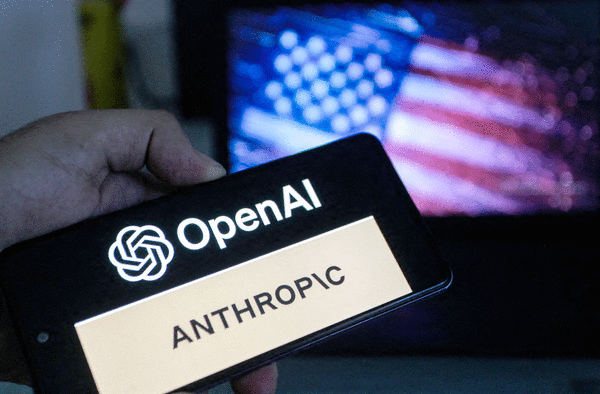
OpenAI is working on steps to address artificial intelligence safety issues with its top competitors Anthropic PBC and Google DeepMind, escalating industry efforts to respond to a groundswell of concern that the technology poses an economic and security threat.
Chris Lehane, the global policy chief for OpenAI, said Tuesday that the company’s engagement with Anthropic and Google had been under way for several weeks. He added that OpenAI does not see the need for an antitrust waiver for the three AI firms to coordinate on safety matters.
“It’s better to try to work together to prioritize safety,” Lehane said at a briefing in Washington.
Anxiety about AI’s existential risks burst into the mainstream following a 3,800-word essay posted Saturday by Anthropic Chief Executive Officer Dario Amodei, who urged restraining development of the most advanced systems so researchers can better understand potential threats. Amodei’s missive was quickly embraced by OpenAI CEO Sam Altman and SpaceXAI chief Elon Musk.
Spokespeople for Anthropic and Google DeepMind, a unit of Alphabet Inc., didn’t immediately respond to requests for comment.
U.S. antitrust regulators are already signaling their skepticism toward giving AI companies an exemption to coordinate on safety. Federal Trade Commission Chair Andrew Ferguson said Tuesday he would be “deeply suspicious” of such requests.
Ferguson added that he sees the AI companies as “asking for barriers to entry” that will insulate their business from challengers. “That sure sounds like moat digging,” he added.
During his briefing, Lehane said the AI companies’ work on safety issues has ample precedent and cited the airline industry as an example. “There are many instances over time where companies are trying to help each other on safety,” he said.
Lehane said that he was in Washington to meet with U.S. lawmakers and that OpenAI would support bipartisan proposals aimed at addressing potential catastrophic risks from the technology.
Measures favored by OpenAI include a framework for federal AI governance from Republican Representative Jay Obernolte and Democrat Lori Trahan, Lehane said. The company also supports a Senate proposal taking shape led by Majority Leader John Thune, Republican Ted Cruz and Democrat Amy Klobuchar that would seek to address catastrophic risks.
“Whatever we can get through,” Lehane said.
Other proposals have emerged to address the potential competition concerns on safety coordination.
Sen. Jim Banks, an Indiana Republican, and Sen. Adam Schiff, a California Democrat, have also proposed a bill that would give AI companies a narrow antitrust carveout to share information with one other related to loss of control over AI systems, cyber or biological threats and attempts by Chinese companies to exfiltrate data. That legislation has been folded into an annual defense bill, a person familiar with the matter said.
Odds of any proposal passing before the end of the year remain slim. Congress is unlikely to act on any AI legislation anytime soon, with the House slated to leave Washington on Thursday and not return until after the November elections. The brief lame duck session after the election is expected to focus on a plan to boost the Pentagon budget.
President Donald Trump has also voiced his vehement opposition to any effort to impose AI guardrails. In a rapid-fire series of social media posts, Trump on Monday belittled a push led by Anthropic and OpenAI to slow work on cutting-edge systems, invoking bombastic language to dismiss existential fears about AI as “a hoax.”
(With assistance from Leah Nylen and Elizabeth Wasserman.)
©2026 Bloomberg L.P. Visit bloomberg.com. Distributed by Tribune Content Agency, LLC.







Comments