Most firms keep cash from tariff refunds, Fed study finds
Published in Business News
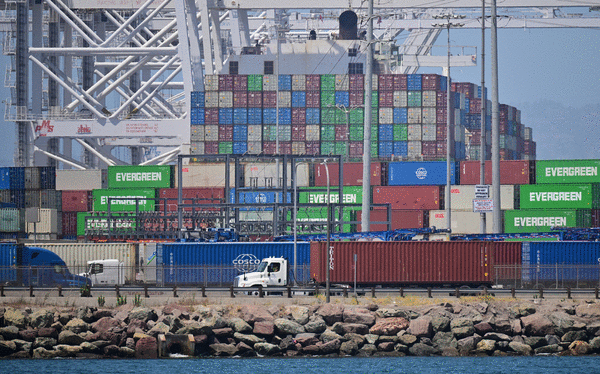
The bulk of companies receiving billions in tariff refunds are mostly holding on to the cash, according to a survey released Monday by the Federal Reserve Bank of Atlanta.
Of the more than 1,100 C-suite executives surveyed in August as part of the Atlanta Fed’s Survey of Business Uncertainty, roughly a quarter said they had either received a refund or were seeking one. Those payouts are expected to average 1.7% of annual revenues.
Refunds began flowing in May after the Supreme Court ruled that $166 billion of so-called emergency tariffs were unlawful. As of Sept. 11, approximately $134.7 billion in refund payments, including interest, had been paid out or accepted for processing, according to a court filing from U.S. Customs and Border Protection.
Not much is known about how that money is rippling through the U.S. economy. Out of 220 executives who shared their plans with the researchers, who included Stanford University economists Nicholas Bloom and Steven J. Davis, roughly three-quarters said they expected to keep the refund in cash.
Slightly more than half of the group also said they planned to invest in research and capital projects, and 17% said they expected to give customers rebates. Nearly 15% said they’d use it to lower prices. Respondents were told to select all of the uses that applied.
“These results also suggest that a nontrivial portion of tariff refunds directly benefit customers and employees,” researchers wrote in a blog post published Monday. The survey was conducted August 10-21.
The question of how much money will flow back to households through rebates, bonuses or lower prices is one that could have significant implications for the economic outlook. U.S. consumers have continued to spend despite persistent inflation from rising gasoline prices and other pressures, bolstering economic growth. Rebates from tariffs or lower prices made possible by the tariff refunds could further support that spending.
The tariff refunds are slowing as the Trump administration works to restore tariff revenue with other legal authorities considered to be more durable. August was the first month since Treasury began issuing repayments that importers paid more in customs duties than they received in refunds.
Fed officials raised interest rates this month for the first time in three years, a step they said was needed to help rein in inflation that is rising after being above target for more than five years. Policymakers are also trying to determine how much inflation is being fueled by supply shocks such as the war with Iran, and how much is driven by demand, including the artificial intelligence boom, which has driven a rise in capital spending and other investments.
©2026 Bloomberg L.P. Visit bloomberg.com. Distributed by Tribune Content Agency, LLC.






Comments