Soaring diesel prices squeeze truckers, farmers as costs hit consumers
Published in Business News
DETROIT — Paul Russo can't afford to absorb the rising cost of diesel.
The president of Wayne, Michigan-based Wayne Industries, a steel hauler, has levied a fuel surcharge for about a decade. But as diesel fuel prices have climbed, the percentage he adds to his trucking rates has climbed with them. Russo now is charging a 45% fuel surcharge on his trucking rates to help offset the cost of diesel, which recently surpassed $6 a gallon.
“I cannot let it linger because all of a sudden I'm eating all that,” Russo said. “I can't afford to eat that. It's just not in my numbers.”
Higher diesel fuel prices are being felt across Michigan’s economy, from farming and trucking to other businesses that depend on diesel-powered transportation to move goods. The higher costs are creating pressure to absorb expenses, raise prices or pass fuel surcharges along to customers.
The U.S. Energy Information Administration said the national average on-highway diesel price reached $6.529 a gallon for the week ending Sept. 21, nearly 74% higher than the same week a year earlier. Farm diesel reached $5.45 a gallon Sept. 4, up from $3.02 a year earlier, according to the American Farm Bureau Federation. In Michigan, the average price of diesel reached $6.8717 a gallon Thursday, up nearly 87% from $3.6801 a year earlier, according to AAA Michigan.
The increase is already putting pressure on businesses that rely on diesel as part of their operations, said Stanley Lim, a supply chain management professor at Michigan State University. And that includes the trucks delivering food to markets, driving retail costs higher.
“For the most part, this increase in cost for large companies, they may be able to absorb the surges, but at some point, it's going to impact not only the production costs, but also the transportation costs and eventually the prices that consumers pay," he said. "Whereas for smaller companies, they may experience the impact a lot sooner through fuel surcharges."
Pressure on diesel intensifies
The higher diesel costs also could factor into longer-term discussions about electrification, experts said.
Diesel prices have been pushed higher as supplies have tightened around the world. U.S. diesel inventories remain below normal levels, with reduced refining activity in Russia, China and the Middle East further tightening global supplies, according to the U.S. Energy Information Administration.
Steve Jastrow, a Minneapolis-based senior vice president of strategic advisory and analytics at Element Fleet Management, said diesel prices had already been under pressure long before this recent spike. One reason: Driven by the war in Ukraine, Europe began replacing diesel supplies tied to Russia with fuel from other regions.
“Diesel has had a sort of an ongoing issue for probably the better part of a year because Europe was sourcing a lot of their diesel from crude coming out of Russia,” Jastrow said.
Recent disruptions involving the conflict in Iran and the Strait of Hormuz have added to the pressure, Jastrow said: “So that is what (has) sort of created this sharp spike over the last several weeks that we're seeing."
The increase is showing up at the pump, where truckers are paying more to fill their tanks. Hussein Nassar, owner of a Marathon gas station in Allen Park, Michigan, and Marathon truck stop in Detroit, watched diesel prices fluctuate and change quickly as it reached nearly $7, at $6.75 on Sept. 17.
And price updates take a moment to go live at the pump "even if the market drops," he said. "If diesel stays this high for a long time, it could put a lot of pressure on tucking companies, small businesses and consumers. Trucking company owners usually they have a budget of about $4,000 to $5,000 on average for fuel. Now, with these prices they're trying to increase the budget by taking from the profit and putting that profit towards the fuel which is making them struggle to make enough money to survive in the company.
"When diesel prices go up, trucking companies pay more to operate, businesses then pay more to see their product and eventually those higher costs can reach consumers. That's why I'm watching the $6 to $7 range very closely because if diesel stays at these high levels, small trucking companies and independent truck drivers could see the pressure and shut down."
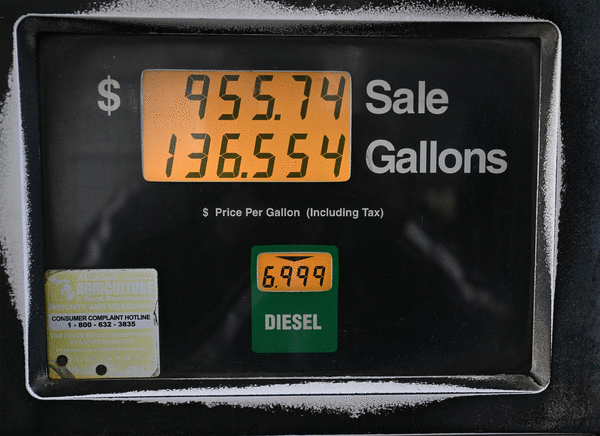
Ezalden Alzokari, a local driver for Kass Logistics LLC, filled his truck with 120 gallons of diesel fuel on Tuesday afternoon at Marathon gas station for over $350 more than the normal fill-up cost. He predicted filling the tank would be around $850; by the time he was finished pumping, the final price was $955.
"I remember when I used to fill $500 or $600 around there," he said. "Every week gets worse and worse since the war happened. It went up slowly but since recent events it just spiked. I have no hope in sight it's going to get better."
"This is not normal for the price to be this high. It is not normal at all," Alzokari said. "These prices affect everything. It goes to the grocery stores. They pass down the charge, (the) fee to the consumer."
William Cadzow, a local driver for American Muscle Trucking LLC, added 25.37 gallons of fuel to his truck for the price of $177.59. The 59-year-old from Dearborn, Michigan, touted the high dependency of the country on freight drivers like himself but said the diesel fuel spike makes him concerned about how inflation would impact his retirement.
"That (price) used to be able to fill this trunk up three quarters of a tank, easy. Usually it's $377 (to fill the entire tank) but yesterday (Monday) was almost $700," he said. He's been driving freight trucks since 1997 and remembers when oil was under $100 a barrel and costed around $2 per gallon.
Rising diesel hits farmers
For trucking companies, the higher costs are forcing some to adjust what they charge customers.
At Wayne Industries, Russo said he typically lets the fuel surcharge remain in place for about a month before adjusting it, but the recent increase in diesel prices happened too quickly to wait: “It's been so drastically, so quickly.”
The company's trucks can carry up to 160,000 pounds legally in Michigan and get about three to four miles per gallon, Russo said. A truck can hold about 300 gallons of diesel, making a full fill-up cost about $1,400 to $1,700 at current prices. The company can spend about $3,500 on fuel in a week when trucks are filled twice.
“It's a lot of money,” he said.
Zach Wagner, a first-generation farmer in St. Johns, Michigan, grows corn, soybeans and canola and raises beef cattle on more than 3,600 acres across four counties. Unlike some farmers, Wagner said the recent spike in diesel prices has not significantly impacted his operation because he contracted most of his fuel at lower prices last year.
He said he paid between $3.50 and $4.00 a gallon, depending on the type of diesel, and he typically has under contract about 80% of the fuel he needs for any given year.
When asked if he's glad he purchased in advance, he said: "Oh, absolutely, absolutely, absolutely. I'm happy because the current price right now is what would be a third, about 30% higher than what I paid."
With diesel prices now more than $6 a gallon, Wagner said he has been dragging his feet on buying more fuel. He has little incentive to lock in additional fuel at current prices.
"Next fall's a whole year, 12 months away," he said. "So there's time. There's time. I mean the price could go up, and I mean it could go back down too. So I'm rolling the dice a bit."
Wagner said his farm's combine fuel tank holds about 350 gallons and he can use a tank of diesel in one day during busy periods. Diesel makes up about 7% of his budget.
The higher commodity prices he is currently able to get for his crops can partly offset the higher cost of fuel. He said it’s a “double-edged sword” that requires balancing such input costs as fuel with the prices he can get for his crops.
“This is the first time in three years we've had a chance to sell corn above $5,” he said. “So honestly, I'm a little optimistic.”
Wagner recognizes that there are some farms that buy fuel as needed it and aren't shielded from the volatility of price spikes, he said: “I know not everyone's in the same situation that I am, especially some of the smaller farmers that just pay as they go.”
Managing high fuel costs
For larger fleets, there are ways to manage fuel costs, but they do not reduce higher prices, Jastrow said.
Companies can negotiate fuel discounts, direct drivers to less expensive fueling locations and use technology to reduce unnecessary fuel consumption. Telematics can help companies monitor idling and driving habits, while route planning can reduce the amount of fuel used.
“It’s the consumption side,” Jastrow said. “We can control the consumption side, but we can't control the input cost.”
Some businesses also may consider shifting to electric vehicles, particularly for fleets with medium duty trucks, Jastrow said: “Electrification can be a longer term strategy to help mitigate the volatility that we see in gas and diesel prices.”
Lim also pointed to electrification: “For sure this is going to accelerate some of these discussions and plans. Whether this will be the main single factor for the conversion to take place at this point, I'm not 100% positive."
Russo said Wayne Industries also tries to control fuel costs by buying fuel at special pricing. The company has fuel tanks at its site and can buy in volume, while its drivers also use truck stops where the company receives volume discounts.
"There's other truck stops that don't give me buying discounts, so I don't go there," he said.
Lim said businesses also can respond by consolidating shipments, combining loads or finding suppliers closer to where goods are needed. Those changes can reduce fuel use, although they can come with longer delivery times or higher inventory costs.
For industries such as food distribution, the options can be more limited because fresh products often require temperature-controlled transportation and storage. The pressure can quickly build for companies that cannot immediately pass higher fuel costs to customers.
“If I was running a business and my delivery cost, as an example, increased by 30% it would be difficult for me to stay in business and eat that difference,” Jastrow said. “So that means I'm going to have to pass some, if not all, onto my client.”
He expects diesel prices eventually to move back toward levels seen about two years ago, but he does not expect that to happen soon. The conflicts affecting diesel supplies would need to be resolved before the market returns to what he considers a more normal environment: “Both will need to be resolved before we get back to a normal view on that.”
©2026 www.detroitnews.com. Visit at detroitnews.com. Distributed by Tribune Content Agency, LLC.










Comments