Judge denies lawmaker request for compliance on Epstein files law
Published in News & Features
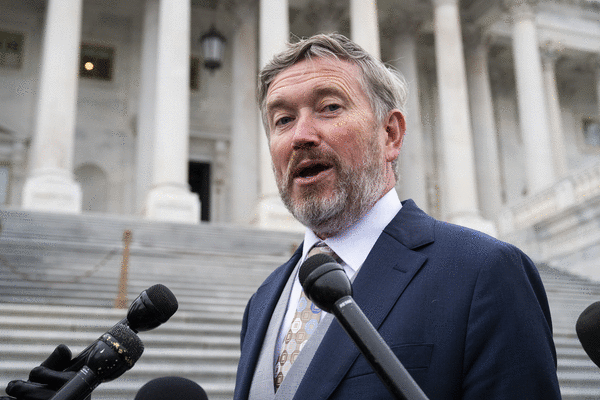
A federal judge in New York on Wednesday denied a request from the main backers of the Epstein Files Transparency Act to appoint someone to oversee the Justice Department’s efforts to comply with the law.
Judge Paul Engelmayer of the U.S. District Court for the Southern District of New York, issued an opinion that denied a request from Reps. Thomas Massie, R-Ky., and Ro Khanna, D-Calif., to appoint a “Special Master and/or Independent Monitor.”
Engelmayer wrote that questions raised by the lawmakers and the victims “are undeniably important and timely,” and “raise legitimate concerns about whether DOJ is faithfully complying with federal law.”
But he wrote that he has no authority to enforce the Epstein law in the essentially closed criminal case, United States v. Ghislaine Maxwell, the place lawmakers sought the court action.
“The Representatives have not articulated how the criminal statutes under which Maxwell was charged would empower the Court to enforce the EFTA,” Engelmayer wrote.
The lawmakers also did not cite any case to show that federal district court power to hear criminal cases also “carries with it the authority to superintend enforcement of the EFTA, a civil records-disclosure statute,” the judge wrote. “No provision of the EFTA vests this Court with that authority.”
And Engelmayer also wrote that the lawmakers are not permitted to join the case because they are not a party to the criminal case and “appointment of a neutral to supervise DOJ’s compliance with the EFTA is far afield from any matter pending before the Court.”
The decision does not opine on whether the lawmakers would have the right to initiate a separate lawsuit, a point the Justice Department raised when opposing the appointment of a special master.
“The Representatives are also, of course, at liberty to pursue oversight of DOJ via the tools available to Congress,” Engelmayer wrote.
In November, Congress overwhelmingly passed legislation ordering the release of documents by a mid-December deadline. The department released a trove of investigative documents on the deadline date and published further documents afterward but hasn’t met the statute’s demands that all the records be released by the December deadline.
Massie and Khanna argued in court the Justice Department not only did not meet the deadline, but did not submit a required report to Congress, overly redacted the files it has released, among other compliance complaints.
©2026 CQ-Roll Call, Inc., All Rights Reserved. Visit cqrollcall.com. Distributed by Tribune Content Agency, LLC.






Comments