Indiana Senate advances ban on ranked choice voting
Published in News & Features
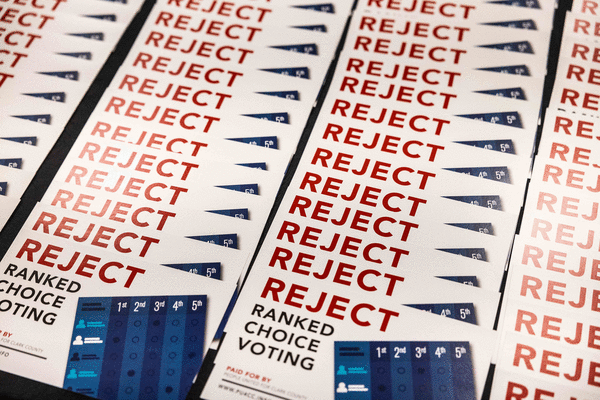
A bill banning ranked choice voting in Indiana, which the state doesn’t utilize as a voting method, passed out of the state Senate on Tuesday.
Senate Bill 12, authored by State Sen. Blake Doriot, R-Goshen, states that an election may not be decided by ranked choice voting.
Julia Vaughn, the executive director of Common Cause Indiana, testified before the Senate Elections committee on Jan. 12 and explained how ranked choice voting works.
Under ranked choice voting, all the first choice votes are tabulated, Vaughn said. If a candidate receives more than 50% of the vote in the first round, he or she wins, Vaughn said.
But if a candidate doesn’t receive 50% of the vote in the first round, then the candidates with the fewest votes are eliminated, Vaughn said. Then, officials take the ballots of the first-choice candidates that were eliminated and count the second choice, she said.
The process continues until a candidate receives 50% of the vote, Vaughn said.
During the third reading discussion of the bill, Doriot said that Indiana doesn’t use ranked choice voting. The process is confusing, especially for the elderly, first-time voters and people with a language barrier, Doriot said.
“People should be able to understand how winners are chosen without needing a math lesson,” Doriot said. “Every vote needs to count. Indiana has always been one vote, one person.”
In a 2022 special election in Alaska, which has ranked choice voting, for a Congressional seat, the Republican candidate started with 110,000 votes and the Democrat started with 75,000 votes for first place, Doriot said. When ranked choice voting ballots were counted, the Democrat ultimately won, he said.
Election data from the 2022 special election show that there were two Republican candidates — Sarah Palin and Nick Begich — to one Democratic candidate, Mary Peltola. Palin and Begich split the 110,000 Republican votes.
Peltola narrowly edged out Palin by 3 percentage points after multiple rounds of ballot counting.
In the event that a ranked choice voting case is heard by the Seventh Circuit Court of Appeals, which covers Illinois, Indiana and Wisconsin, that could force Indiana to undergo ranked choice voting, Doriot said.
“Ranked choice voting is not clear, it’s confusing, and it needs to be banned,” Doriot said.
State Sen. Andrea Hunley, D-Indianapolis, offered an amendment to the bill when it was heard on second reading last week that would’ve formed a committee to study the impacts of ranked choice voting in Indiana.
When the legislature decides something is difficult or “hard to learn,” it is “disparaging the ability of Hoosiers to understand complex things,” Hunley said.
“We learned how to play Euchre for goodness sake.”
Hunley clarified that she’s not arguing in favor of ranked choice voting.
“I don’t even fully understand it enough to make an informed decision about whether or not it would be appropriate for us here in Indiana,” Hunley said. “I do think that it’s a poor practice to ban something before we have really taken the opportunity to consider all impacts of that decision.”
State Sen. Mike Gaskill, R-Pendleton, said Democratic politicians like U.S. Representative Alexandria Ocasio-Cortez, D-New York, and U.S. Senator Bernie Sanders, I-Vermont, support ranked choice voting, while President Donald Trump and the Republican National Committee oppose it.
“When you break it down to the core, what we’re talking about here is clarity, fairness and trust in our election system. Hoosiers expect elections to be simple to understand, transparent to administer and to deliver timely results. Ranked choice voting fails on all three of these,” Gaskill said.
State Sen. Greg Taylor, D-Indianapolis, said the bill was filed to allow for political discussion about Democratic politicians nationwide.
“We don’t have this in Indiana, Senator Doriot. We don’t need this law. But I see why we have it on the agenda, so we can get up and talk about people on the other political side of the aisle. We need to start getting down to the business of the people and start working on affordability,” Taylor said.
The bill passed 38-9 Tuesday. It will move on for consideration by the House.
_____
©2026 Post-Tribune (Merrillville, Ind.). Visit at chicagotribune.com/suburbs/post-tribune. Distributed by Tribune Content Agency, LLC.




Comments