China's Wang warns Takaichi over Japan's 'ghosts of militarism'
Published in News & Features
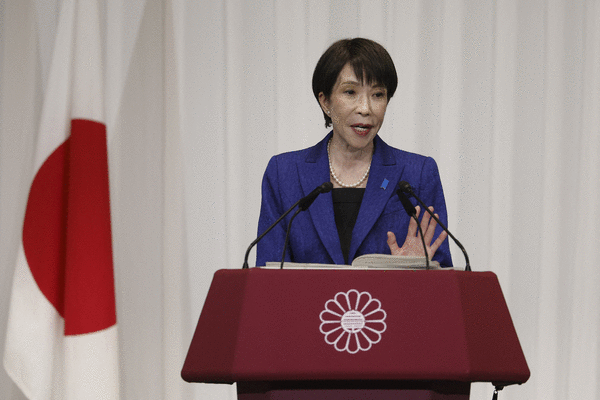
Chinese Foreign Minister Wang Yi invoked Japan’s World War II history of aggression and warned Prime Minister Sanae Takaichi against a return to militarism as he blasted her support for Taiwan as “a very dangerous development” for Asia.
Wang’s comments at the Munich Security Conference on Saturday rebuffed overtures for dialogue made a day earlier by Japan’s defense minister, and suggested no retreat from the deepening standoff.
“If Japan doesn’t repent on its wrongdoing, history will only repeat itself,” he said. “If you go back down the old road, it will be a dead end. If you try gambling again, the loss will be faster and more devastating.”
The Asian neighbors have been locked in a spiral of hostility since Takaichi suggested that Tokyo might come to the aid of Taiwan — the self-governing democracy that Beijing claims as its own — in the event of a conflict with China. She won a landslide last weekend on the back of her stance, which also includes advocating that Japan shift away from its postwar pacifism and rearm.
Wang singled out Takaichi for criticism, saying that her comment on Taiwan “directly violates China’s territorial sovereignty, and it directly challenges the fact that Taiwan has been returned to China.”
“It completely violates Japan’s commitment to China,” he said in a question and answer session with conference chairman Wolfgang Ischinger. “Could China possibly accept this provocation? No way.”
He contrasted Germany’s “reckoning” with the crimes of the Nazi era with Japan’s approach to its wartime past and shrines to “so-called heroic spirits.” Japan, Wang said, “has lingering ambitions for invasion and colonialism of Taiwan, and the ghosts of militarism are still haunting the country.”
“The Japanese people should not let the far-right extremists fool and drag them along,” he said.
The remarks by China’s top diplomat are a rebuke to Japanese Defense Minister Shinjiro Koizumi, who used his appearance in Munich on Friday to downplay tensions with Beijing — even after Japan seized a Chinese fishing vessel the same day.
“Even though we have differences, we have disagreements, Japan’s stance is very clear — we are always open to the dialogue,” Koizumi said. “We are not going to shut down any channels regardless of our differences.”
At the same time, he said Takaichi’s election result, winning a supermajority, “gave me the courage to push our security policy.”
Japan will still need to be careful explaining to the public why Tokyo needs to strengthen its security policy, “by explaining what we are seeing around us,” said Koizumi.
Takaichi is scheduled to visit Washington in March to meet with Donald Trump, ahead of the U.S. president’s planned trip to China the following month.
U.S. Secretary of State Marco Rubio met with Wang Yi in Munich on Friday, showing that “we expect nation states to interact with one another,” irrespective of differences, Rubio said.
“I think it would be irresponsible for great powers not to have relationships and talk through things and to the extent possible, avoid unnecessary conflict,” he said in a Bloomberg interview.
Wang expressed confidence in the U.S.-China relationship, saying he’s “encouraged” by the way Trump is showing respect to President Xi Jinping and to the Chinese people, but warned conflict between the two sides could happen if anti-China forces in the U.S. get their way.
“He has stressed that the U.S. and China working together can get a lot of great things done, and the two presidents can make the fantastic relationship between the United States and China even better,” Wang said. “But I’m not sure whether all people in the United States share this view.”
Wang said others were trying everything possible to suppress and contain Beijing, seeking “decoupling from China and severing supply chains.”
“They are cobbling together all these small, exclusive circles, and they are trying to split Taiwan from China and stepping on China’s red lines, which would very much likely push China and the United States toward conflict,” he said.
©2026 Bloomberg L.P. Visit bloomberg.com. Distributed by Tribune Content Agency, LLC.






Comments