House passes bill to track antisemitic incidents in Missouri schools
Published in News & Features
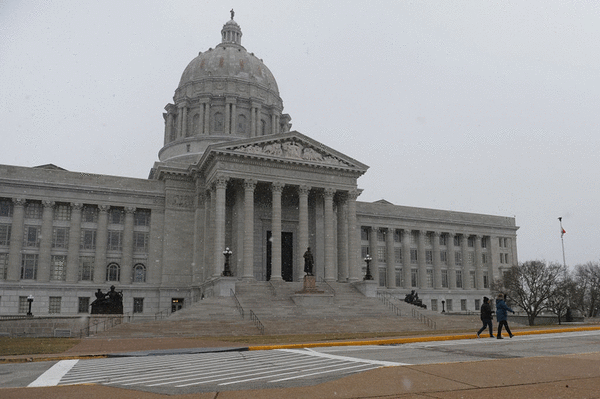
ST. LOUIS — A bill requiring Missouri schools to investigate antisemitic incidents passed the Missouri House Monday despite criticism that the proposal carves out protections for Jewish students not afforded to other groups.
House Bill 2061 passed on a 109–21 vote. It now moves to the Senate, where a similar measure stalled last year.
“Jewish students should be able to go to school without fear for their safety,” said bill sponsor, Rep. George Hruza, R-St. Louis. Hruza grew up in communist Czechoslovakia and his mother survived the Holocaust.
“The idea that Missouri Jewish students are blamed for what is happening in Israel and Gaza is absurd,” he added.
War and famine have gripped the Gaza Strip following the war that began on Oct. 7, 2023, when Hamas-led militants stormed into Israel, killed nearly 1,200 people and abducted 251 others.
The bill requires the state Department of Elementary and Secondary Education and the Department of Higher Education and Workforce Development to investigate alleged antisemitic incidents.
Under the bill, if state officials find a school inadequately addressed an incident, they can report the matter to the federal Department of Education and the Department of Justice.
Several House Democrats said the bill effectively would chill speech about the Israel-Palestine conflict, intimidate teachers and afford Jewish students unique protections.
“I value what the bill handler is trying to do,” Rep. Bridget Walsh Moore, D-St. Louis, said during an earlier House debate. “The unintended consequence is we’re creating a hierarchy of minority groups by tracking one and allowing certain protections for one group.”
Title IV of the federal Civil Rights Act prohibits discrimination based on race, national origin and other characteristics, but not religion. Other federal laws prohibit racial discrimination in schools.
Hruza said Jews neither belong to a religion nor a nationality because members do not come from one single ethnic or national origin and they do not always practice their religion. “Jews do not fit into any category that is covered,” he said.
The state would publish an annual report of complaints on the education department website. DESE currently does not collect data on antisemitic incidents.
Students from St. Louis-area schools testified in support of the bill during a committee hearing January.
“I was struck by the number of students, in particular, (Washington University) students from St. Louis, that felt a level of intimidation and fear,” said Rep. Steve Butz, D-St. Louis, who voted in favor of the bill.
Hruza said students who face antisemitism often do not find relief because school administrators lack a clear definition of antisemitism.
Schools would use the International Holocaust Remembrance Alliance’s definition of antisemitism to determine whether an incident qualifies as antisemitic. Some House Democrats objected to the use of that definition because it describes some criticism of Israel as antisemitic, echoing some testimony at a January hearing on the bill.
Concerns over the law’s effect on free speech dominated a Feb. 11 House debate when lawmakers approved an amendment introduced by Rep. Bill Hardwick, R-Dixon.
Under the amendment, complaints about political or religious comments protected under the First Amendment’s guarantee of free speech would be excluded from the annual report. Speech that qualifies as harassment or threats of violence, however, would be included.
“We don’t combat bad speech with suppression,” Hardwick said on the floor as he introduced his amendment. “We combat bad speech with free speech. And in the free market of ideas, hateful ideas crumble.”
Just one Republican, Bryant Wolfin of Ste. Genevieve, voted against the bill Monday. Among Democrats, nine voted for it, 20 against, 17 voted "present" and four did not vote.
©2026 STLtoday.com. Distributed by Tribune Content Agency, LLC.






Comments