Weeks in the making: How a brittle snowpack primed the Sierra for disaster
Published in News & Features
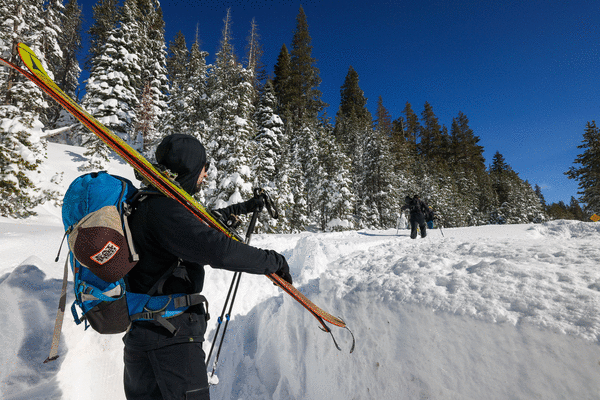
SAN JOSE, Calif. — The conditions that led to California’s deadliest avalanche in modern history began forming weeks ago, when the high Sierra’s snowpack thawed and froze again and again into glass-like shards of ice.
That fragile layer sat exposed for much of January, warming during the day and hardening at night. Then this week’s blizzard buried it beneath feet of heavy powder — a classic setup for a catastrophic slide.
Three days after at least eight backcountry skiers died in the wilderness near Donner Pass, it remains unclear what triggered the avalanche. Another person is missing and presumed dead. As of Friday morning, the bodies remained on the mountain slope because extreme winter weather and continued avalanche risk did not permit first responders to safely access the area. Investigators also have been unable to reach the site to determine the precise cause of the slide, said Wendy Antibus, a spokesperson for the Sierra Avalanche Center.
Six skiers, including one of the four guides leading the trip, survived. Two were treated at a hospital for injuries that weren’t considered life-threatening.
Key questions remain: Did the group of 15 skiers trigger the avalanche themselves? Or did the deadly slide release naturally under the weight of the storm?
While officials await safe access to the site, avalanche scientists say many of the warning signs were embedded in the snowpack.
“It’s quite possible that they triggered an avalanche,” said Daniel Swain, a University of California, Los Angeles climate scientist who focuses on extreme weather events. “Although under those conditions, it’s very easy to trigger one. Which is why backcountry travel is so strongly advised against under those conditions.”
“I don’t know what the guides were doing,” said Craig Clements, professor of meteorology and climate science at San Jose State University. “But we don’t know the story yet.”
When the storm battered the central Sierra on Tuesday, the old layer of weakened snow crystals likely could not support the weight of several feet of new snowfall, Clements said. That fragile base layer was prone to cracking and sending a slab of snow cascading downhill even without human involvement, he said.
Or the group could have triggered the avalanche as they attempted to return in blizzard conditions from backcountry huts at the end of a planned three-day trek. The trip was led by Truckee-based Blackbird Mountain Guides, which is facing law enforcement investigations after the disaster.
Regardless of the precise trigger, experts say the mountains were a dangerous place to be. The Sierra Avalanche Center issued a warning early Tuesday morning advising against traveling “in, near, or below” avalanche-prone slopes.
“A widespread natural avalanche cycle is expected over the next 24 hours,” the warning read, cautioning that large avalanches could even run through forested areas often considered safer terrain.
The center’s preliminary report describes the avalanche that struck the group as powerful enough to break trees.
Clements, an experienced skier, said he personally would not have traveled in the backcountry that day. He also said it would be unusual for most members of a group to be exposed simultaneously; backcountry travelers often spread out, with some waiting in safer areas such as basins or dense trees while others cross more exposed slopes, reducing collective risk.
Still, investigators have not yet detailed how the group was traveling or exactly where they were positioned when the avalanche released.
The guiding company has not responded to requests for comment. The company has faced sharp criticism on social media for proceeding with the trip despite avalanche warnings. Nevada County Sheriff Shannan Moon said Wednesday that there were “great questions” about the guides’ decisions, but added the company had been cooperative with first responders.
Swain, of UCLA, noted during a livestream that the tragedy occurred during one of the warmest winters on record in California’s mountains — a season marked by erratic early snow followed by prolonged dry spells.
After modest storms over the holidays, the central Sierra turned bone dry in January. Daytime warmth softened the thin snowpack; nighttime freezes hardened it again. That cycle created so-called facets in the snow — “like shards of glass” with “no cohesion or strength whatsoever,” said Robert Rice, a University of California, Merced associate teaching professor who previously forecasted avalanches for Utah’s transportation agency.
In technical terms, the process formed a “weak persistent layer,” Rice said — a fragile base incapable of supporting heavy new snowfall.
Rice said he expected avalanches under those conditions but was surprised such a disaster would strike a group led by experienced guides. He said he assumed they would be traveling through relatively safer terrain, such as basins or forested areas. Because investigators have not yet reached the site, it remains unclear exactly where the group was when the slide released. The initial report places the skiers beneath Perry’s Peak, an 8,000-foot prominence near Frog Lake.
“It was probably a very large avalanche,” Rice said. He added that high snowfall rates alone may have been enough to release it naturally above the group.
The conditions resembled those more common in the Rocky Mountains, Rice said, where persistent weak layers frequently contribute to deadly avalanches. Between 1950 and the 2024-25 ski season, 328 people died in avalanches in Colorado, compared with 74 in California.
In January, an experienced snowmobile rider was killed in an avalanche near Castle Peak, not far from this week’s disaster.
Although the avalanche warning for the central Sierra was downgraded Friday, risk remained “considerable.”
That did not deter Marshall Yanzick, 36, of Portland, Oregon, and three Bay Area friends from heading into the backcountry Friday morning to ski terrain on the south side of the peak that was not closed for recovery operations.
He said they were cautious of the “pretty hard, bulletproof icy layer” beneath several feet of fresh snow and planned to stick to openings in the forest.
“Making sure you choose the right terrain is important,” Yanzick said.
Experts say the underlying weak layer will eventually compress and stabilize under the weight of new snow. Until that process runs its course, however, the snowpack can remain unpredictable — and the risk of another slide lingers.
©2026 MediaNews Group, Inc. Visit at mercurynews.com. Distributed by Tribune Content Agency, LLC.





Comments