Caribbean leaders welcome Rubio's assurances in initial encounter, await deeper talks
Published in News & Features
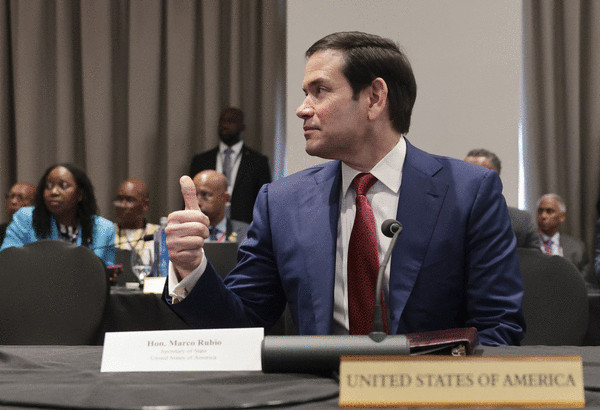
BASSETERRE, St. Kitts and Nevis — U.S. Secretary of State Marco Rubio began a day of talks with Caribbean leaders here telling them he wants to reinforce the long-term relationship between the United States and the region.
The statement, though brief, was encouraging, Caribbean leaders said as they prepared for longer closed-door discussions and bilateral meetings with the top official in the Trump administration.
“At one point we were concerned,” Antigua and Barbuda Prime Minister Gaston Browne said. “It is a very positive message in terms of helping to secure the future of Caribbean countries, working very closely with Caribbean countries. It is a very positive message in terms of helping to secure the future of Caribbean countries, working very closely with Caribbean countries, recognizing the fact we are all linked by geography, we are linked by our people.”
The Caribbean community has the largest diaspora in the United States, he noted.
"The statement he made, though brief, would have signaled a level of commitment to enhanced relationships between the United States and Caribbean Community, and that itself is very encouraging,” Browne added.
The visit is Rubio’s second official trip to the Caribbean in less than a year. Unlike his previous visit, when only a handful of leaders were invited to meet with him, he is expected this time to engage with the full 15-member bloc in a joint CARICOM-U.S. closed door meeting here in the Federation of Saint Kitts and Nevis.
Ahead of the extended deliberations, Rubio held a brief introductory session with the regional group. He entered a conference room at the Saint Kitts Marriott Resort at about 12:25 p.m. and remained for less than 15 minutes before departing to prepare for bilateral meetings with the prime ministers of Trinidad and Tobago, Guyana and Haiti, followed by a broader discussion with the full organization. In his brief address in the conference room, leaders said, Rubio was direct but “encouraging.”
The prime ministers of Haiti, Dominica and Trinidad, along with the foreign ministers of Saint Kitts and Nevis, echoed Browne’s assessment and said they were eager to raise specifics with Rubio.
“First of all, we appreciate his visit,” Dominica Prime Minister Roosevelt Skerrit said, adding that he was looking forward to the discussion continuing later in the afternoon. “It’s important that the dialogue can continue. There are a number of hot topic issues that we’ll have to discuss and address and find mutual approaches to them.”
Haiti Prime Minister Alix Dider Fils-Aimé said the meeting “was very good,” and added Rubio delivered “a few messages.”
Ahead of Rubio’s arrival early Wednesday, Caribbean Community leaders said they were hoping for a reset in relations with Washington.
Trinidad Prime Minister Kamla Persad-Bissessar, who used an address at the opening ceremony on Tuesday night to issue a strong endorsement of the Trump administration’s policies in the region, said Rubio was brisk and clear. It was clear, Persad-Bissessar said from Rubio’s opening exchange, which was delivered without notes, that “he’s very familiar with the issues in the region.”
The two discussed energy matters in her oil-rich nation, but also “we talked about Haiti, we talked about Cuba, of course, we talked about engagements with Venezuela and the way forward.”
Persad-Bissessar confirmed that she is among several Latin American leaders invited to attend the one-day Shield of the Americas summit that President Trump is scheduled to host at his resort in Doral on March 7.
Rubio’s much-anticipated visit comes amid mounting U.S. pressure on eastern Caribbean nations to reform their Citizenship by Investment program — which allows foreign nationals to get passports for as little as $100,000 investments — military strikes on boats in the southern Caribbean and intensifying scrutiny over the region’s ties to Cuba and Venezuela.
The Trump administration, which has prioritized mass deportations, also wants countries to open their doors to rejected asylum seekers in the U.S. Caribbean governments have long maintained close ties with Cuba, which has invested heavily in the region through healthcare agreements and scholarships for Caribbean nationals. But with the U.S. blocking shipments of oil to the island, leaders say they fear a spillover effect from Cuba’s humanitarian crisis into the wider Caribbean.
Douglas said he hoped the meeting would include an “emphasis on continued cooperation between CARICOM countries, leaders and people, and the United States of America, government and people.”
“We are basically neighbors. As a result of that, what transpires in one country naturally affects us as neighbors. We want to make sure that the critical issues, particularly our views of Haiti, particularly views on other countries in the Caribbean, where there seems to be, at the moment, some uncertainty. We want to have clarity on those issues,” he said.
That includes Cuba, Douglas added.
“CARICOM wants to ensure that the humanitarian crisis, which may be escalating in Cuba, that it is seriously looked at and adjusted. We have our people who have studied there, who continue to be there,” Douglas added. “We believe in the Cuban people their rights to enjoy quality of life like other people, and we will do our best to emphasize those matters.”
Browne, the prime minister of Antigua and Barbuda, said after Wednesday he does hope there is a “reset” in the relations.
“We hope that this will be a reset, one in which there will be strong relations, one in which the United States will understand the vulnerabilities of Caribbean countries, the needs of Caribbean countries, and one in which they will work with us to adjust those vulnerabilities while at the same time strengthening our common security interests and ensuring that this hemisphere remains a zone of peace,“ he said.
“I know some people don’t like to hear it, but that is what keeps us united, and that is what helps to fuel growth and development within the Caribbean region,” Browne added. His eastern Caribbean nation is one of two, along with Dominica, recently placed on a partial visa ban by the Trump administration. Haitian nationals who do not have U.S. visas or whose travel documents expire are under a full ban.
_____
©2026 Miami Herald. Visit at miamiherald.com. Distributed by Tribune Content Agency, LLC.






Comments