Maryland sheriffs say two new ICE-related bills will further limit needed interactions
Published in News & Features
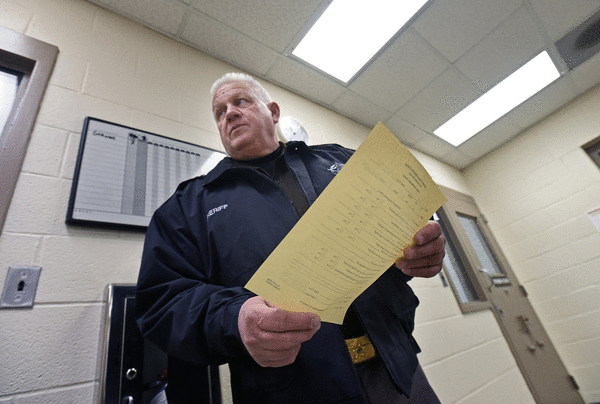
Two weeks after Gov. Wes Moore signed a law banning 287(g) agreements between local law enforcement and U.S. Immigration and Customs Enforcement (ICE), sheriffs representing seven Maryland counties gathered in Annapolis on Wednesday to speak against two bills that aim to limit interactions with ICE even further.
After Moore signed the bill, the sheriffs vowed to continue working with ICE within a narrow framework, such as sending arrest sheets to ICE or holding individuals for up to 48 hours in local jails for ICE officials. These legal, informal interactions with ICE would be the next to go if the “Community Trust Act” is signed into law.
“They want to do everything they can to handcuff law enforcement, handcuff sheriffs across the state,” said Frederick Sheriff Chuck Jenkins during a Wednesday news conference. “We’re going to do everything we can to fight against it.”
Jenkins, a Republican, is running for reelection this year. Frederick County had a 287(g) agreement with ICE before they were banned earlier this month.
The “Community Trust Act” prohibits local law enforcement from investigating or detaining someone for citizenship-related reasons and prohibits the notification or transfer of individuals to ICE without a warrant.
The sheriffs said this bill contradicts Moore’s previous position that he would support an informal partnership between local law enforcement and ICE to “keep violent offenders accountable,” which he said while signing the bill banning 287(g) on Feb. 17.
Wicomico Sheriff Michael A. Lewis said a lack of communication with ICE would lead to an increased presence of immigration enforcement on the streets, instead of a safe transfer of individuals inside detention centers.
“Now ICE has to go out into our communities, and in many cases, kick doors in,” said Lewis, a Republican running for reelection. “This is nothing more than politics over public safety.”
Proponents hope these bills will improve relationships between immigrant communities and local law enforcement, but the sheriffs said they don’t believe individuals in immigrant communities have any hesitation talking to law enforcement.
Jenkins said what is happening in Minneapolis and Los Angeles is not what is happening in Maryland.
The other bill being considered requires local law enforcement to respond to ICE actions and keep a publicly available report and body camera recording of the action. The report would include details about the warrant, ICE officers, amount of force and restrictions placed on law enforcement by ICE.
The sheriffs said this bill would pit federal law enforcement against local law enforcement.
“Federal law enforcement handcuffs are considerably larger than state police handcuffs, than sheriff’s deputies’ handcuffs, than local law enforcement handcuffs,” Lewis said. “Who are we to tell them how to do their job?”
Erik Robey, director of Legislative and Community Affairs with the Harford County Sheriff’s Office, said legislators don’t understand the day-to-day responsibilities of deputies.
“Now they want us to go be the photographer and the videographer for some ICE interaction that’s going on,” Robey said. “Give me a break.”
Carroll Sheriff James T. “Jim” DeWees, who didn’t attend Wednesday’s news conference, told The Carroll County Times he is “completely against” the two new bills, and he expects legal action from the sheriffs if it is passed and signed.
The bills were discussed in the Senate Judicial Proceedings Committee on Wednesday afternoon.
_____
©2026 Baltimore Sun. Visit baltimoresun.com. Distributed by Tribune Content Agency, LLC.






Comments