Trump says Iran attacks may last weeks with Tehran defiant
Published in News & Features
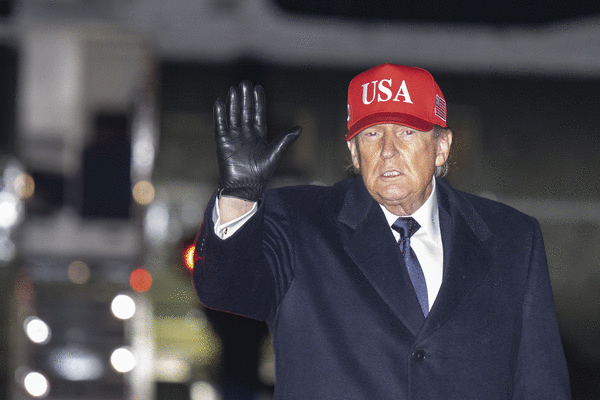
U.S. President Donald Trump said the bombing campaign against Iran could last for weeks and called on the nation’s leaders to capitulate, while the Islamic Republic’s security chief ruled out negotiations.
The conflict continued to reverberate across the Middle East on Monday, with blasts heard across Israel, Saudi Arabia, Qatar and the United Arab Emirates, as states intercepted Iranian missiles launched in response to U.S.-Israeli strikes. Oil surged the most in four years and airlines suspended flights, causing major disruptions at some of the world’s busiest airports.
The U.S. said three fighter jets crashed in Kuwait due to an apparent friendly fire incident. Israel expanded its campaign to Beirut after coming under attack from Hezbollah fighters in southern Lebanon, who are allied with Tehran.
Oil traded about 10% higher near $80 a barrel as traders gauged the impact of the war on energy flows, with tanker traffic through the vital Strait of Hormuz at a near halt.
QatarEnergy suspended production of liquefied natural gas due to attacks on its facilities, while operations were paused at Saudi Arabia’s largest refinery after a drone strike. Fuel prices soared across global markets. Stocks tumbled.
Trump called on Iran’s generals to hand power to the nation’s people and said he’s agreed to talk with new leadership after the weekend killing of supreme leader, Ayatollah Ali Khamenei, according to The Atlantic. Iran’s security chief Ali Larijani said Tehran won’t negotiate with the U.S., responding to reports that he had reached out to American officials through Omani mediators.
Over the past 48 hours, Trump has made various and sometimes contradictory statements on the attack, including that it could end in a few days or last four to five weeks. He’s listed aims such as the freedom of Iranians and preventing the country from having long-range missiles and nuclear weapons. He’s also said he could cut a deal with the Islamic Republic.
The impact of the escalating conflict on the Strait of Hormuz heightened concerns that shipments from some of the world’s largest energy exporters could be disrupted. Investors reacted to the weekend events by shunning risky assets, although trading was volatile. OPEC+ on Sunday agreed to resume production increases next month to counter an expected further rally in oil prices.
Trump said the bombing campaign will continue after the U.S.-Israeli alliance struck hundreds of targets across Iran. The U.S. leader said on social media that American forces sank nine Iranian naval vessels and the headquarters of the navy was “largely” destroyed in a separate attack.
“Combat operations continue at this time in full force and they will continue until all of our objectives are achieved,” Trump said. He called on Iranian people to “seize this moment” and “take back your country.”
The U.S. military’s Central Command announced the first American fatalities on Sunday, saying that three service members were killed and five “seriously wounded.”
“There will likely be more before it ends,” said Trump, who campaigned against the involvement of American soldiers in overseas wars. “That’s the way it is.”
In an interview with the New York Times on Sunday, Trump said the assault on Iran could last “four or five weeks” and called on Iran’s generals to either hand power to the nation’s people or embrace a model similar to Venezuela, whose new leader has been compliant with U.S. demands after the ouster of Nicolas Maduro in January.
He added that he had “three very good choices” to lead Iran, without elaborating. Trump later told ABC News the initial attack “was so successful it knocked out most of the candidates,” adding: “it’s not going to be anybody that we were thinking of because they are all dead.”
The Wall Street Journal reported earlier that Larijani — chief of Iran’s Supreme National Security Council — made a fresh push to resume nuclear talks with Washington through Omani mediators, prompting the denial by the Iranian official on X. The U.S. and Iran had been in discussions over a deal to restrict Tehran’s atomic activities in exchange for sanctions relief before the weekend strikes.
Tehran is looking to name a new supreme leader after Khamenei was killed during the opening salvo of U.S.-Israeli strikes. Foreign Ministry Spokesman Esmail Baghaei said he “hopes” a successor will be elected “within the next few days.”
The war spread across the Middle East over the weekend, as Iran sent waves of missiles at Israel and targets in multiple countries that host U.S. military facilities. In the Islamic Republic, state media reported strikes on military and civilian sites, including one that killed over 140 people at a school in Hormozgan. More than 550 people were killed in the attacks across the country, according to Iran’s Red Crescent.
Nearly all civilian air traffic is closed across the Gulf after Dubai’s main airport, the world’s busiest aviation hub, was hit. Dubai landmarks, including the luxury Palm Jumeirah island and Burj Al Arab hotel, incurred damage during a series of blasts that shook the financial hub. The UAE said the Abu Dhabi Securities Exchange and Dubai Financial Market will be closed on Monday and Tuesday.
Arab countries in the Gulf condemned Iran for its attacks, with the UAE telling Tehran to “come back to its senses” and stop hitting countries that aren’t taking part in the U.S.-Israeli assault.
Ministers from Gulf Cooperation Council nations held an extraordinary meeting on Sunday and said they maintained the right to respond to Iran in “self-defense, either individually or collectively.”
GCC members “will take all necessary measures to defend their security and stability and to protect their territories, citizens, and residents, including the option to respond to the aggression,” it said in a statement.
The prospect of a weeks-long regional war is a nightmare scenario for U.S. allies in the Gulf such as the UAE, Saudi Arabia and Qatar, who fear the chaos and flight shutdowns now unfolding could hit their economies and deter tourists as well as foreign investment.
Trump said the military operation was required after Iran refused to renounce nuclear weapons, which Tehran has repeatedly said it isn’t pursuing. The most recent round of talks took place Feb. 26.
-------
—With assistance from Galit Altstein.
©2026 Bloomberg L.P. Visit bloomberg.com. Distributed by Tribune Content Agency, LLC.





Comments