Alaska lawmakers consider statewide marijuana sales tax
Published in News & Features
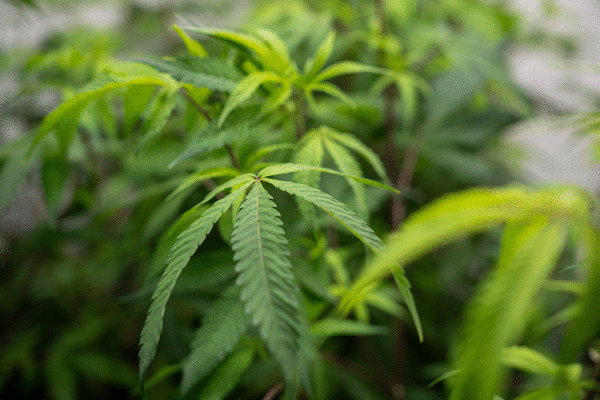
A Fairbanks lawmaker is pushing to overhaul Alaska's marijuana tax structure, as cultivators and retailers say the current structure is an "existential threat" to their business.
HB 91 would phase out the existing $50 per ounce tax levied on cultivators to replace it with a 6% sales tax paid by consumers, modeled after the "sin tax" in place for alcohol and cigarettes.
The bill's sponsor, Fairbanks Democratic Rep. Ashley Carrick, argued that the flat per-ounce tax puts Alaska growers at a structural disadvantage, especially as retail prices fall and illegal sellers undercut licensed businesses.
Alaska has among the highest cultivation tax rates in the nation for marijuana.
"We believe these challenges are threats existential to Alaska's regulated cannabis industry, and without tax relief, the regulated market will continue to get replaced by the unregulated, illicit market," Lacy Wilcox, vice president of the Alaska Marijuana Industry Association, told lawmakers during a hearing in February 2025.
Anchorage Democratic Sen. Matt Claman is sponsoring a separate bill that cuts the current excise tax from $50 per ounce to $12 per ounce, without introducing a sales tax.
Under current state law, marijuana is taxed at the cultivation stage, not at the point of sale. Growers pay $50 per ounce of bud, $25 per ounce of immature bud, and $15 per ounce of trim. The tax is due whether or not the product ultimately sells in retail stores.
Beginning in July 2026, under Carrick's bill, the excise tax would drop from $50 per ounce to $12.50 per ounce. Eventually, the excise tax would be repealed entirely and replaced with a 6% sales tax.
A number of Alaska communities already collect sales taxes on marijuana, including Anchorage, Fairbanks, Juneau and Bethel.
The proposed structure stems from recommendations made by Gov. Mike Dunleavy's recreational marijuana task force, convened in 2022.
"I think every year that we don't take action, the industry faces more and more challenges with growing and stabilizing the work that they do," Carrick said. "I do think that every year there's a little bit of added pressure and added momentum, and we also have reduced revenue."
Marijuana excise tax revenue has steadily declined in recent years. The state collected about $30 million in 2021. By 2025, that number had dropped to roughly $25 million.
Cultivators and retailers say those declines reflect an industry under strain. Legal marijuana in Alaska typically retails for between $180 and $400 per ounce, according to Bailey Stuart, chair of the Alcohol & Marijuana Control Office board. By comparison, black market marijuana can cost between $100 and $150 per ounce, according to the Alaska Marijuana Industry Association as of 2023.
Different parts of the plant are taxed at different rates: $50 for an ounce of bud, $25 per ounce of immature bud and $15 an ounce for trim, according to Brandon Spanos, deputy director of the state's tax division. Spanos told lawmakers at a House Finance committee meeting that when the market first launched, most reported products were taxed at the full $50-per-ounce bud rate.
"But now what we're seeing is the majority of reporting to us is immature, seedy bud or trim, and somehow the bud has just disappeared off the plants or is not being sold at retail," Spanos said.
By the end of 2025, 69 cultivators were past due on more than $5.5 million in unpaid taxes to the Department of Revenue.
Stuart said the black market remains a serious competitor. Much of the illicit marijuana entering Alaska is shipped through the mail from the Lower 48, she said. Another avenue is diversion, when marijuana intended for the regulated system is siphoned off to the black market to avoid taxation.
The proposed tax overhaul would come with significant short-term revenue losses.
Under current law, marijuana tax revenue spending is set out in statute: 50% goes to the Department of Corrections for recidivism reduction programs, 25% funds the marijuana education and treatment fund and 25% goes to the state's general fund. Carrick's bill would also change that formula, redirecting the 25% that currently goes to the general fund toward funding K-12 education.
The state would see an estimated $8.1 million reduction in revenue in fiscal year 2027, according to the state Department of Revenue. That loss would gradually shrink to about $6.5 million in 2028 and roughly $5 million by 2032, as the new sales tax structure stabilizes.
In fiscal year 2027, the recidivism reduction fund would lose an estimated $4 million, while the marijuana education and treatment fund would see about a $2 million drop.
©2026 Anchorage Daily News. Visit at adn.com. Distributed by Tribune Content Agency, LLC.





Comments