High-Speed Rail says it could save $2B on Central Valley route. What will it take?
Published in News & Features
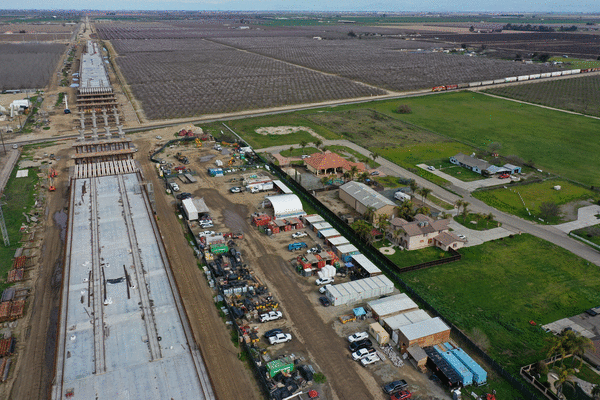
If things go according to the California High-Speed Rail Authority’s plans, the agency says it could save an extra $2 billion on its initial Central Valley route through Fresno.
A draft of the agency’s 2026 business plan released Friday says the savings would bring that route’s total estimated cost to $34.76 billion, down from the $36.75 billion cost the rail authority projected last August and from the $51 billion it says the route would cost without its savings plan. The rail authority says it’s possible to finish the route’s construction by 2032.
But to stay on schedule and realize the possible savings, the agency says it will need the state government to grant it more power over land and money. It’ll also need to access money faster through partnerships with the private sector — not just on an annual basis from the state.
The agency did not respond to questions by The Fresno Bee’s deadline for this story. But in a Friday news release, Tom Richards, the rail authority’s board chair and a Fresno businessman, said the draft business plan “sets out the path forward.”
In its own report released Monday, the California Legislative Analyst’s Office (LAO) cast doubt on the project’s savings potential, noting its plan depends on changes to the law that the agency has yet to fully explain.
The project has grown controversial since California voters in 2008 approved $9.95 billion in bonds for a train that would connect the state’s major metro areas at a total cost of about $45 billion. Today, after years of delays and cost increases, state law requires that the rail authority focus on completing the Central Valley segment first — a 171-mile Merced-to-Bakersfield line that is expected to lose money with low ridership.
Since taking lead of the rail authority in 2024, CEO Ian Choudri has proposed redesigns for Central Valley construction and floated state legislation to quicken the construction timeline, cut costs and move the project toward Los Angeles and San Francisco. He recently went on voluntary leave following his arrest after a domestic disturbance at his home, though he was not charged with a crime.
Among other policies, the rail authority has said it wants a faster way to get through eminent domain cases in court, relocate utilities and obtain permits. It also wants changes to a state law that requires the rail authority to focus its spending on the Central Valley — a law Choudri says could keep the project from landing private investors who want to build more profitable routes.
The agency is also now pitching some new high-speed rail financing strategies for the future, including the use of surplus dollars from California’s General Fund and also tax dollars captured from local sales and property value increases near its stations.
Where do possible Central Valley cost savings come from?
The cost savings the rail authority is planning would mostly come from the Merced and Bakersfield extensions. The agency expects it could reduce the cost of the Bakersfield extension, which would be built south from the Shafter area, by $1.8 billion.
It expects savings of $759 million for the Merced extension, which would be built north from Madera County.
The draft business plan does not detail how these savings would be achieved. But the rail authority over the past year has said it plans to downsize the Central Valley station designs to cut costs, though future construction could increase their size if ridership levels require it.
The agency has also pitched delaying the Merced extension so it can first build to Gilroy, and more recently pitched changing the Merced station location from the city’s downtown to an unincorporated area to the city’s southeast. The agency says the new proposed location would save $1 billion.
CA Legislative Analyst’s Office casts doubt on high-speed rail savings plan
Monday’s report from the LAO says the rail authority’s cost estimates make “assumptions that might not be realistic.”
That report analyzed the cost savings projected in the rail authority’s previous August update and said the Central Valley segment, as of its August update, still faced a $2 billion funding gap.
The new $2 billion in potential savings seen in the rail authority’s Friday report could clear that gap, but the LAO also noted achieving the savings will not be easy.
The LAO’s report notes the rail authority has itself indicated its legislative proposals “are necessary for it to achieve its proposed schedule and cost estimate.”
“The implications for these estimates if the Legislature were not to approve the proposed statutory changes are unclear,” the LAO report says.
The LAO report also says some savings will rely on redesigns that the rail authority “may not be able to implement unilaterally.”
“Staying on budget may be difficult, particularly given the history of the project, its size and complexity,” the LAO report says.
©2026 The Fresno Bee. Visit at fresnobee.com. Distributed by Tribune Content Agency, LLC.






Comments