Trump claims he 'forced' Israel into Iran war, contradicting Rubio's account
Published in News & Features
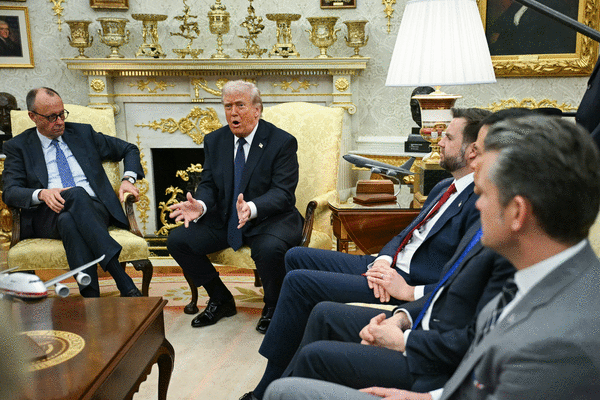
WASHINGTON — President Donald Trump on Tuesday offered a much different explanation for how the United States and Israel opted to launch a surprise war with Iran, contending he pushed Prime Minister Benjamin Netanyahu into the conflict.
The U.S. commander in chief offered a brief update on the war’s status, telling reporters in the Oval Office that the American-Israeli side has been “doing very well.”
“They have no air detection, that’s been knocked out,” Trump said of the Iranian government and military. “Their radar has been knocked out, and just about everything’s been knocked out. So we’ll see how we do.”
Amid reports of depleted U.S. weapons stockpiles, Trump claimed that “we have a tremendous amount of munitions, ammunition at the ... upper level, middle and upper level(s), all of which is really powerful stuff.”
As many Democratic lawmakers have criticized Trump’s decision to launch a weekslong bombardment of the Islamic Republic, and questioned whether he has a long-term plan with Supreme Leader Ali Khamenei dead, Trump’s Tuesday visitor in the gold-plated office, German Chancellor Friedrich Merz, has struck a more measured tone.
While Democrats have invoked the ghosts of troubled U.S. operations like those in Iraq and Afghanistan, Merz reportedly on Sunday called such comparisons “only partially valid.” He also has said because of Germany’s support for Ukraine, his government was in no position to come to Washington “lecturing our partners on their military strikes against Iran.”
On Tuesday, Merz did not criticize the American leader’s decision to go to war. Instead, he told reporters they would be talking about the “day after” the conflict ends.
To be sure, Trump could use some political cover.
“There was no imminent threat to the United States of America by the Iranians,” Senate Intelligence Vice Chairman Mark Warner, D-Va., told reporters Monday evening. “There was a threat to Israel. But if we equate a threat to Israel as the equivalent to an imminent threat to the United States, then we are in uncharted territory. We have seen the goals for this operation change, I believe, four or five times.”
Americans, too, have reluctance. Fifty-nine percent of respondents to a CNN poll conducted Saturday and Sunday disapproved of the strikes, with 41% approving.
Here are three takeaways from Trump and Merz in the Oval Office.
‘Forced their hand’
Trump contradicted his secretary of state and national security adviser, former GOP Sen. Marco Rubio, by contending he likely forced Israel into launching the conflict.
“No, I might have forced their hand. You see, we were having negotiations with these lunatics, and it was my opinion that they were going to attack first. They were going to attack,” Trump told reporters. “I felt strongly about that.
“And based on the way the negotiation was going, I think they were going to attack first. And I didn’t want that to happen,” he added. “So, if anything, I might have forced Israel’s hand. But Israel was ready, and we were ready, and we’ve had a very, very powerful impact, because virtually everything they have has been knocked out.”
But on Monday afternoon, before briefing House and Senate lawmakers, Rubio suggested the opposite scenario led Trump to decide to attack.
“It was abundantly clear that if Iran came under attack by anyone, the United States or Israel or anyone, they were going to respond, and respond against the United States,” Rubio told reporters at the Capitol.
“We knew that there was going to be an Israeli action. We knew that that would precipitate an attack against American forces, and we knew that if we didn’t preemptively go after them before they launched those attacks, we would suffer higher casualties.”
Rubio was seated on a sofa a few feet from Trump on Tuesday. He did not attempt to clarify his remarks on how the war started.
‘Not going to know anybody’
In a remarkable admission, Trump said the U.S.-Israeli strikes very well could kill every single potential new Iranian leader whom administration officials had been talking with about taking over.
“Well, most of the people we had in mind are dead. So, you know, we had some in mind from that group that is dead,” he said of Saturday airstrikes that killed the supreme leader and a large group of other Iranian officials. “And, now, we have another group. They may be dead also, based on reports.
“So I guess you have a third wave coming in pretty soon,” Trump said of a promised massive round of airstrikes to come. “We’re not going to know anybody. ... The leader of the pack is gone.”
That would seem to put the operation’s long-term goal of a more stable Islamic Republic at risk. Trump even mentioned the beginning of the 2003 Iraq conflict, when the George W. Bush administration opted against propping up a surviving member of Saddam Hussein’s government.
“If you look at Iraq, where, very stupidly, everybody was fired, the generals were fired, the military was fired, the police were fired, the fire departments were fired, and all of the government workers were fired,” he said. “So after ... by the way, ISIS was born. That’s where ISIS came from."
In another stunning moment of candor, Trump admitted about the next Iranian leader: “We haven’t been thinking ... too much about that.
“It would seem to me that somebody from within, maybe, would be more appropriate,” he said. “But it would seem to me that somebody that’s there that’s currently popular, if there’s such a person. But we have people like that.”
He did not name names, nor say whether any of what he called “more moderate” candidates were even still alive.
Back in the Oval
When the day’s press pool crossed the threshold to the Oval Office, it broke a trend of the White House this year keeping visits by world leaders behind closed doors.
Rowdy Oval Office scenes featuring American and foreign reporters crowded around couches featuring tense aides to Trump and other global leaders were a core part of the first 12 months back in office but became more rare during recent months. But since Trump returned from a holiday vacation in South Florida, the White House has shifted its strategy.
Last month, Israeli Prime Minister Netanyahu became the third major world figure to visit the West Wing this year that didn’t feature a raucous “pool spray” in the gold-plated Oval Office.
There also was no cacophony of shouted questions or Trump, as he has done this year in other settings, taking verbal swipes at reporters and their employers on Feb. 3, when Colombian President Gustavo Petro met privately with Trump.
Journalists also were kept away on Jan. 15, when Venezuelan opposition leader María Corina Machado visited. That day’s White House guidance email listed the Machado meeting as a working lunch in the president’s private West Wing dining room.
There were reasons Machado and Petro were kept away from reporters and cameras — both came to the White House amid disagreements with Trump.
Merz’s light tone on the Iran war offered the White House an opportunity, and aides opted to end the trend.
“We are on the same page in terms of getting this terrible regime in Tehran away,” the German chancellor said with a polite smile. He then changed the subject to Washington-Berlin trade talks.
_____
©2026 CQ-Roll Call, Inc. Visit at rollcall.com. Distributed by Tribune Content Agency, LLC.




Comments