Trump pledges safe Mideast oil transit as Iran war rages on
Published in News & Features
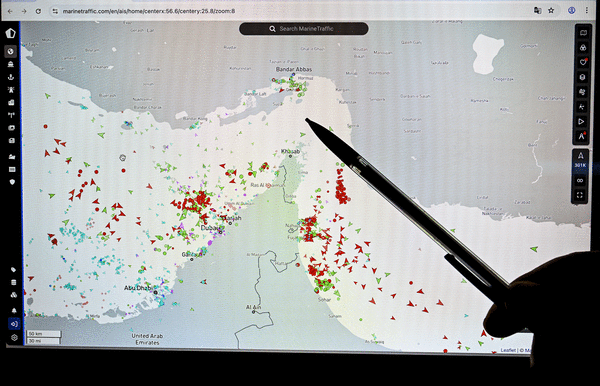
President Donald Trump said the U.S. will ensure safe passage of oil from the Middle East to head off a potential energy crisis, as the Iran war continues to reverberate across the region and roil markets.
The conflict has showed no signs of abating five days after it erupted, with Israel and Iran continuing to exchange airstrikes and missile fire. More than 1,000 people have died in Iran and dozens elsewhere in the region. The U.S. says six of its servicemen have been killed.
“We have no trust in the Americans and no intention of negotiating with the U.S.,” Mohammad Mokhber, an adviser to the late Supreme Leader Ayatollah Ali Khamenei who was slain in the first salvo of strikes, told Iran’s state-run television.
In all, about a dozen nations have become embroiled, with Tehran striking U.S. bases and embassies across the Middle East, and Israel launching an air and ground offensive against Iranian-aligned Hezbollah in Lebanon. Turkey also came under fire on Wednesday, a first for a member of the North Atlantic Treaty Organization since the conflict began. The alliance’s air defense shot down the ballistic missile heading from Iran, and Ankara warned Tehran against acts that could further widen the war.
An Iranian warship sank on Wednesday off the coast of Sri Lanka, with 32 sailors rescued and more than 100 missing or dead. China, India, Japan and South Africa are among a host of nations to express concern about the conflict’s mounting impact.
Trump said Tuesday that the U.S. International Development Finance Corporation would offer insurance “at a very reasonable price” to help ensure the flow of energy and other commercial trade in the Gulf. The U.S. Navy will begin escorting tankers through the strategic Strait of Hormuz “as soon as possible” if necessary, he said.
“No matter what, the United States will ensure the FREE FLOW of ENERGY to the WORLD,” the president posted on social media.
Trump’s assurances helped calm nerves in some markets initially. Later, a New York Times report that Iran made indirect contact with the U.S. to negotiate an end to the war boosted hopes that the conflict could be short-lived, followed by a rebound in stocks.
Futures for the S&P 500 rose 0.3% after falling nearly 1% in the previous session. Brent crude pared earlier gains and was trading 0.9% higher at 4:55 p.m. in Dubai. Gold resumed its upward trend to trade above $5,100 an ounce, while a selloff in global bonds eased.
Shares opened sharply lower in Dubai and Abu Dhabi after markets resumed trading for the first time since the war began.
While Trump’s announcement reduced some of the risk premium in energy markets, traders remain skeptical the plan will allow oil flows to return swiftly to normal levels in the region.
Crude prices have surged around 13% since the U.S. and Israel began attacks on Iran over the weekend, triggering widespread disruptions in the Middle East and effectively halting flows in the critical Strait of Hormuz, through which a fifth of the world’s oil transits.
Trump’s post didn’t elaborate on the insurance mechanism to be offered by the DFC, an institution that usually mobilizes private capital to developing nations and lowers risks for investments in poor countries.
Political risk insurance, like that offered by the DFC, helps cover losses due to war, violence and other political turmoil.
Gulf attacks
There’s little sense of how long the fighting will last, with Trump saying it could go on for weeks. The Islamic Republic has shown no signs it will bow to demands to abandon its nuclear-enrichment ambitions, scrap its ballistic missile program or stop supporting militant groups. It is fighting on despite Israeli and U.S. claims they’ve destroyed hundreds of Iranian missiles and launchers.
Iran still has “significant capabilities,” Danny Danon, Israel’s ambassador to the United Nations, told Army Radio when asked if Iran’s arsenal is running low. “There’s still a long way to go in this war.”
While Iran’s surviving leaders have publicly said they won’t negotiate with Trump, operatives from the intelligence ministry reached out indirectly to the Central Intelligence Agency a day after the attacks began offering to discuss terms for ending the conflict, the New York Times reported, citing officials who were briefed on the outreach. Israeli officials urged the U.S. to ignore the approach, and for now the offer isn’t considered serious in Washington, according to the newspaper.
A survey carried out in Israel by the Institute for National Security Studies, a Tel Aviv University-linked think tank, showed 81% of 954 respondents supported the strike on Iran and 63% said it should continue until its government was overthrown. That contrasts sharply with U.S. polls indicating an overwhelming majority of Americans oppose the war.
Iranian strikes on U.S. sites in neighboring Arab states continued overnight, with a drone attack on the U.S. consulate in Dubai, the latest American diplomatic facility to be targeted. The drone caused a “limited” fire near the consulate that was extinguished, according to the Dubai Media Office.
Saudi defense forces said they intercepted two cruise missiles in an area housing Prince Sultan Air Base, a U.S. facility outside Riyadh, and destroyed nine drones that entered Saudi airspace. A drone was also intercepted on Wednesday in the eastern province, which houses some of the world’s biggest oil-producing facilities.
Supplies from Aramco’s Ras Tanura refinery were unaffected after an attempted attack and that no damage was reported, according state-run SPA, citing an unnamed Saudi energy ministry source. Ras Tanura, the kingdom’s largest, has been shut down since Monday when it was attacked by Iranian drones.
Earlier in the week, two drones attacked the U.S. Embassy in the kingdom’s capital, Saudi Arabia and the U.S. said Tuesday. A CIA station was hit in that strike, according to multiple news reports.
Crown Prince Mohammed bin Salman reiterated the kingdom will take all necessary measures to protect itself. Pakistan, which entered a defense pact with Riyadh last year, reportedly warned Iran against continuing attacks against the kingdom.
Sirens also sounded in Bahrain, home to a U.S. navy site. In Qatar, U.S. air base Al Udeid was hit by an Iranian missile and another was intercepted. Qatari authorities arrested 10 suspects working for the Islamic Revolutionary Guard Corps, who were spying on military facilties in the country and tasked with carrying out sabotage, according to state media.
A British air base on the Mediterranean island of Cyprus was struck by a drone strike on the weekend — so far the only attack on European territory.
Israel struck 60 Hezbollah targets in Lebanon after the Iran-backed group carried out attacks on Israel on Tuesday. Israel’s military said it hit dozens of command centers across Tehran and has struck some 300 missile launchers since the conflict began. Iran fired four barrages of missiles at Israel overnight.
Israel confirmed attacking the Assembly of Experts building in Iran’s Qom - a conclave for selecting the successor to Khamenei. The military spokesperson also appeared to acknowledge that, as widely reported, the site was empty at the time and the clerics survived.
The leadership selection process is close to complete, with options having been identified, Iran’s semi-official Mehr news agency reported, citing Ahmad Khatami, a member of the assembly.
Preparations were under way for Khamenei’s funeral to begin in Tehran on Wednesday, but the ceremony has been postponed to a later date, Iran’s semi-official Tasnim news agency reported.
The semi-official Mehr news agency on Wednesday put the latest death toll in Iran at 1,045, citing the Foundation of Martyrs and Veterans Affairs.
----------
—With assistance from Galit Altstein, Yasufumi Saito, Eltaf Najafizada and Thomas Hall.
©2026 Bloomberg L.P. Visit bloomberg.com. Distributed by Tribune Content Agency, LLC.




Comments