Ex-Illinois inmate's lawsuit over forced labor induction tests Gov. JB Pritzker on reproductive rights
Published in News & Features

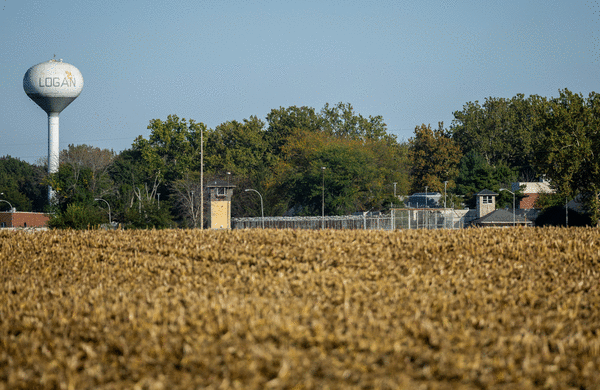


EAST ALTON, Ill. — She arrived at X House resigned to delivering her baby while incarcerated.
Amy Hicks was 7 ½ months pregnant and convicted of an illegal drug offense that would keep her behind bars for months to come. Still, as Hicks waited inside that transitional cellblock of the Logan Correctional Center women’s prison, she thought she’d give birth to her daughter when she was ready to be born.
She quickly learned it wouldn’t go as she planned.
Other inmates warned Hicks that the prison would force her delivery through an induction of labor, a procedure typically reserved for medical necessities, none of which applied to her, she said. She heard the same from a correctional officer, who claimed the process was part of prison policy, and from a prison psychiatrist.
Depressed and worried, she filed grievances objecting to what she believed would be a forced medical intervention. But two weeks before her due date, in early 2024, Hicks underwent the induction.
Now two years later, she describes the experience as painful, physically violating and traumatic.
“That was my right that got stripped away from me when I should have been able to have, you know, this baby whenever she felt like coming,” said Hicks, an East Alton resident who is now 40 and a mother of four.
Hicks’ account forms the basis of a federal lawsuit against Gov. JB Pritzker’s Illinois Department of Corrections, the prison’s medical provider, Wexford Health Sources, and others.
The suit alleges Logan’s staff violated her constitutional right to refuse a medical procedure and ran afoul of Illinois’ Reproductive Health Act.
The 2019 Pritzker-backed measure, supported by reproductive rights advocates, declares that every person has a “fundamental right” to make autonomous decisions about reproductive health care — including the right to refuse it — and bars the state from interfering with that right, including for people in custody. Hicks’ suit is believed to be the first of its kind where an individual has brought claims against the state under the Reproductive Health Act.
Hicks is being represented by the American Civil Liberties Union of Illinois, which helped push for the reproductive health law.
“We want to be proud of being a state that respects everybody’s decision-making. That has to include women who find themselves in prison when they give birth,” said Edwin Yohnka, director of communications and public policy for the ACLU of Illinois. “If it doesn’t, then we’re not really keeping faith with what we want to do about everything else. We can’t leave anybody behind in this moment.”
Citing pending litigation, the governor’s office declined in a written statement to answer questions about the specific allegations made in Hicks’ lawsuit but said, “There is no policy at IDOC that forces women to give birth through induced labor. Pregnant individuals in custody may choose to undergo induction or wait for labor and deliver naturally.”
A spokeswoman for the Department of Corrections, Naomi Puzzello, said all medical procedures require informed consent and that a long-standing protocol documents that requirement. Wexford Health Sources declined to comment.
Yohnka said Hicks’ experience contradicts those assurances.
“Despite whatever claims that the Department has made about their policy,” he said, “Amy Hicks was forced by prison staff and medical providers to undergo an induction of labor against her repeated wishes. We have seen nothing that indicates she gave informed consent to the induction procedure.”
‘Consent needs to be given’
The lawsuit arrives at a moment when Illinois has positioned itself as a national safeguard for reproductive rights. Pritzker has funded ballot initiatives and advocacy campaigns in other states aimed at protecting abortion access. But Hicks’ case raises questions about how those principles are applied in Illinois behind prison walls.
It also reflects a broader, largely unexamined national issue: how much control incarcerated women retain over childbirth decisions.
In Arizona, reporting by The Arizona Republic in 2023 documented allegations from three incarcerated women who said they were induced before their due dates against their wishes between 2020 and 2022. Medical records reviewed by the newspaper showed each induction occurred prior to the women’s expected delivery dates; one woman said she was induced twice during separate pregnancies in prison.
Arizona corrections officials said in an email to the Tribune that under the agency’s current director, Ryan Thornell — appointed in 2023 by Democratic Gov. Katie Hobbs — no woman has received delivery care without the woman’s consent. They said hospital physicians oversee labor and that decisions about induction rest with the patient after consultation about risks.
The department also created a women’s services administrator position in late 2023 to modernize gender-specific care.
“Any discussions related to induction of labor will take place between the physician and patient, may include any risk-based facts important to the decision, and will ultimately be the decision of the patient,” the email said.
Democratic lawmakers in Arizona have repeatedly introduced legislation to prevent the forced induction of pregnant women in prison. The measures have not advanced. Supporters argue that while consent may be current practice, it is not embedded in statute and could shift with changes in leadership.
“My piece of legislation is very simple in that it says that any incarcerated person that is pregnant, consent needs to be given in order to induce labor,” said Arizona state Rep. Stephanie Stahl Hamilton, a Democrat from Tucson.
Advocates say the issue persists in part because pregnant incarcerated women represent a small population, and data is scarce.
“Prisoners do not forfeit all of their rights when they become incarcerated,” said Donna Leone Hamm, executive director of Middle Ground Prison Reform in Arizona. “Constitutionally adequate medical care is one of them.”
In Illinois, disputes over childbirth decisions have surfaced before.
In 2022, a woman who was 38 weeks pregnant in the Vermilion County Jail objected when officials attempted to coerce her into scheduling an induction, according to the ACLU of Illinois. A local judge appointed a guardian ad litem for the fetus during a hearing — a move the ACLU argued conflicted with the Reproductive Health Act. The woman ultimately gave birth without being induced, and the Illinois Supreme Court later dismissed the ACLU’s petition as moot.
A 2024 report by the Chicago-based Women’s Justice Institute and ACLU of Illinois described often-poor conditions for pregnant women in county jails across the state, including inconsistent prenatal care, insufficient nutrition and a lack of transparency.
The report found little publicly available data on many aspects of pregnancy in jails, including on how often labor is induced in custody, concluding that the absence of standardized reporting makes it difficult to assess compliance with reproductive health protections.
“More specific data and investigation are needed to understand for each county jail, for example, how many individuals are detained while they are pregnant or postpartum, what prenatal care individuals are receiving, how many individuals give birth while in custody and how often their labor is induced … among many other important questions,” the report said.
Alexis Mansfield, director of policy and special projects at the Women’s Justice Institute, said incarcerated women maintain “decision-making power over their bodies.”
“And that includes, for someone who is pregnant, decision-making over what happens with their pregnancy and their body during the pregnancy,” she said.
A questionable test
Hicks was sent to Logan Correctional Center, located near Lincoln, on a conviction for delivery of methamphetamine and was released from the prison system about five months later. Since then, she’s faced charges in separate cases for forgery, burglary and unauthorized use of a credit card — all of which are matters still pending in court.
In an interview with the Tribune, Hicks said she’s sought help through Narcotics Anonymous and has even been a speaker at meetings about the prison system and her past struggles with substance abuse.
She says her ordeal began shortly after she entered Logan in January 2024 during her third trimester. She had previously given birth to two children through spontaneous labor.
Before her time in Logan, Hicks was already familiar with what it meant to be induced because, she said, her mother had the procedure for a baby that was stillborn. Her mother still gets upset when she talks about it.
“That has scared me all my life. I had never wanted to do abortions, never wanted to do anything with induction,” said Hicks. “So whenever it was introduced to me, you know, saying that that was what was going to happen, you know, later on, it scared me, because I did not want to go through anything like that.”
Still, at an early prenatal visit, Hicks said, a prison gynecologist told her she would be scheduled for induction before her due date but did not explain that it was medically necessary. Hicks and her legal team allege medical personnel later diagnosed Hicks with gestational diabetes — a condition that afflicts some pregnant women — as further justification to induce her.
Indeed, Hicks was scheduled for a gestational diabetes test, she said. According to the lawsuit, she was not told to fast and had eaten a sugar-heavy breakfast of pancakes with syrup, jelly and orange juice, along with several cookies and Kool-Aid before being tested. She recalls walking to the clinic, eating a cookie along the way, only to learn upon arrival that she was being screened.
“I looked at her, and I said, ‘I can’t take that. I just, I didn’t fast,'” Hicks recalled telling the employee, who then told Hicks she had to take the test because the gynecologist ordered it.
She tested positive.
“I’m like, ‘Wait a second,’ I said, ‘I have never had that,’ you know, so I argued a little bit,” Hicks said. “All this stuff’s going through my head. I’m freaking out … Now they’re telling me my baby’s got gestational diabetes, and I wanted to get it out, because I knew that that test was messed up because of what I ate that morning.”
Even with diet-controlled gestational diabetes, induction at 38 weeks is not recommended by the American College of Obstetricians and Gynecologists or the Society for Maternal-Fetal Medicine, according to the lawsuit. Both organizations emphasize individualized assessment and ACOG “guidance also makes clear that healthcare professionals have an ethical obligation to respect a patient’s right to refuse recommended treatment, even when pregnant,” according to the lawsuit.
Hicks was placed in the infirmary for observation. Nurses checked her glucose levels three times daily; she says the readings were normal or low. Still, she said, the initial diagnosis was cited as “another reason” to induce her. She was placed on a restricted diet that left her hungry.
When she asked for more time to consider the induction, she said the gynecologist refused.
“I asked him again. I said, ‘Do I have to be induced? I don’t want to be induced, you know, that is too early.’ And he said, ‘Yes, you have to be induced,'” Hicks recalled. “I said, ‘Is there any way that I can have more time to think about this?’ ‘No, you cannot have … more time. Prisoners do not get to pick and choose.'”
Is the baby OK?
About a week before the scheduled procedure, a nurse practitioner told her that her blood glucose levels were normal. Yet the nurse practitioner’s notes stated the induction would nevertheless occur due to Hicks’ “uncontrolled” gestational diabetes, according to the lawsuit.
On the morning of the induction, she was shackled and transported about 30 miles away to a Springfield hospital. She had expected her husband to be present, but a paperwork error prevented him from attending.
“They put me in the back of the van, and that was it. I was on my way to Springfield, and the whole way there, I’m crying,” she said. “We got there and, I mean, everything started so fast. They, they really didn’t even ask me if I wanted it, wanted this or wanted that. They forced it upon me. And whenever I had asked them … what they were doing, they didn’t explain nothing. The nurses were just looking at me like, ‘Am I supposed to say anything to her?'”
At the hospital, she said, Hicks wasn’t shackled during the procedure, though she was accompanied by two correctional officers, one man and one woman. She received an epidural and an IV infusion of Pitocin. When labor did not progress quickly, the doctor performing the procedure manually ruptured her membranes when he inserted his hand into her, according to the lawsuit.
“So he comes out, and he had blood all over his hand, and I’m freaking out,” she recalled. “I said, ‘Is the baby OK? Is the baby OK?'”
Her daughter was born within hours of Hicks’s arrival at the hospital, according to the lawsuit.
After a brief stay, Hicks was transferred to another facility, the Decatur Correctional Center, where she was placed in a prison nursery program for mothers and their babies. Not too long after that, though, she saw a doctor who prescribed her antibiotics to treat an infection she developed after giving birth, the lawsuit stated.
About five months after her release in June 2024, she was hospitalized for heavy bleeding and underwent surgery for a ruptured ovarian cyst. During that hospitalization, she says, medical staff asked whether she had experienced any cervical “intrusions,” prompting her to recount the induction, according to the lawsuit.
Now 2 years old, her daughter has experienced respiratory issues and required speech therapy. Hicks says she does not know whether those challenges are connected to the induction.
But she remains convinced the decision should have been hers.
“I just want the ladies that come after me, you know, to know that they do have their rights,” she said. “I want them to know they still have their rights, that no matter what they’ve done, you still have a right to have a healthy baby.”
©2026 Chicago Tribune. Visit at chicagotribune.com. Distributed by Tribune Content Agency, LLC.






Comments