How the University of Florida law school got faculty to 'bend the rules' for AG James Uthmeier
Published in News & Features
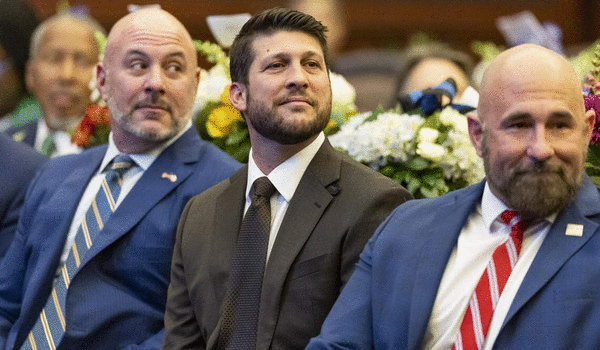
TALLAHASSEE, Fla. — Leaders at the University of Florida’s law school sidestepped internal rules to rush Attorney General James Uthmeier into a part-time teaching role, granting unusual leeway to a politically powerful adjunct earning a $100,000 salary.
Internal emails reviewed by the Miami Herald/Tampa Bay Times show that Uthmeier began teaching at UF’s Levin College of Law more than a month before his first course was formally approved, submitted incomplete syllabi and never received the full faculty sign-off required under law school protocols.
The correspondence also captures mounting frustration from the professor tasked with overseeing the attorney general’s course review, who warned the dean he was willing to “bend the rules” — but not ignore them altogether.
The apparent corner-cutting illustrates how top brass at Florida’s flagship law school relaxed longstanding safeguards to fast-track the state’s top legal official into its classrooms — even as Republican leaders in Tallahassee demand greater transparency and oversight of university instruction.
Under law school rules, new adjuncts teaching more than one course per academic year must receive approval from the full faculty. In Uthmeier’s case, that never happened.
The attorney general also bypassed a policy requiring proposed courses to include detailed syllabi listing weekly topics, assigned readings and grading standards before they can be reviewed by the law school’s curriculum committee. That paperwork never fully materialized.
The issues are surfacing amid heightened political scrutiny of what is taught on Florida campuses. A new state law requires all 40 public colleges and universities to publicly post detailed syllabi and instructional materials at least 45 days before the first day of class.
Yet emails show Uthmeier was already five weeks into teaching his inaugural course, “Executive Power,” when he formally submitted his proposal to the faculty-run curriculum committee.
The attorney general’s slapdash onboarding adds mounting scrutiny over his UF position. Some law school faculty have expressed frustrations that they only learned of the attorney general’s compensation after a Herald/Times investigation revealed he was earning $100,000 annually for two courses and a part-time advisory role.
When pressed about Uthmeier’s lack of faculty approval at a recent closed-doors meeting, the law school’s longtime interim dean, Merritt McAlister, said information about Uthmeier’s employment may not have been forwarded to the full faculty body.
As for the attorney general’s curricular reviews, the dean took responsibility for “irregularities” with the process but did not detail the mishaps.
“That was a screw-up on our part,” she told her colleagues.
A UF spokesperson, Steve Orlando, said in a statement that the university and the law school “followed all appropriate processes and procedures, as well as state law” when it hired Uthmeier.
The attorney general’s office did not respond to questions about Uthmeier’s hiring or course reviews. The seven faculty members and administrators who approved his fall course declined to comment or did not respond to inquiries by the Herald/Times.
‘Bend the rules’
The internal emails reviewed by the Herald/Times show Uthmeier’s proposal was filed well after fall classes were underway — and was incomplete.
The attorney general’s syllabus, as the curriculum committee’s chair described it at the time, was “quite sparse.” It lacked a full reading list, detailed grading criteria and week-by-week lesson descriptions — all required under faculty policy. Instead, Uthmeier would upload reading assignments online on a weekly basis.
The committee chair, Mark Fenster, repeatedly pressed McAlister and one of her lieutenants for the missing materials. In one missive, he noted the political sensitivity of the moment.
This is the attorney general we’re talking about, Fenster reminded the law school’s chief academic officer, and Tallahassee power brokers “have made an enormous deal about syllabi in the past few years.”
The emails suggest Uthmeier did not directly provide the missing materials to the committee. Instead, administrators accessed his online course portal and captured screenshots of reading assignments from the first five weeks to share with faculty.
The correspondence does not include any direct exchanges between Uthmeier and the committee. The dean instead served as intermediary — an unusual role in what is typically a faculty-driven process and far below the scope of an average college dean’s duties.
By late September, Fenster was pressing McAlister for Uthmeier’s class readings. “I hate being put in the position of crusty old bureaucrat,” he wrote to the dean. “I’m willing to bend the rules by allowing for a partial submission but not to ignore them entirely.”
As the fall semester progressed, Fenster grew visibly frustrated with the pace and rigor of the review. In early October, he was bristling to McAlister that he was “not entirely comfortable” with how the process was playing out.
Approving a course more than halfway through the term seemed “highly irregular,” Fenster told the dean, and it was “difficult to make sense of the logic and planning behind” Uthmeier’s curriculum. He had assumed the review would be “simple and almost ministerial” and completed in August.
Still, he acknowledged the political reality.
“I understand,” he wrote, “that the actual course content is less significant than the teacher’s identity.”
McAlister ended up delivering the partial list of Uthmeier’s class readings to the curriculum committee on Oct. 1. When the committee considered the attorney general’s course proposal that evening over email, Fenster acknowledged that some members disclosed their “discomfort” with the process to him. He offered to delay a vote if there was “sufficient unease.”
At least three curriculum committee members voiced concerns about Uthmeier’s drip-feed approach to assigning class readings and a lack of clear grading standards. But the committee ultimately approved the attorney general’s proposal as a provisional course.
In the end, Fenster came to regret that decision.
‘I apologize for implicating you in this’
Three days after the Herald/Times broke news about Uthmeier’s $100,000-a-year teaching stipend, Fenster lamented in a letter to the curriculum committee about not taking a firmer stance about the procedural irregularities.
He argued that the dean’s office saddled the committee with using an incomplete list of Uthmeier’s course materials, leaving members to “extrapolate what the remainder of the semester would look like.”
Had Fenster known about the attorney general’s compensation, the professor wrote, he would not have suggested approving the course until it “met our expectations.”
“In the end, we decided, based on the limited information we’d been given, that the value of the class outweighed these procedural irregularities,” Fenster told his colleagues. “I am sympathetic to busy adjuncts who contribute their time to the Law School and our students and feel slightly guilty about putting bureaucratic burdens on them. Someone who is in fact a well-compensated member of the law school should meet those requirements.”
“I apologize for implicating you in this,” the professor concluded.
At least one committee member disagreed, likening the group’s role to the U.S. Food and Drug Administration; the agency considers whether pharmaceutical applications meet regulatory standards — not economic considerations like drug prices, the professor wrote.
Fenster responded that he would agree “if the only relevant issue here was an economic question.”
“But in this instance,” he wrote, “I helped an incomplete application, that was filed late, to be considered by the committee” without full information. “I was persuaded that a busy, temporary adjunct could be allowed to skirt the requirements applied to everyone else.”
“I hope,” he went on, “that a well-run FDA would kick back an application that failed to include all relevant information, as I now believe we should have.”
When it came time for the curriculum to evaluate Uthmeier’s spring course, “Separation of Powers and Federalism,” McAlister informed Fenster that it would not be subject to review protocols. After discussing the matter with the attorney general, the dean said the class would be registered as a seminar — which “do not require the fulsome Curriculum Committee process.”
Like his fall course, the seminar’s syllabus does not include Uthmeier’s reading assignments. Per the document, the attorney general is now lecturing students about, among other subjects, “real-life examples of separation of powers and federalism at work.”
_____
©2026 Miami Herald. Visit miamiherald.com. Distributed by Tribune Content Agency, LLC.






Comments