Ferguson outlines his requirements for WA 'millionaires tax'
Published in News & Features
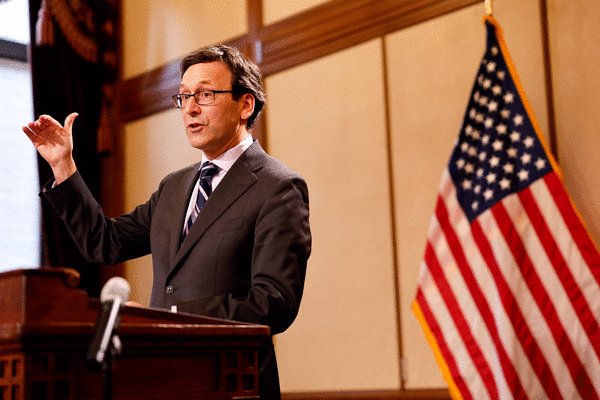
OLYMPIA — A day after the Senate passed a revised income tax bill, Gov. Bob Ferguson on Tuesday called it a “good start” and for the first time detailed his conditions for signing it, including $1 billion in small business-tax relief and a major expansion of the state’s Working Families Tax Credit.
Ferguson's stipulations come two weeks after he publicly rejected the proposal the day Democrats unveiled it, saying it didn't deliver enough relief for Washingtonians while offering no specifics on what changes he would require.
Senate Bill 6346, which advanced out of the chamber Monday after tweaks by Democrats, would establish a 9.9% income tax on annual earnings above $1 million. For example, someone making $1.2 million a year would pay the tax only on $200,000. The measure would affect an estimated 30,000 Washingtonians and would generate about $3.5 billion annually. The tax does not take into consideration the value of an individual’s home or retirement savings.
Ferguson said his plan would return $1.9 billion of that revenue “back in the pockets of Washingtonians,” through targeted relief, tax credits and sales tax holidays, while still funding education and other state priorities.
While lawmakers’ initial proposal directed most of the revenue straight into state coffers with only a modest business relief and a slight expansion of the WFTC, Ferguson said he doesn’t support that approach and does not believe it would gain public approval.
“We need to go much bigger to assist small business owners who help our economy and create jobs,” Ferguson said, suggesting that $1 billion in revenue from the income tax should be used for tax breaks, a move that would “dramatically” increase the small business tax credit.
Ferguson estimated that doing so would wipe out the business and occupation tax on the first $2.5 million in total revenue for a business, and would result in approximately 170,000 small businesses no longer on the hook to pay the state’s high B&O tax. Another 30,000 businesses would see a reduction in B&O taxes, resulting in a savings of about $5,000 every year for businesses.
The governor said he appreciated amendments made to the Senate bill so far, including one to exempt businesses with gross revenues of $300,000 or less from paying the B&O tax — which supporters say exempt more than 70% of small businesses from the tax — and an amendment passed on the debate floor Monday by Sen. Marko Liias, D-Mukilteo, that repeals sales taxes on retail services enacted as part of the $9 billion new revenue package in 2025.
Additionally, Ferguson called for a major expansion of the WFTC, noting that including it in the income tax bill is “paramount.”
About 350,000 households are currently eligible for the tax credit, according to the Department of Revenue, meaning they have filed a federal tax return and meet other program requirements. For the 2024 tax year, DOR has issued 289,300 refunds to date, covering about 83% of the eligible households.
Eligibility is based on income and family size. The maximum credit for a single filer is $335, rising by $325 for one child and $335 for each additional qualifying child. Under the current program, a family with three or more children could receive up to $1,330 annually.
Refunds have grown substantially in recent years. In 2025, DOR issued more than $228.9 million in refunds, up from $147.8 million in 2024.
Ferguson called the WFTC a “great program, that currently leaves many working families out. He wants to expand both eligibility and benefit amounts, which he estimates would cost about $380 million a year and reach 460,000 additional households. He supports the Senate's proposal to eliminate the age limit but plans to fund the expansion with new revenue from the income tax.
Senate Democrats also proposed eliminating sales tax on hygiene products, a move the governor supports, and said he would like to see baby diapers and other baby products added to the list of exemptions. Ferguson also suggested two sales tax holidays a year that would allow Washingtonians to purchase certain items less than $1,000 without paying any tax. He said he would like to see one three-day weekend and one two-day holiday where sales taxes are exempt.
There are other measures still alive in the Legislature that would rollback taxes enacted last year, including a proposal to rollback changes made to the estate tax. Ferguson said he supported all of those measures and said he recognizes that some of those taxes enacted last year went too far.
“Maybe these impacts weren't quite what we intended — we need to change that,” he said.
While nearly all Democratic lawmakers support the income tax proposal, there is no support from the Republican side of the aisle, with criticisms that the bill is a gateway for a broader income taxation and concerns that it would prompt wealthy Washingtonians to leave the state.
With less than a month to get the final version of the tax proposal over the finish line, and to pass a supplemental budget for the 2025-27 biennium before the legislative session adjourns March 12, lawmakers face mounting pressure to meet the governor's conditions for his signature.
©2026 The Seattle Times. Visit seattletimes.com. Distributed by Tribune Content Agency, LLC.





Comments