Fast-tracked asylum hearings for Somali refugees being held in secret
Published in News & Features
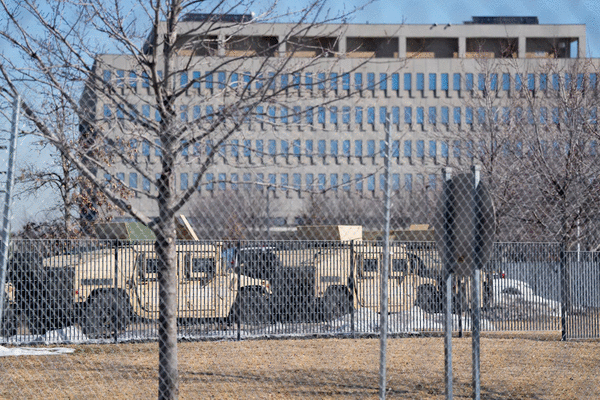
MINNEAPOLIS — The Fort Snelling Immigration Court is holding expedited online hearings, largely in secret, for Somali nationals with asylum claims.
Nicknamed the “rocket docket” by attorneys and court observers, the only public notice of these hearings is a sheet of paper pinned to a board each day in the lobby of immigration court in the Bishop Henry Whipple Federal Building. The dockets are often incomplete or inaccurate.
Everyone appears for the hearings remotely and observers are rarely allowed. While the immigrants who are the subject of the proceedings are in Minnesota, the judges and government attorneys are in other states.
The practice is the latest example of the diminishing transparency in courts operated by the Executive Office for Immigration Review since President Donald Trump returned to office promising mass deportations. At Fort Snelling, courtrooms are often locked, dockets are redacted and observers are restricted, contrary to federal law stipulating most hearings be open to the public.
Suleiman Adan, deputy executive director of the Minnesota chapter of the Council on American-Islamic Relations, said immigration officials have not provide an explanation about fast-tracked online hearings for Somali refugees. He noted that family members are unable to observe the hearings.
“When hearings are expedited, families lose the ability to hire counsel and gather evidence,” Adan said. “It is a due process issue.”
The Advocates for Human Rights, a Minneapolis-based nonprofit, filed a federal lawsuit on Thursday, March 12, challenging the “increasingly restrictive limitations on public access to immigration court proceedings” at the Whipple Federal Building. It names Attorney General Pam Bondi, the Executive Office for Immigration Review — part of the Department of Justice — and the chief immigration judge.
“Federal law is clear: Immigration court hearings are open to the public,” Michele Garnett McKenzie, executive director of the Advocates for Human Rights, said in a statement. “When the government closes the courthouse doors without a valid basis, it undermines the transparency that is essential to the rule of law.”
Kathryn Mattingly, spokeswoman for the Executive Office for Immigration Review, which oversees 70 immigration courts nationwide, said any judge throughout the U.S. can hear cases at any time to help with caseloads. She said hearings can be closed to protect immigrants’ privacy or be held with limited attendance.
Court rules stipulate that only immigrants, not the federal government, can ask judges to close hearings if they fear torture, have been abused or have an existing protection order.
Federal law requires immigration officials to decide asylum claims within 180 days of receiving an application. But there are 2.4 million pending applications and it typically takes years for a decision.
The expedited hearings for Somali nationals come after Trump referred to Minnesota’s Somali community as “garbage” and used social services fraud allegations as a justification for Operation Metro Surge. In January, then-Homeland Security Secretary Kristi Noem said a deportation protection known as Temporary Protected Status (TPS), in place for Somali refugees for 34 years, would not be renewed after March 17.
Revoking TPS would affect about 2,500 Somali nationals living in the U.S., many of them in Minnesota. Somali TPS holders and advocacy organizations sued the Trump administration in federal court in Massachusetts on Tuesday, March 9, over its move to revoke the program.
Matthew Mockenhaupt, a local immigration attorney, said at the end of January he was flooded with notices of rescheduled hearings for clients who are Somali nationals with asylum claims. Immigrants who are not in custody typically wait eight months to more than a year between hearing dates.
Mockenhaupt had dozens of previously in-person hearings fast-tracked to online and is expected to prepare for 40 final asylum hearings in the coming months.
These hearings can take weeks to prepare for because they require attorneys to gather and present police reports, medical records and other evidence about why their clients fear torture and reprisal if they are sent back to countries they fled.
“The bottom line is they are targeting an entire group of people based on their nationality,” Mockenhaupt said. “The way this docket is going forward is unprecedented. We have never had an entire nationality of people that have been scheduled at such a rapid pace.”
A Minnesota Star Tribune reporter was not allowed to observe one of Mockenhaupt’s online hearings Tuesday. Immigration Judge Abdias Tida, who is in Houston, cited internet capacity issues as the reason for not allowing observers into the hearing.
The reporter was briefly let into the end of a second hearing with Judge Nina Carbone, who is in Denver, after Mockenhaupt told the judge someone wanted to observe the proceedings.
Immigrants being held in detention typically appear for their hearings remotely with the judge, attorneys and members of the public in-person in a courtroom at Fort Snelling. Judges routinely cite internet capacity as a reason for requiring observers to come in person.
“This isn’t Court TV,” Immigration Judge Sarah Mazzie said during a hearing in January.
But the public can’t observe hearings on the “rocket docket” because they are not tied to a local courtroom and could happen anywhere in the U.S. Observers from the Advocates for Human Rights have also been barred from the virtual hearings.
In their lawsuit, the organization asks the Executive Office for Immigration Review to either follow their stated policies or explain in writing the reason for limiting the public’s access to court hearings.
_____
©2026 The Minnesota Star Tribune. Visit startribune.com. Distributed by Tribune Content Agency, LLC.






Comments