Bill targeting 'terrorist' groups, 'Shariah' law heads to governor's desk
Published in News & Features
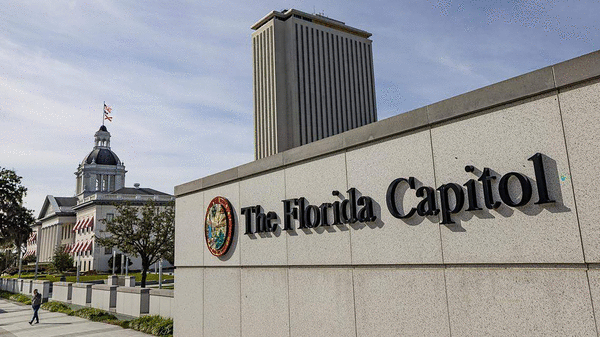
Legislation that would allow Florida leaders to designate domestic “terrorist” groups is headed to Gov. Ron DeSantis’ desk, even as critics say it unfairly targets Muslims.
The House first signed off on the proposal last week, but it had to vote on it again on Thursday because the Senate approved an amended version of the bill.
After nearly an hour of heated debate, the Florida House said “yes” a second time, all but guaranteeing the bill will become law. Gov. Ron DeSantis’ office authored the proposal, the Tampa Bay Times reported this week, though a spokeswoman declined to comment about whether he would sign it.
House members approved the Republican-backed legislation along party lines, with several Democrats arguing its passage would infringe on Floridians’ constitutional rights.
The bill would allow the Florida Department of Law Enforcement’s chief of domestic security to designate certain groups as terrorist organizations, with the approval of the Florida Cabinet, which is chaired by the governor and is made up of three other statewide elected officials.
Islamic groups are particularly concerned about the consequences of the legislation because it references Shariah law, the duties required of Muslims.
State universities and colleges that “advocate for” state-designated terrorist groups might have their performance funding withheld, and students who promote these organizations could be expelled. Additionally, anyone who works for state-designated terrorist organizations could face felony charges.
Schools that are affiliated with these groups could be barred from receiving vouchers, which students use to pay tuition at nearly 2,500 campuses across the state. A tiny fraction of those schools, less than 1%, are Islamic. The majority are Christian.
The Senate approved an amended version of the bill (HB 1471) last week that, among other changes, clarified what it meant to “promote” terrorist groups on college campuses. To meet that definition, someone must recruit members or provide material support; make a threat of unlawful violence; disrupt the learning environment or commit some action that results in “substantial disorder;” or impedes the rights of others.
Simply expressing support for an organization during a class discussion or protesting would not be considered promoting it, bill sponsor Rep. Hillary Cassel said.
“‘Promote’ is not just speech alone,” said Cassel, a Republican from Dania Beach.
Democrats pushed back, some arguing that the state once attacked the NAACP and other civil rights groups and saying they feared that type of persecution could happen again.
Clarifying that simply speaking in support of an organization that the state considers to be “terrorist” won’t land a college student in hot water wasn’t enough, they said.
“The fact is it’s too easy to blur the lines of taking away someone’s First Amendment rights because you don’t like what they’re saying and designating them as a terrorist of the state,” said Rep. Rita Harris, an Orlando Democrat.
Tensions flared throughout the discussion. Democrat Angie Nixon of Jacksonville told her Republican colleagues they were “dead wrong” to support the legislation, which she considered “un-American” and “disrespectful.”
Cassel fired back at the Democrats, suggesting that people who didn’t support the bill were “surrendering their children to terrorism.” The proposal, she said, “protects the Constitution, protects us from those that want to change us, protects us from those who want Western civilization to fall.”
A related proposal (HB 1473) would exempt from public disclosure records concerning the decision to designate groups as terrorist organizations. The House also gave approval to that bill on Thursday.
_____
©2026 Orlando Sentinel. Visit orlandosentinel.com. Distributed by Tribune Content Agency, LLC.




Comments