Merz's latest regional election test may produce no real winners
Published in News & Features
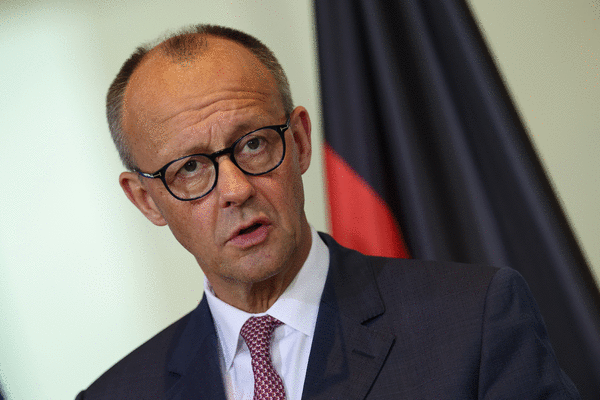
Friedrich Merz will have another chance to secure a regional election victory on Sunday after the German chancellor’s conservative party suffered a bruising defeat in a wealthy southwestern state two weeks ago.
Failure to take power in the wine-growing region of Rhineland-Palatine would be a heavy blow for Merz’s Christian Democratic Union. But a defeat for the rival Social Democrats, who have governed the region for 35 years, would be even more painful, compounding the party’s turmoil after its worst-ever result on March 8 in neighboring Baden-Wuerttemberg.
The dynamic amounts to a potential lose-lose situation for Merz’s coalition in Berlin, which has struggled to win traction among German voters with halting efforts at reforms and an emerging challenge from the far right. A spiraling energy crisis, technology-driven shifts in the manufacturing sector and sluggish growth have weighed on Merz’s bid to turn Europe’s biggest economy around.
Polls show a tightening race in Rhineland-Palatine, with the CDU’s once-solid lead over the SPD shrinking as the ballot draws nearer. Merz’s conservatives had 29% support, two percentage points ahead of the SPD, according to a March 19 poll for ZDF.
A similar dynamic played out in Baden-Wuerttemberg, where Merz’s party saw a double-digit lead over the Greens evaporate in the weeks before the contest. The environmental party won by less than a percentage point, extending its 15-year stewardship of the state, home to Mercedes-Benz AG and Porsche AG.
The setback was significant for Merz, who weeks before secured backing for his leadership at a party conference in Stuttgart — confidently predicting two March victories in Germany’s southwest as he proclaimed the Christian Democrats the “DNA of this republic.”
But, along similar lines to the Baden-Wuerttemberg campaign, the conservatives are facing an SPD incumbent state premier, Alexander Schweitzer, whose personal popularity far outstrips their candidate, state CDU leader Gordon Schnieder. The Social Democrat, who is not directly elected, had the backing of 40% of voters compared with 25% for Schnieder, according to the ZDF poll.
Voting ends at 6 p.m. local time on Sunday, with exit polls published by Germany’s main broadcasters offering a first look the result. Ballots will be tallied through the evening.
For the SPD, Merz’s coalition partner in Berlin, the stakes are arguably higher. The party’s 5.5% showing this month — barely making the threshold to enter state parliament — was by far its worst there in the state’s post-World War II history.
By contrast, the SPD has long dominated Rhineland-Palatinate, occupying the state premiership since 1991. SPD co-leader Lars Klingbeil, Germany’s vice chancellor, made clear that the March 8 debacle made a victory on Sunday all the more urgent.
A loss would pile pressure on the Social Democrats — and could complicate their co-habitation with the conservatives in Berlin all the more difficult. The parties have already struggled with sharp differences over pension policy, Germany’s jobless program and fiscal discipline.
The contest will be a gauge of support for the far-right Alternative for Germany, which polls show more than doubling its backing to almost 20% since the last election five years ago. Three more regional votes this year — particularly in the eastern states of Saxony-Anhalt and Mecklenburg-Western Pomerania — will be dominated by the surge in the performance of the AfD.
In Saxony-Anhalt, the AfD could potentially secure an absolute majority, which would put the party, which has called for a halt to immigration and mass deportations of non-Germans, in charge of a regional government for the first time since it was founded in 2013.
©2026 Bloomberg L.P. Visit bloomberg.com. Distributed by Tribune Content Agency, LLC.






Comments