California bill would create an official designation for the state's iconic surf spots
Published in News & Features
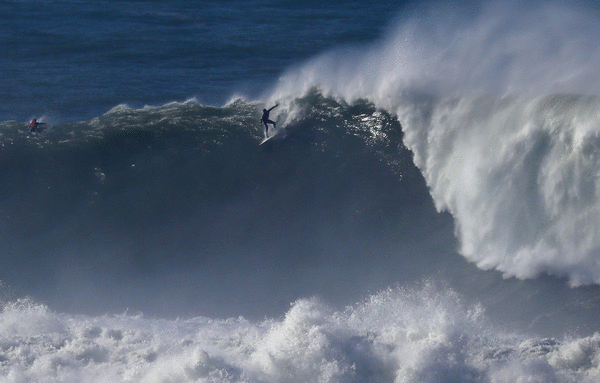
SACRAMENTO, Calif. — A Southern California lawmaker hopes to create a new designation for the state’s iconic wave breaks through the creation of “surfing reserves.”
Excepting perhaps Hawaii, California’s coastline is home to more world-famous waves than any state. Breaks dot the coast, from renowned Malibu and San Diego beaches to the monstrous Mavericks big wave spot near Half Moon Bay to dozens of lesser-known waves (including some consciously kept secret by local surfers) running from the Mexico to Oregon borders.
Assembly member Jacqui Irwin, D-Thousand Oaks, seeks to officially recognize popular breaks, particularly as they face threats from rising seas, coastal erosion and pollution. She’s introduced a bill that would create a process for local governments to designate treasured breaks as “surfing reserves” with the California Ocean Protection Council — a conservation body the Legislature created in the 1970s.
The bill won’t immediately create any new environmental protections for surf spots, but could lay the groundwork for such measures down the road, Irwin said.
“We look at it as much more of a way to increase tourism and call attention to these zones as areas that should be protected,” Irwin said. The bill doesn’t have any vocal opposition, Irwin said, but the Legislature has failed to pass it on previous occasions.
“Certainly in the future, you could look at having surfing reserves be part of (land conservation programs),” Irwin said. “We just are trying ... to do a first step that’ll have a low cost and could really create a lot of excitement.”
Irwin’s bill would require the Ocean Protection Council to create criteria that local governments need to meet to receive the surfing reserve designation. The council must consider “wave quality and consistency, surf culture and history, environmental characteristics, and management priorities,” in that criteria.
When applying for the designation, local governments would also document the economic impact of the surf break.
Surfing is big business, both in California and worldwide. One 2025 study, commissioned by local surf advocacy groups, found that in Santa Cruz alone visiting surfers brought an economic impact of more than $44 million a year.
That same study found that a rising ocean would lessen the area breaks’ number of surfable days. If the ocean rises by a foot, which 2022 research led by the National Oceanic and Atmospheric Association suggested was likely by 2050, Santa Cruz wave breaks would lose enough surfable days to cut down visitor expenditures by almost $13 million.
In the short term, however, California surfing is set to get a big boost on the world stage in 2028, when Los Angeles hosts the Summer Olympics. Surfing debuted as an Olympic sport in Japan in 2020, but the waves were small. In 2024, the competition moved to the French Polynesian island of Teahupo’o, one of the world’s most famous, and feared, breaks. Tens of millions of viewers watched captivated as surfers navigated thunderous waves that broke over a dangerous reef.
In 2028, the third Olympic surf competition is slated to take at Trestles State Beach, a state park just south of San Clemente on the border of Orange and San Diego counties that is known for consistent and powerful waves.
Irwin’s bill was scheduled for an assembly committee vote late Monday.
_____
©2026 The Sacramento Bee. Visit sacbee.com. Distributed by Tribune Content Agency, LLC.





Comments