Venezuela pushes to reopen embassy in US as diplomatic relations restart
Published in News & Features
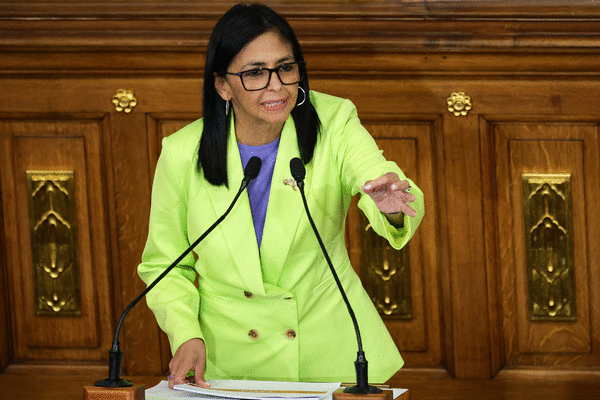
Venezuela’s interim president, Delcy Rodríguez, announced Tuesday that her government will send a diplomatic delegation to Washington later this week to launch a new phase of political and diplomatic dialogue with the United States, as the Trump administration moves to facilitate the reopening of the Latin American nation’s diplomatic facilities on U.S. soil.
Speaking during a meeting with investors and business leaders, Rodríguez said the initiative reflects Caracas’ intention to stabilize ties with Washington and deepen engagement after years of rupture.
“I want you to take away — on my behalf and in the name of the government of Venezuela — the firm assurance that this is our intention,” Rodríguez said. “This week, a delegation of diplomats will depart for Washington to undertake the launch of this new phase of diplomatic and political relations and dialogue between the two governments.”
The planned visit builds on a broader diplomatic thaw that began earlier this month, when the U.S. and Venezuela agreed to restore formal diplomatic and consular relations for the first time since ties were severed in 2019.
In a March 5 statement, the U.S. State Department said the agreement was intended to support stability and lay the groundwork for Venezuela’s political transition following the ouster of former strongman Nicolás Maduro.
“This step will facilitate our joint efforts to promote stability, support economic recovery, and advance political reconciliation in Venezuela,” the department said, adding that engagement with interim authorities aims to create conditions for a peaceful transition to a democratically elected government.
The restoration of ties marks a sharp reversal from years of diplomatic isolation, when Washington withdrew embassy staff from Caracas and managed its Venezuela policy largely from neighboring Colombia after recognizing opposition leader Juan Guaidó as interim president.
That rupture became one of the defining features of Venezuela’s prolonged political crisis under Maduro, as the U.S. imposed sweeping sanctions and sought to isolate his government internationally.
The current rapprochement follows a dramatic U.S. operation in January that resulted in Maduro’s capture, along with his wife, Cilia Flores. Both are now facing drug-trafficking charges in New York. In the aftermath, the Trump administration outlined a three-phase transition plan centered on stabilization, economic recovery and eventual democratic elections, placing Rodríguez, who served as Maduro’s vice president, at the helm of the interim government.
The latest diplomatic push also coincides with a recent measure by the U.S. Treasury Department’s Office of Foreign Assets Control aimed at enabling Venezuelan government missions to resume operations in the United States.
Under the authorization, transactions otherwise prohibited under U.S. sanctions are allowed if they are tied to goods and services necessary for the functioning of Venezuela’s official missions or its permanent missions to international organizations in the United States.
The measure permits payments provided they are for official use or for the personal use of mission staff and their immediate family members, and are not intended for resale. It excludes transactions involving real estate and maintains all other legal restrictions.
Crucially, the authorization allows U.S. financial institutions to open and maintain bank accounts for Venezuelan diplomatic missions, extend credit and process funds transfers on their behalf—steps seen as essential for reopening embassies, consulates and related offices that have been largely dormant under sanctions.
Analysts say the move does not lift broader sanctions but is designed to remove practical barriers that had prevented Venezuelan diplomatic facilities from operating, signaling a willingness by Washington to restore a functional diplomatic presence as talks advance.
In recent weeks, both governments have already begun taking initial steps in that direction. In late January, U.S. chargé d’affaires Laura Dogu arrived in Caracas to begin the process of reopening the American diplomatic mission, while discussions have intensified over restoring full consular services.
The reestablishment of those services could have immediate effects for millions of Venezuelans living abroad, as well as for Americans with ties to the country, particularly in areas such as visas, passports and other documentation.
Rodríguez told business leaders that her government is also seeking to move beyond the current system of limited U.S. authorizations, known as temporary licenses, which have allowed select companies such as Chevron to operate in Venezuela under strict conditions.
Instead, she said Caracas is pursuing a framework that provides “permanent legal certainty” for investors, aiming to create predictable conditions for short-, medium- and long-term investment.
The shift would mark a significant departure from the sanctions-driven model that has governed U.S.-Venezuela economic relations for years and is likely to be a central issue in the upcoming talks.
_____
©2026 Miami Herald. Visit miamiherald.com. Distributed by Tribune Content Agency, LLC.






Comments