Federal court backs Trump administration's immigrant detention policy
Published in News & Features
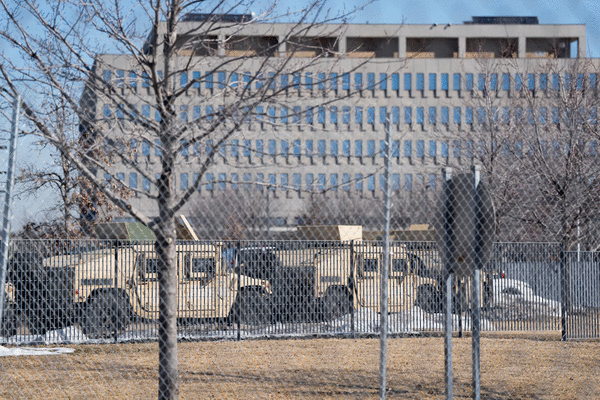
A federal appeals court has sided with the Trump administration’s stance that immigrants who came to the U.S. illegally are ineligible for bond hearings.
In a 2-1 ruling, the panel of judges in the 8th U.S. Circuit Court of Appeals on Wednesday determined the U.S. government correctly interpreted federal law in arguing immigration officers can lock up a person in deportation proceedings without a chance for a bond hearing.
The ruling applies to district courts in Minnesota, Arkansas, Iowa, Missouri, Nebraska, North Dakota and South Dakota.
“We find that the district court erred in holding that the Government could not detain (the immigrant) without bond,” wrote judges Steven Grasz and Bobby Shepherd in upholding the Trump administration’s policy.
The appeal stems from the case of Joaquin Herrera Avila, who was detained without bond in Minneapolis last summer by the Department of Homeland Security. Herrera Avila, a Mexican national who first came to the U.S. in 2006, later filed a habeas petition seeking his release from custody. He was released on a $7,500 bond after U.S. District Judge John Tunheim granted his petition in October, which the U.S. government later appealed.
“This is an unfortunate decision,” said David Wilson, Herrera Avila’s attorney, in an email to the Minnesota Star Tribune. “It is hard to reconcile how so many district court judges can take one view and two judges at the circuit level can ignore the wisdom of over 100 judges. But that’s why we must keep fighting on.”
Attorney General Pam Bondi praised the ruling as a “massive court victory against activist judges and for President Trump’s law and order agenda” in a post on X.
“The law is very clear, but Democrats and activist judges haven’t wanted to enforce it,” she wrote. “This administration WILL.”
The U.S. Department of Homeland Security ushered in its mandatory detention policy change last year to boost the number of detained immigrants. The shift marked a departure from 30 years of court precedent which allowed people in immigration proceedings to post bond if they have no criminal record, are not considered dangerous and are not a flight risk.
The change led hundreds of detained immigrants to file habeas petitions challenging their detention, which quickly flooded Minnesota’s federal courts in recent months after Operation Metro Surge began Dec. 1. The petitions have been the source of many terse exchanges between prosecutors and judges, who have accused the government of violating their orders in habeas cases by not releasing immigrants on time or transferring detainees to detention facilities in other states. Late February, Minnesota’s chief federal judge alleged the U.S. government’s violations in habeas cases reached as many as 113 violations in 77 cases.
In recent weeks, judges have raised the possibility of holding Minnesota’s U.S. Attorney Daniel Rosen in contempt over the government’s failures to immediately return many immigrants’ property upon release from custody when their habeas cases were granted.
Questions remain about the hundreds of immigrants arrested during Operation Metro Surge who were previously released because a judge granted their habeas petitions. It’s unclear if federal immigration officials will try to re-detain them.
“It feels like this is the type of administration that might give it a go,” said Julia Decker, policy director for the Immigration Law Center of Minnesota.
In his dissent, Erickson wrote: “Five presidential administrations, including the first Trump administration, and most immigration judges interpreted (the federal law) to apply only to those arriving at the border.”
“The fact that Congress never attempted to correct the other two branches is also worthy of consideration,” Erickson said.
The decision comes after another federal appeals court last month sided with the Trump administration’s policy. In a split decision, the Fifth U.S. Circuit Court of Appeals supported the mass detention policy in a ruling that applied to courts in Louisiana, Mississippi and Texas.
“We hope that Minnesota judges will follow the lead of Texas judges who are granting bond hearings, despite a similar Fifth Circuit Court opinion, because that’s the due process right people have. Pragmatically, we brace for more dismal conditions for detainees related to ICE bed capacity,” Mid-Minnesota Legal Aid said in a prepared statement.
_____
©2026 The Minnesota Star Tribune. Visit startribune.com. Distributed by Tribune Content Agency, LLC






Comments