Pakistan on high alert ahead of crucial US-Iran peace talks
Published in News & Features
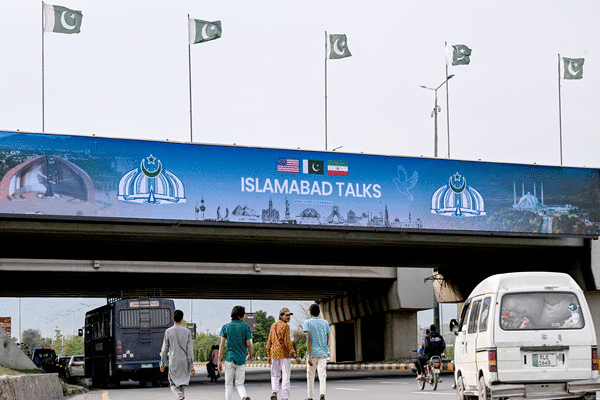
Roads blocked by shipping containers, armed soldiers out on patrol, and luxury hotels quietly asking guests to vacate: the leafy Pakistani capital Islamabad has transformed into a security fortress as officials prepare for high-stakes peace talks between the U.S. and Iran.
U.S. President Donald Trump is dispatching Vice President JD Vance, along with special envoy Steve Witkoff and son-in-law Jared Kushner to the city to meet with Iranian officials on Saturday, after announcing a Pakistan-brokered ceasefire agreement earlier this week.
The nuclear-armed Islamic nation has carved out an unlikely role as mediator in the Middle East conflict, capitalizing on its warm ties with nearly all of the key players in the six-week conflict, giving the Pakistani capital a rare moment on the global stage.
Pakistan and the U.S. have had a bumpy relationship since a U.S. operation secretly killed Al-Qaeda leader Osama bin Laden in a compound just 75 miles north of Islamabad in 2011. But ties blossomed again last year, in part over a counter-terrorism collaboration and a budding personal relationship between Trump and Pakistani army leader Asim Munir.
Pakistan meanwhile shares close ties with its neighbor Iran, as well as China and other Gulf countries. The exception is Israel, not officially recognized by Islamabad and which is not attending the talks.
The negotiations mark the first trip by a top U.S. official in years to the Pakistani capital. Former Secretary of State Mike Pompeo visited the city in 2018, while Joe Biden paid a visit in 2011 as vice president in the shadow of the war in neighboring Afghanistan.
Trump said he was “optimistic” about a deal coming together, though the Strait of Hormuz has remained largely at a standstill despite the ceasefire, while Israel’s parallel war on Lebanon remains a flashpoint.
All across Islamabad, frantic preparations for Saturday’s talks were unmistakable.
Workers hoisted green crescent-moon Pakistani flags all along the Srinagar Highway, which bisects the city’s checkerboard downtown. Businesses have closed up after city administrators announced an impromptu two-day public holiday Thursday and Friday.
The Serena Hotel — the sprawling luxury venue favored by international cricket teams — was being sealed off on Thursday in preparation for the arrival of delegates. The venue has been booked out from Friday to Sunday evening, with no other guests allowed to enter during that time. A similar cordon was evident at the nearby Marriott, the imposing gray accommodation on the city’s northeast fringe.
Security is front of mind for officials. Top hotels across the country have been a frequent target for militancy in the past, with the Islamabad Marriott shaken by a deadly bombing in 2008 during a particularly violent spell of attacks in the capital that were brought to an end a decade later by a military campaign.
In February, Islamabad residents were rattled by a suicide bomb which killed dozens at a major mosque, shattering a long stretch of calm.
Pakistan’s security forces are battling domestic insurgencies on its northeastern and southwestern borders, and is itself observing a ceasefire following a clash with Afghanistan.
Pakistan is no stranger to playing middle-man to history. In July 1971, when then-President Richard Nixon and his National Security Advisor Henry Kissinger were quietly planning a surprise rapprochement with China, Kissinger feigned illness on a visit to Pakistan — an American ally in the Cold War — as cover for a secret trip to Beijing.
After the Sept. 11 attacks, legions of foreign journalists from CNN to the BBC descended on Islamabad, overwhelming the Marriott and the Holiday Inn, to observe the U.S. preparations for war in Afghanistan. Foreign TV networks took over hotel rooftops for live transmissions, with some venues demanding $500 a day for the service.
As yet another neighbor finds itself in the crosshairs of the U.S., Islamabad is once again center stage.
--------
—With assistance from Khalid Qayum and Bilal Hussain.
©2026 Bloomberg L.P. Visit bloomberg.com. Distributed by Tribune Content Agency, LLC.



Comments