Who was Mohamed Jalloh? Here's what radicalized the Old Dominion University shooter.
Published in News & Features
Mohamed Bailor Jalloh was in the Virginia National Guard when he became hooked on speeches by Anwar al-Aulaqi in about 2014.
The U.S.-born cleric was already dead by the time his words moved Jalloh: He had been killed in Yemen in a drone strike ordered by President Barack Obama in September 2011.
The American news media referred to Aulaqi as a “hate preacher,” drawing the young guardsman to the radical cleric’s words — including the view that “every able Muslim” must resist the American presence in Iraq and Afghanistan.
Jalloh’s exposure to Aulaqi, court documents say, led him to quit the Virginia Army National Guard in April 2015, ending a six-year stint in the service.
Two months later, Jalloh, then 25, and his father traveled to Sierra Leone, the West African nation where Jalloh spent his first eight years of life.
The trip’s purpose was to allow Jalloh’s father — then in frail health — to visit his homeland before he died. But while there, Jalloh also met members of a terrorist organization that was plotting against U.S. service members.
When he got back to Virginia, Jalloh had a falling out with his girlfriend and wanted to find a Muslim wife. And a man he thought could help him in that quest turned out to be an undercover informant for the FBI.
In conversations with that man — secretly recorded by the FBI — Jalloh talked about wanting to be a Muslim martyr. He expressed admiration for the deaths of U.S. servicemen in previous terrorist attacks.
Although he didn’t have the courage at the time to carry out such attacks himself, he gave money to the organization. And he bought an AR-15 semiautomatic rifle at a Northern Virginia gun shop in July 2016, leading to his arrest on a felony charge the next day.
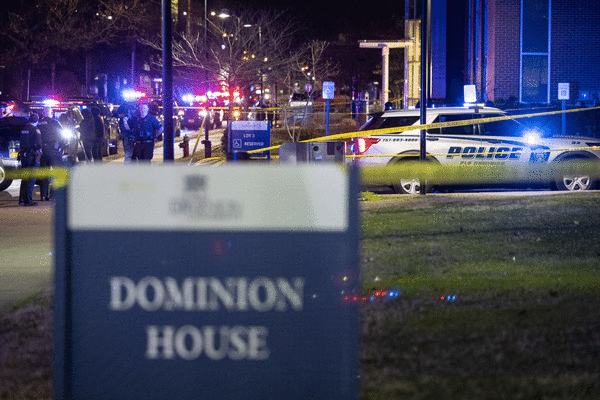
After serving about eight years in federal prison, Jalloh reenrolled last summer at Old Dominion University, the Norfolk school he previously attended for several years.
On March 11, he bought a .22-caliber Glock handgun from a Smithfield man. The next day, the 36-year-old Jalloh drove to the ODU campus, parked his car near the school’s Islamic Center, and walked with his new gun to Constant Hall.
Jalloh twice asked for confirmation that the class was an ROTC session.
When he was told yes, witnesses said, he yelled “Allahu akbar,” the Arabic phrase that means “God is great.” He then fired multiple rounds at Army Lt. Col. Brandon Shah, the head of the school’s ROTC program who was leading the class.
Jalloh shot and wounded two other students. Several students subdued the gunman, with one of them drawing pocket knife and stabbing him to death.
The following narrative has been drawn largely from hundreds of pages of court documents filed in a 2016 case against Jalloh in U.S. District Court in Alexandria.
Jalloh was born in September 1989 in Sierra Leone, during a time of severe civil strife in the West African nation.
He was the youngest of his father’s eight children, and his young mother’s sole child. When Jalloh was 2, his mother moved to the United States, leaving the boy to be raised in Sierra Leone by relatives.
During the civil war, food was hard to come by. And Jalloh often saw dead bodies, including that of his own grandmother.
He witnessed a 12-year-old deaf boy being shot to death at point-blank range when he didn’t understand a soldier’s questions. Jalloh was also sexually assaulted by a cousin around that time.
Jalloh and other relatives were later declared refugees, and he moved to the United States when he was 8 years old.
Jalloh was sent to live with an older sister in a run-down section of Cleveland. His lawyer would later contend that all of the uprooting and abandonment throughout his life made the boy easily influenced.
It isn’t clear where Jalloh attended high school. But he enrolled in Old Dominion University in the fall of 2007, just before his 18th birthday.
Although he never earned a degree, he would take classes intermittently there until 2013.
In April 2009, when Jalloh was 19 and still at ODU, he joined the Virginia Army National Guard. His family believed he was attempting to show commitment to something.
He left for Africa only two months after quitting the National Guard in April 2015.
It was soon after Jalloh arrived in Sierra Leone that he made contact with a man whom court documents describe as a charismatic “online ISIL supporter” who offered assistance for those wanting to join the terrorist group.
That man, in turn, put Jalloh with another man — known in court documents only as “a known ISIL facilitator” — who pushed Jalloh to join the organization. ISIL, or the Islamic State of Iraq and the Levant, is a designated terrorist organization.
The facilitator and Jalloh met in Nigeria in August 2015. Although Jalloh initially agreed to join ISIL in Libya, he quickly backed out to “visit a family friend.”
A month later, in September 2015, Jalloh again agreed to join the organization, even boarding a truck that was to take new recruits through the Sahara Desert to Libya.
But Jalloh lost his courage along the way, leaving the truck and fleeing back to Sierra Leone. He explained that he “was not ready to fight for ISIL,” even as he gave the facilitator $100 for transit costs.
A month later, Jalloh sent the facilitator another $340 to defray travel costs for other recruits.
Then, in December 2015, Jalloh made contact online with Abu Saad Sudani, an African man who was “engaged in plotting an attack on the United States.”
And when Jalloh returned to the U.S. in January 2016, he and Sudani kept in touch. In fact, Jalloh sent Sudani two payments totaling $700 early that year.
Once he was back in Northern Virginia, Jalloh’s girlfriend of six years broke up with him — sending him risqué photos and videos with her new boyfriend to prove to Jalloh that her relationship with him was over.
Jalloh grew despondent and depressed, turning to alcohol and drugs — and deciding he needed a Muslim wife.
Around that time, in March 2016, Sudani — still living in Africa — brokered an online meeting between Jalloh and a man who — unbeknownst to either Jalloh or Sudani — was working for the FBI.
“At this time, Sudani was actively planning an attack in the United States,” the court documents said. In fact, Sudani hoped the attack would be carried out with the help of Jalloh and the undercover informant.
Jalloh’s attorney, Joseph Flood, would later contend that the FBI informant “groomed” Jalloh and “channeled” him toward terrorism, — appearing to be “pious” and making empty promises about finding him a Muslim wife.
Jalloh and the FBI informant met in person in a Loudoun County hotel room in April 2016. During that meeting — secretly recorded by the FBI — Jalloh told the informant how he had quit the National Guard the year before after listening to Aulaqi’s speeches.
Jalloh also told the FBI informant that the gunman who killed five U.S. service members in July 2015 in Chattanooga, Tennessee, was “a very good man.”
Moreover, Jalloh also told the informant that he was “thinking of conducting a Nidal Hassan-style attack.” That was in reference to a former U.S. Army major who killed 13 people and wounded 32 in Fort Hood, Texas in 2009.
But Jalloh confided that he was having doubts about following through. In April 2016, Jalloh told the informant that he and Sudani had discussed a terrorist attack, but that he didn’t want to “give his word and not fulfill it.”
Yet Jalloh seemed to regain his courage a month later, telling the informant: “I just want to live a good Muslim life and die as a (martyr).”
When they met in person a second time in May 2016, Jalloh said he was “working on himself” so “his heart would be strong” when he was needed. He said he purchased a Glock 9 mm handgun three months earlier.
Jalloh told the FBI informant that conducting a terrorist attack was “a test,” and that attaining “Jannah” — the reward for dying as a martyr — “is not easy.” He said an attack is “100 percent the right thing,” and that he prays to Allah to help him die for the cause.
“Sometimes you just have to take action,” and “you can’t be thinking too much,” Jalloh told the informant in a recorded phone call.
But once again, Jalloh stopped short of offering to take part in an attack, instead offering the possibility of providing cash and guns.
In June of 2016, Jalloh went to North Carolina with an acquaintance and spent several hours trying to buy an untraceable AK-47 for the effort. But a planned gun purchase was unsuccessful.
Around that time, Jalloh sent $500 to an account he thought was affiliated with ISIL — but was actually an undercover FBI account. That brought the total amount Jalloh contributed — or thought he had contributed — to more than $1,600.
Finally, in late June 2016, Jalloh conducted several online searches about the weapon used to shoot up a nightclub that month in Orlando, Florida. On July 2, 2016, Jalloh walked into a gun store in Northern Virginia and bought an AR-15-style semi-automatic rifle.
But the FBI was ready: The weapon was “rendered inoperable” even before Jalloh left the store. He was arrested the next day on a charge of “attempting to provide material support to a foreign terrorist organization.”
Jalloh pleaded guilty to the crime later that year.
At the sentencing hearing in February 2017, Jalloh’s lawyer contended that a lot of what his client had said over the preceding months was “bravado,” as well as “half-baked and half-hearted.”
“It wasn’t real,” Flood said. “It was very hollow, and it was artificial.”
Flood also questioned the FBI informant’s sting tactics. For example, the undercover source told Jalloh he’d help him find a Muslim wife, but would always “demand some sort of cooperation in return.”
The informant “is promising in his effort to find a wife, but then he is always back dooring this thing or this operation,” Flood said at the hearing.
Assistant U.S. Attorney John Gibbs acknowledged that the FBI informant was pushy. “I would have preferred the (informant) not to push quite as hard,” Gibbs said.
But, Gibbs added, “it’s a great mischaracterization” to say that Jalloh’s involvement with the terrorist group was driven by the informant — saying Jalloh knew exactly what he was doing.
Jalloh fell on his sword at the hearing. In a 2017 letter to the judge, Jalloh said he felt “deep regret in having been driven by my emotions rather than my intellect and becoming involved with such an evil organization.”
“I feel like a complete idiot for accepting such a superficial and dishonest interpretation of Islam, and for blindly accepting what I was being told,” he wrote. “I will make it my life’s mission to tell the truth about ISIL and all Islamic terrorists, and to prevent other troubled young men from falling prey to their propaganda like I did.”
Jalloh told the judge he loves and is grateful to the United States, saying his life’s proudest moments were serving as a combat engineer in the National Guard.
“I am deeply, deeply, deeply ashamed, and I am sorry to the men and women of this country that serve and protect us,” he said. “At the time of this offense, your honor, I was going through deep emotional pain, and it left me lost and purposeless.”
When the judge asked him why he bought the gun, Jalloh said he was working as a security guard at the time. He bought the rifle, he said, out of “camaraderie” with the ex-Marines he worked with who often touted their guns.
“I had no plans with that weapon,” he said.
But prosecutors didn’t buy that.
“The defendant’s conduct is particularly reprehensible because he attempted to target people for their service to our country,” Gibbs wrote. As a National Guardsman, Jalloh “knew better than most the sacrifices that our men and women in the military make.”
“The defendant was fully aware of what he was doing,” Gibbs added. “His only misgivings seemed to be a fear that he would waver at the critical moment.”
By casting the murder of U.S. military members as his path to paradise, “the defendant showed how strongly committed he was” to killing the service members.
Prosecutors asked for 20 years to serve, in line with federal sentencing guidelines in the case. Jalloh’s attorney asked for 6.5 years.
U.S. District Judge Liam O’Grady split the difference, sentencing Jalloh in February 2017 to 11 years.
“You have no criminal history, and you have been a law-abiding citizen and a member of the National Guard,” the judge told him. “So I think that the ultimate sentence that I hand down should reflect the good things you have done as well as the horrendous things.”
After accounting for time served pending trial, good behavior credits and a credit for a prison drug program, Jalloh was out of federal custody 7 years and 10 months later — in December of 2024.
About seven months after that, in the summer of 2025, Jalloh re-enrolled at Old Dominion.
He was taking online classes for the spring semester, studying geography, before opening fire in the ROTC classroom at 10:43 a.m. on March 12.
©2026 The Virginian-Pilot. Visit at pilotonline.com. Distributed by Tribune Content Agency, LLC.





Comments