Hungarians sweep away Orban after 16 years in seismic vote
Published in News & Features
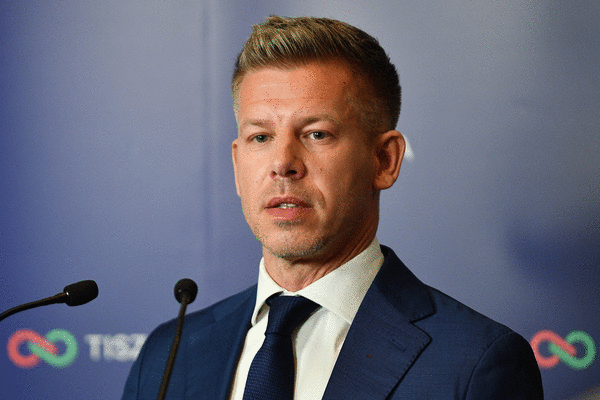
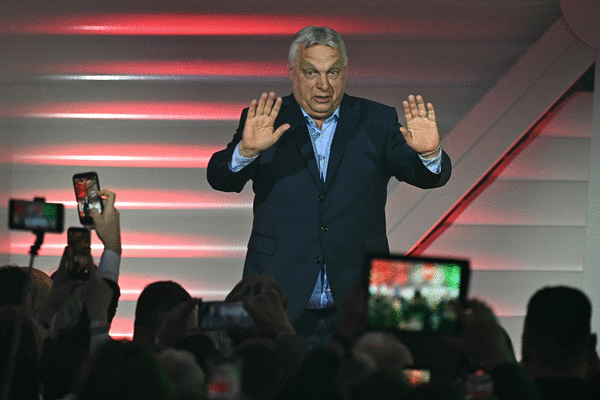


An upstart opposition party in Hungary ousted Prime Minister Viktor Orban after 16 years in a historic election that will redefine the country’s relationship with the European Union, Russia and the U.S. administration of President Donald Trump.
Peter Magyar’s Tisza party was headed for a supermajority in parliament that will allow it to deliver on bold promises to dismantle Orban’s self-styled illiberal system. Tisza had 69% of the parliamentary mandates compared with 28% for Orban’s Fidesz, according to the Election Office in Budapest on Sunday, with 82% of the votes counted.
Orban conceded the election, telling supporters that the result was “painful” for him. He said he had congratulated Magyar on his victory. The forint extended a months-long rally against the euro to rise to the strongest level in three years.
Magyar, a 45-year-old former ruling party insider, galvanized the country over the past two years with his message of change in the face of an increasingly authoritarian regime. As results trickled in, drivers honked their horns in celebration along the Danube river in Budapest as revelers took to the streets.
The result is a blow to Trump and Russian President Vladimir Putin, who sought to keep the European Union’s longest serving prime minister in power. Trump repeatedly endorsed Orban and sent Vice President JD Vance to Budapest to campaign for him just days before the vote.
The outcome also marks a defeat for the nationalist camp in Europe for whom Orban had been a trailblazer and the driving force behind its Patriots party, now the third-largest inside the European Parliament.
But it came as a big relief for the EU, which had struggled to overcome Orban’s obstructionism over the years. Putin had relied on the Hungarian leader to sow division in the EU, block aid to Ukraine and dilute sanctions against Moscow.
His ouster is now likely to pave the way for the release of €90 billion ($106 billion) in assistance that Kyiv badly needs to stay in the fight after more than four years of Russia’s full-scale invasion.
“Hungary has chosen Europe,” European Commission President Ursula von der Leyen said on X. “Europe has always chosen Hungary. Together, we are stronger.”
But it’s in Hungary — once a poster child for the transition from communism to market democracy, where Orban is a larger than life political figure — where the impact of Sunday’s elections will be most keenly felt.
Magyar tapped into growing anger over cronyism, stagnant economy and rapidly deteriorating public services to challenge and eventually break the EU’s longest-serving head of government’s stranglehold on power.
Orban has gone from a liberal, anti-communist student leader in the 1980s to become center-right, conservative prime minister for the first time in 1998 at the age of 34. After losing power in 2002, he returned to office in 2010 as a pro-Kremlin nationalist on a mission to eradicate liberal democracy.
Magyar had campaigned on a pledge to not only oust the MAGA movement’s populist icon but to bring down his system. Much of his momentum now rides on fulfilling that promise — and doing it just got more manageable with Tisza appearing to have surpassed the 133-seat threshold to give it a two-thirds parliamentary majority.
But he’s also going to inherit some of the economic challenges that contributed to Orban’s undoing and were only made worse by the the prime minister’s pre-election spending spree, which included lifetime income tax exemptions for mothers and increases in pensions and wages.
The government ran up a cash-flow based deficit of 3.4 trillion forint ($10.6 billion) in the first quarter, a year-to-date record. Magyar will have to take urgent steps to trim the budget to avert Hungary’s sovereign credit rating being cut to junk.
Magyar has said he’ll ask the Orban-allied president, Tamas Sulyok, to shorten the 30-day period until the formation of the new parliament for a swift transition of power. He’s cited concern that the Orban-dominated lame duck legislature could pass laws to hamper his administration.
The opposition leader has vowed to oust Orban’s key loyalists such as the president, top justices, the chief prosecutor and the heads of several state regulators. He also plans to eventually pass a new constitution, change election rules that were widely seen as favoring Fidesz and take public media’s news coverage, which Orban had reduced to a government mouthpiece, off the air until balanced political coverage is restored.
Those changes are needed to return Hungary to the European mainstream and to liberate its political and economic sphere from Fidesz’s influence, Magyar said on Sunday after he cast his vote.
A two-thirds majority will also help a Magyar administration pass key legislation to unlock some of the more than $20 billion in EU funds that had been withheld from the Orban government on rule-of-law and corruption concerns — and which a cash-strapped budget badly needs. They include approving anti-graft laws, cooperation with the EU chief prosecutor’s office and restoring media and academic freedoms.
Magyar has vowed to introduce a two term limit for prime ministers to prevent Hungary from reverting to authoritarian rule. He’s said that would disqualify Orban, who has served four consecutive and five overall terms, from running in the future for the top government job.
The prospect of easing tensions with the EU — and the potential for a Magyar administration to eventually embrace the adoption of the euro, something Orban has adamantly opposed — has fueled a currency and bond rally in Hungary months ahead of vote. The forint strengthened near a three-year high in the days ahead of the election.
Orban himself had relied on a so-called supermajority since 2010 to pass a new constitution and election rules without opposition support and extend his influence over all walks of life, form court benches to boardrooms to classrooms.
In the process, the prime minister had castigated minorities, notably the LGBTQ+ community and immigrants, targeted journalists and independent civil society in what were widely seen as tactics out of the Kremlin’s playbook.
Magyar, who describes himself as a center-right conservative, united liberals and disaffected Fidesz voters like himself under the Tisza umbrella.
He also did what other former opposition parties had failed to do: win over the countryside through relentless campaigning that took him to the smallest of villages, once Fidesz’s stronghold where Tisza made big gains on Sunday.
Magyar had focused on addressing the economic concerns of Hungarians, including a cost-of-living, education and health-care crisis.
He’s also vowed to hold senior officials accountable for what’s been seen as the capture of state assets and which led to the creation of a new class of politically connect super-rich, including Orban’s family and friends. Hungary has plunged to last place in the EU in graft watchdog Transparency International’s corruption rankings.
For the EU, the looming change in Hungary couldn’t come sooner. Orban had cast Magyar as the bloc’s puppet and had opposed aid for Ukraine, which he vetoed last month. He’s also called Ukraine the enemy, mirroring the strategy of Russia, which had invaded Hungary’s neighbor in 2022.
“Let’s join forces for a strong, secure and, above all, united Europe,” German Chancellor Friedrich Merz said on X.
Magyar has pledged to improve relations with the EU and key members such as Germany and Poland, while loosening ties with Russia, including by reviewing the Orban government’s controversial expansion of the Paks nuclear plant in a project led by Russia’s Rosatom Corp.
At the same time, Magyar has given a drawn-out timeline, extending into the next decade, for weaning the country off Russian oil and gas, despite an EU plan to cut energy dependence on Moscow soon.
©2026 Bloomberg L.P. Visit bloomberg.com. Distributed by Tribune Content Agency, LLC.




Comments