Iran war powers resolution blocked for fourth time in Senate
Published in News & Features
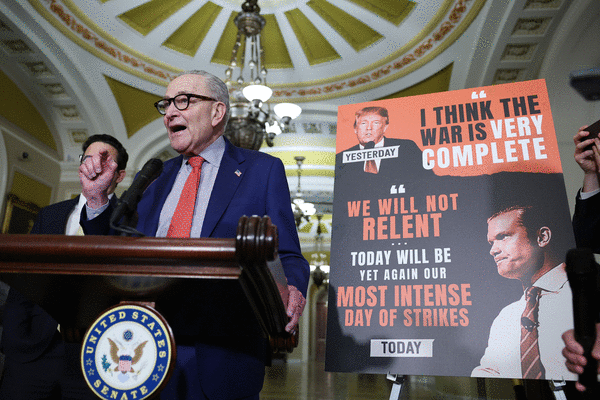
WASHINGTON — Senate Republicans again fended off a Democratic attempt to force President Donald Trump to end the war in Iran, but there are signs GOP anxiety could bubble up as the conflict nears the 60-day mark.
The Senate on Wednesday voted 47-52 against a motion to discharge from the Foreign Relations Committee a joint resolution from Sen. Tammy Duckworth, D-Ill., that would direct the president to “remove the United States Armed Forces from hostilities within or against Iran, unless explicitly authorized by a declaration of war or a specific authorization for use of military force.” The vote effectively killed that measure.
It was the fourth such vote in what Democrats are now promising will be weekly attempts to force senators to go on record about the war until the conflict ends.
“Throughout all this miasma, all this mess, this horrible war, where are the Senate Republicans? Months into this war, and still no hearings, no testimony, no clarity on how it will end,” Senate Minority Leader Charles E. Schumer, D-N.Y., said on the Senate floor Wednesday. “It’s been 47 days already, where are you? And if Republicans vote no yet again, we will continue to force votes on these resolutions every week until either this war ends or Republicans get the courage to stand up to Donald Trump.”
Three more Iran war powers resolutions filed by Democrats last month are ripe for a procedural vote at any point. Earlier this week, Democrats filed seven more joint resolutions that will be ready for votes in the coming weeks.
So far, all four Senate votes on Iran war powers measures, including Wednesday’s, have gone the same way: GOP Sen. Rand Paul of Kentucky has broken party ranks to support the measures, while Democratic Sen. John Fetterman of Pennsylvania has broken with his party to oppose them.
Most Republicans have been steadfast in their support for the war and Trump’s approach.
“Not only does he have the right to do this, he has the duty to do this,” Senate Foreign Relations Chairman Jim Risch, R-Idaho, said Wednesday on the floor, referring to the president. “He took an oath to defend the people of the United States of America.”
But some Republican senators who have been sympathetic to non-Iran war powers efforts in the past have started to signal they view 60 days, which comes April 29, as the deadline to end the war or seek congressional approval.
Under the 1973 War Powers Resolution law, the president must withdraw forces from military conflicts in 60 days if there is no congressional authorization for the war. That can be extended to 90 days if more time is needed to safely complete a withdrawal.
“There’s the 60-day shot clock, so to speak, that we’re currently in the midst of, and I think that we can revisit this once we get to that point and see where we are,” Sen. Josh Hawley, R-Mo., who backed a Venezuela war powers resolution earlier this year before flipping against it, told reporters Tuesday. “Two weeks is a long time in the context of this conflict, and I would hope in two weeks this would be over.”
Right now, the United States and Iran are in a fragile ceasefire that is set to expire April 22. But even amid the ceasefire, the U.S. Navy is blockading Iranian ports. Pakistan, which has served as the mediator in the conflict, is working to arrange a second round of talks after talks in Islamabad over the weekend failed to produce an agreement to end the war, according to The Associated Press.
With Republicans placing weight on the 60-day deadline, Sen. Tim Kaine, D-Va., one of the leaders of the Democratic effort to force repeated votes, expressed some optimism that Democrats could peel off GOP votes as the war continues.
“We’ll have (a vote) all the weeks of this work period, including right up against the 60-day period,” Kaine said Tuesday. Lawmakers are hearing a lot from their constituents about the war, he said, which may help sway some votes in favor of ending the conflict “if the pace of this war continues, and there isn’t this comprehensive deal to end it, and people are continuing to suffer the escalated gas prices and inflation.”
House efforts
Meanwhile, the House is expected to vote on its own version of an Iran war powers resolution later this week. Lawmakers agreed by unanimous consent Wednesday morning to tee up the resolution for a vote in the coming days.
Three of the four House Democrats who voted against an Iran war powers measure last month have said they plan to support it this time: Reps. Greg Landsman of Ohio, Juan C. Vargas of California and Henry Cuellar of Texas. Still, it’s unclear if any more than the two Republicans — Reps. Thomas Massie of Kentucky and Warren Davidson of Ohio — who supported it last time will do so this time, likely meaning it still lacks the votes to be adopted.
Even if the Congress adopted the House measure, as a concurrent resolution, it would likely be nonbinding under a 1983 Supreme Court ruling that declared legislative vetoes unconstitutional.
_____
©2026 CQ-Roll Call, Inc., All Rights Reserved. Visit cqrollcall.com. Distributed by Tribune Content Agency, LLC.






Comments