Critics question feds' plans for future of Colorado River: In years of severe drought, 'the system is failing'
Published in News & Features
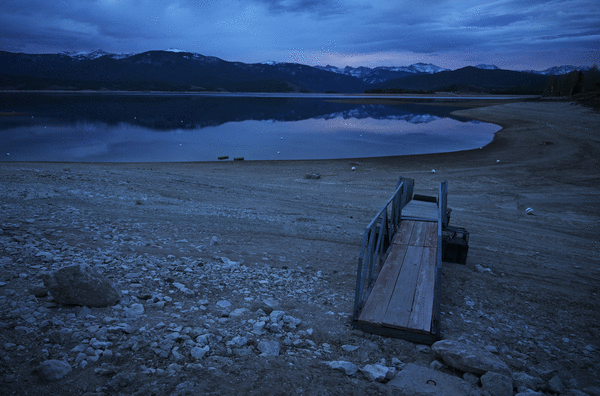
The multitude of water managers tasked with overseeing the drying Colorado River system stand at a dire crossroads.
As a yearslong stalemate in negotiations persists between the seven states that share the river, it’s become increasingly likely that the federal government will impose its own long-term plan, choosing from a range of proposals officials have outlined in recent months.
But experts and water managers across the 250,000-square-mile Colorado River basin are raising the alarm about the five plans, questioning if any of them hold up under the new climate reality. They say the federal plans won’t keep the system from crashing in critically dry years — which are becoming more frequent — and could wreak chaos on the pivotal lifeline for 40 million people in the American Southwest.
“In every one of those alternatives, under what they call critically dry hydrology, the system is failing,” said Andy Mueller, the general manager of the Colorado River District, a taxpayer-funded agency based in Glenwood Springs that works to protect Western Slope water. “And critically dry hydrology is what we have continued to see consistently in the basin in the last 25 years and what we should expect going forward.”
Climate change and persistent drought have already sapped hundreds of billions of gallons of water from the river’s annual flow. Officials from the U.S. Bureau of Reclamation took emergency action Friday to add more water to Lake Powell — one of the system’s two major reservoirs downstream of the river’s headwaters in the Colorado mountains — after updated projections showed that spring flows into the already-low reservoir could be less than a third of average.
Federal water managers over the next year will release hundreds of millions of gallons of water from Flaming Gorge Reservoir in Wyoming and Utah to keep Lake Powell above “minimum power pool” — the reservoir elevation needed to send water through hydropower turbines. Without access to the turbines, water released from the dam must flow through much smaller bypass tubes that are unsafe to use for extended periods, choking flow from one of the West’s largest water banks.
Emergency decisions like those taken Friday illustrate some of the risks of failing to prepare for intense drought, experts say.
In extremely dry years, the longer-term plans under consideration by Reclamation would allow the water levels of the system’s two main reservoirs to repeatedly fall below minimum power pool. Federal officials then would be forced to make recurring emergency cuts to the water supplies of the three states downstream of the reservoirs, creating uncertainty for millions of people and a massive agricultural industry.
For more than two years, negotiators from the seven states that rely on the river have tried and failed to agree on a new plan to operate the river that runs from Colorado’s high country to Mexico. The technical nitty-gritty of the disputes is wonky, but the key issue underlying the schism between the states is simple: Who should be forced to use less water — and how much less — as the Colorado River’s flows shrink?
Reclamation officials on Friday said they are preparing to implement their own plan this summer if the states can’t agree on answers to those questions. In January, federal officials released five potential operational guidelines — called “alternatives” in federal jargon — and asked for input.
They got an earful of feedback, including critiques from across the basin asserting that none of their plans would function well in dry years. That criticism also applied to the only plan the Bureau of Reclamation can implement without consensus from the basin states or without gaining new legal powers.
Letters from a number of Colorado entities — including the Northwest Colorado Council of Governments, irrigation districts, the Western Slope’s Club 20 and county commissions from a vast swath of the state — urged federal officials to present at least one plan that would hold up in extremely dry years.
“Sound science dictates that Colorado River management must evolve to handle a permanently drier future,” Tina Bergonzini, the general manager of the Grand Valley Water Users Association, wrote in her comments to the bureau. “The current federal preference for predictability is an atmospheric impossibility given that studies indicate rising temperatures have already slashed river flows by a fifth.”
Bureau of Reclamation officials declined an interview request for this story. But they have publicly acknowledged the risk.
“In critically dry periods, all of the alternatives have unacceptable performance,” bureau engineer Rebecca Smith said during a Jan. 29 webinar about the plans. Even imposing large cuts to water usage in those years would not keep the major reservoirs at functional levels, she said.
The conflict on the Colorado is likely one of the world’s first major water policy overhauls to grapple with the reality of climate change, said Brad Udall, a senior water and climate research scholar at Colorado State University’s Colorado Water Center.
In the past, Colorado River managers made operational tweaks and short-term deals to address drought. This time, it’s different.
“We’re not looking at an incremental step here,” Udall said. “We’re looking at a complete redo of how we operate this resource that affects 40 million people.”
‘Downright scary what’s going on’
The West first wrestled with divvying up the powerful Colorado River in 1922, when delegates from each of the seven states met in Santa Fe and signed the Colorado River Compact.
At its most basic, the compact divides up the 18 million acre-feet of water then estimated to be in the river — including 7.5 million acre-feet reserved for the Upper Basin states of Colorado, Utah, Wyoming and New Mexico, and 7.5 million acre-feet for the Lower Basin states of California, Arizona and Nevada. An acre-foot of water is the volume of water it takes to cover an acre of land in a foot of water — about 326,000 gallons — and is generally considered the annual water consumption of two families.
The 18 million acre-feet was likely an overestimation of how much water there was even a century ago, but today’s river provides even less than the total amounts promised to states in 1922.
“Since 2000, the flows have been radically different,” Udall said.
The 20-year average annual flow measured in 1925 was 17.6 million acre-feet, Bureau of Reclamation data show. In 2025, it was 12.7 million acre-feet.
But even that number hides the reality of recent dry years. The five-year average amounts to only 10.9 million acre-feet. Last year’s flow measured at 8.5 million acre-feet.
This year will be even lower due to record-low snowpack across much of the basin.
The conditions this year are not a one-off, Udall said, but symptoms of a larger warming trend fueled by human-caused global climate change. Hotter temperatures not only increase water loss through evaporation but also make plants and soils thirstier, reducing the amount of water that flows downstream. Evidence is also piling up indicating that climate change is reducing precipitation across the Colorado River’s headwaters, Udall said.
“I think this is quite nerve-racking — and perhaps just downright scary — what’s going on,” he said.
The Bureau of Reclamation acknowledges the likelihood of a hotter, drier future in its draft environmental impact statement, though it shies away from using the term climate change.
“The basin is experiencing increased aridity due to climate variability, and long-term drought and low-runoff conditions are expected in the future,” the document’s executive summary states.
Expect more critically dry years
Future hydrology is the biggest and most impactful uncertainty federal officials must reckon with while crafting plans for the river, Smith said in the January webinar.
The bureau modeled hundreds of potential future conditions and then compared how each of its five proposed plans would perform under different levels of river flow over the next 20 years, broken into three categories:
•Average (12-14 million acre-feet average over 20 years)
•Dry (10-12 million acre-feet average over 20 years)
•Critically dry (less than 10 million acre-feet average over 20 years)
If average flows over the next two decades fall in the “average” category, the plans generally would be able to keep Lakes Powell and Mead — the two big downstream reservoirs — above critical levels and eliminate the need for emergency reductions in water supplies to keep them functional.
But that’s not how recent years have gone.
Since 2020, Colorado River flows have fallen into Reclamation’s “critically dry” category in four of six water years. The repeated dry years, coupled with downstream consumption that has not changed to match the reduction in inflow, have drained Powell and Mead, which are now less than a third full.
“Critically dry hydrology is what we have continued to see consistently in the basin and what we should expect going forward,” said Mueller, from the Colorado River District.
Between 2021 and 2025, the river’s flows averaged 11.2 million acre-feet — low enough to fall into Reclamation’s dry hydrology category. That average was boosted by the unusually wet 2023 year when the river delivered 17.4 million acre-feet of water, while most of the other years fell into the critically dry category.
As modeled by the bureau, if critically dry years continue, Powell and Mead will more often fall so low that their hydropower plants will become unusable, impacting power availability for more than 1 million people. Bureau officials would more often be forced to implement emergency water cuts to try to keep the reservoirs functional.
In its comments to the bureau, the Colorado River District urged officials to add an alternative plan that would function well in critically dry periods.
“The population of the state of Colorado and the entire Colorado River basin is best served by the Department of the Interior studying alternatives that actually bring the system into balance,” Mueller said, referring to the cabinet department above the bureau. “And recognizing that those management alternatives will have some extremely harsh realities — hydrologically and politically — up and down the basin. But that’s what we’re best served by.”
Bureau of Reclamation’s most likely plan
Without a deal between the seven states or obtaining more legal authority from Congress or the states, federal officials will be forced to implement a plan dubbed “Basic Coordination.”
The plan mandates the least cuts for the Lower Basin states and is generally less flexible than the other proposals.
In dry periods under that plan, Lakes Powell and Mead could fall below minimum power pool 30% to 40% of the time, according to Bureau of Reclamation projections. In critically dry periods, that figure rises to more than 70%.
The federal agency estimates that Lake Powell will be vulnerable to falling below that level in the first five years under the Basic Coordination plan if the average annual flows in that period amount to less than 11.3 million acre-feet. The five-year average has fallen below that level in three of the last five years.
If the federal government enacts the Basic Coordination plan, the bureau will keep scrambling to make emergency decisions to ensure Powell and Mead are operable. Such decisions could involve cuts to Lower Basin water supplies or the sending of water from federally-managed reservoirs upstream — like Flaming Gorge or Colorado’s Blue Mesa — to keep enough water in Powell.
Federal officials could also seek water from other water sources the government owns or operates in Colorado, Mueller said, such as from irrigation projects on the Western Slope or the Colorado-Big Thompson Project, which delivers Colorado River water across the Continental Divide to northeastern Colorado.
“Legal uncertainty and hydrologic uncertainty would erupt,” he said. “We, as good water managers throughout our state and the basin, should try to avoid that.”
Under the Basic Coordination plan, reactive chaos will erode what certainty remains on the changing river, said John Berggren, the regional policy manager for Western Resource Advocates, a climate advocacy organization.
“We will be right back where we are with emergency operations,” he said, like pulling water from upstream reservoirs to prop up Powell. “But you can’t do that every single year because there isn’t enough water in the Upper Basin reservoirs.”
Bureau of Reclamation officials plan to finalize new long-term guidelines by Aug. 15, in time for the Oct. 1 start to the new water year, which generally tracks with the start of snowfall.
“You don’t want to limp through with Basic Coordination, you’d want to put everything on the table you can,” Berggren said.
“We’re facing a crisis,” he continued. “We have tools available, we know what they are — we just need to implement them.”
________
©2026 MediaNews Group, Inc. Visit at denverpost.com. Distributed by Tribune Content Agency, LLC.






Comments