Trump keeps building his ballroom amid Supreme Court's silence
Published in News & Features
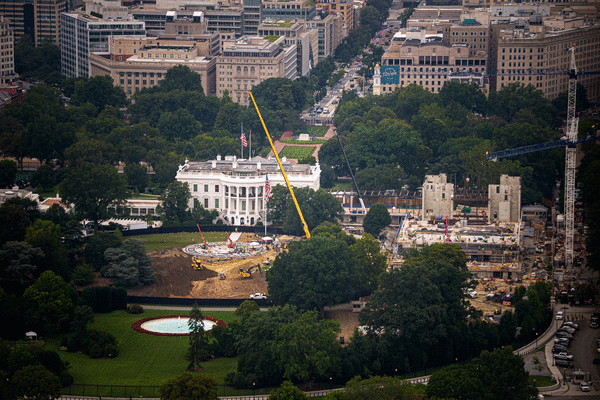
Construction on President Donald Trump’s White House ballroom shows no signs of slowing down. And the U.S. Supreme Court shows no signs of wanting to stop it.
More than a week has passed since Chief Justice John Roberts issued an interim order letting work continue while the court considers the case. Two lower courts said Trump flouted the law by starting the project without congressional authorization.
On its face, Roberts’ order was neutral. The one-page administrative stay gave no explanation and said nothing about the likelihood of Trump securing the necessary five votes for a longer-term order to let construction continue without restriction while the litigation proceeds.
But the practical consequences are clear. Work continues at a breakneck pace on the ballroom, a 90,000-square-foot behemoth with gold decor and a security bunker underneath. The administration told the justices its 250-person crew is working 20 hours a day, seven days a week.
A White House spokesperson said this week those numbers remain accurate.
The court’s willingness to allow the work suggests the justices have already voted to grant the White House a stay and are holding off an announcement while a dissent is being crafted, says Stephen Vladeck, a Georgetown Law Center professor who closely follows the court’s docket.
“It’s hard to imagine that the court is allowing construction to continue if it’s already voted to block it,” Vladeck said in an email. “So the fact that Chief Justice Roberts’ administrative stay is still in effect seems a pretty strong indication that the full court is going to agree.”
The group challenging the construction, the National Trust for Historic Preservation in the United States, told the justices Trump is trying to “outrun judicial review” and make the ballroom a “fait accompli.” The National Trust is a nonprofit organization chartered by Congress to preserve and promote the country’s architectural and cultural heritage.
The administration readily agrees it is moving as quickly as it can, telling the Supreme Court that “every day added to the project is another day impairing full security.” Trump has taken to calling the ballroom a military complex.
The administration turned to the Supreme Court after a federal appeals court ruled against Trump, upholding a district court ruling that would halt most above-ground construction. The appeals panel put its ruling on hold for two weeks to give the administration time to seek Supreme Court intervention. That hold was set to expire on Aug. 21 before Roberts issued his temporary stay.
The next move is likely to come from the full nine-member court, which has six conservative Republican appointees. The court generally has come to Trump’s aid on emergency matters in his second term, letting him implement his policies while legal fights go forward, even after lower courts have said the administration is acting illegally.
The case is National Park Service v. National Trust for Historic Preservation in the United States, 26a203.
_____
With assistance from Hadriana Lowenkron.
_____
©2026 Bloomberg News. Visit at bloomberg.com. Distributed by Tribune Content Agency, LLC.






Comments