Las Vegas jury reaches guilty verdict in Tupac Shakur murder trial
Published in News & Features
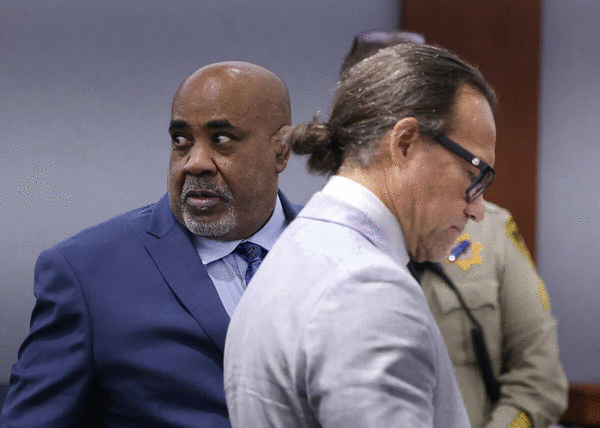
LAS VEGAS — Jurors have reached a guilty verdict Monday in the murder trial over the death of Tupac Shakur after attorneys made their final pitch in closing arguments, with prosecutors arguing the defendant’s prior accounts were corroborated and the defense attorney questioning his client’s veracity.
Duane Davis, 63, was found guilty of first-degree murder with a deadly weapon. He is the only person ever prosecuted in connection with the 1996 shooting near the Strip that fatally wounded the hip-hop icon and injured Death Row Records CEO Marion “Suge” Knight, whose head was grazed by a bullet.
With physical evidence against Davis scarce, the outcome will likely hinge on Davis’ prior statements to law enforcement, to the media and in a memoir he now disputes writing which described his involvement in the slaying, including providing a gun for the shooting.
“Do we honestly think the guy who’s dumb enough to write a book could keep this story straight this many times, this many times over?” asked Chief Deputy District Attorney Marc DiGiacomo. “How does he in 2008 tell the most compelling version of events that is corroborated by every single piece of paper or every single other piece of evidence in this case?”
Defense attorney Michael Sanft has argued the opposite.
“There’s not one thing that says that Mr. Davis was in Las Vegas on the night of the shooting of Tupac Shakur,” Sanft told jurors.
Authorities have alleged Davis was the “shot caller” who conceived the plan to exact revenge on Shakur and Knight in retaliation for an attack by Shakur and his entourage against Davis’ nephew, Orlando Anderson, earlier that night at the MGM Grand.
According to prosecutors, the Bloods-associated Mob Piru gang had ties to Death Row Records, and the South Side Crips — of which prosecutors say Davis was a leader — were associated with Bad Boy Records, a label owned by Sean “Diddy” Combs.
Chief Deputy District Attorney Binu Palal pointed jurors to instructions on a defendant’s statements, telling them that if they believed Davis, they did not need to corroborate his words against other evidence.
He said Davis changed his accounts over time based on self-interest, but was never unclear about what happened.
“Mr. Davis’ confessions are direct evidence of a crime,” he said.
But he also argued that corroborating evidence existed to establish that Davis was a gang leader, shot caller and drug dealer. He said an Excalibur receipt for Anderson established that Davis’ crew was in Las Vegas at the time of the killing.
Palal pointed to the trial testimony of James McDonald, a former Mob Piru who objected to some questions, saying they could harm Davis. McDonald also indicated that in gang warfare following the slaying, Davis and Anderson were targets.
The prosecutor said that testimony served as additional corroboration.
He also cited Davis’ statement in a 2008 confidential interview with law enforcement that a Sebring seemingly followed him after the shooting, saying that detail was not publicly known at the time.
“Why would he create the story that makes him legally liable for murder when he could just make himself a witness?” Palal asked.
Sanft encouraged jurors to look for corroboration and directed them to a jury instruction allowing them to disregard a witness’ testimony if they believe a witness has lied.
He said Davis’ statements over time conflicted with each other. He told jurors that despite his client previously saying he recognized Shakur because of screaming fans, witnesses testified no such thing happened.
He asserted that the men alleged to have been in the car from which shots were fired did not die at the hands of Piru Bloods because they weren’t really in the car. And he attacked law enforcement, saying they failed to verify information. He suggested the Sebring detail could have been leaked or discussed on the street.
Sanft also played an interview clip in which Davis asked where a detail came from and an interviewer then reminded him that it was in his memoir, which prosecutors have said he adopted.
“Does that sound like someone who wrote his own book?” he asked.
DiGiacomo said he agreed Davis’ book was mostly “garbage.”
He pointed the jury to additional evidence, including a scrapbook he said Davis kept about Shakur and Christopher Wallace, a rapper known as the Notorious B.I.G. who died in 1997.
“This guy’s scrapbooking his murder for God’s sake,” he said.
_____
©2026 Las Vegas Review-Journal. Visit reviewjournal.com.. Distributed by Tribune Content Agency, LLC.





Comments