Large, fast-burning wildfires are making it hard for Colorado forests to recover
Published in News & Features
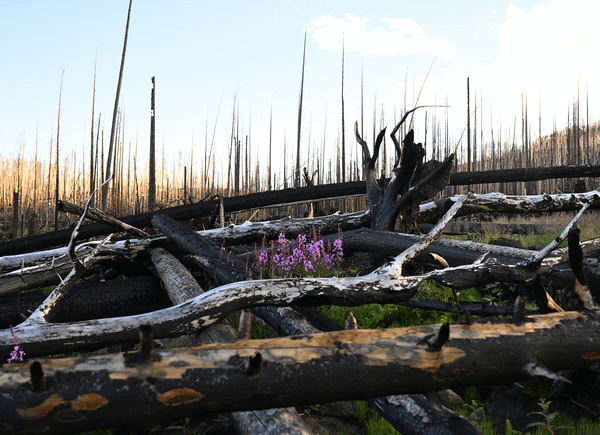
DENVER — Large, fast-moving wildfires are devastating Colorado’s forests and they may not be able to recover to become the dense, dark-green habitats that people are used to seeing in the mountains, according to a recently published study.
Scientists at Colorado State University and Western Colorado University collected data from 3,500 wildfires that burned in conifer forests in the American West between 2012 and 2023 and found that fast fires — fueled by a hotter, drier climate — may cause long-term ecological damage. The study was published last month in the journal Science Advances.
Camille Stevens-Rumann, a CSU associate professor and director of the Colorado Forest Restoration Institute, said Colorado still has a lot of green forest compared to the Sierra Nevada mountain range in California or the Cascade range in eastern Washington and Oregon.
But huge wildfires like 2020’s Cameron Peak and East Troublesome fires are scorching landscapes beyond recovery.
“What’s scary is how many more places could change in Colorado,” Stevens-Rumann said. “You won’t see them be that dense, dark forest again in your lifetime.”
When forest fires burn hot and fast, they can destroy tens of thousands of acres in a single day, leaving no vegetation behind.
Trees such as the ponderosa pine, the Englemann spruce and most firs only regrow when seeds from living trees spread to barren areas, Stevens-Russman said. Those living trees can only spread their seeds for about 100 yards.
“If you’re in the middle of a 10,000-acre path of every tree being dead, it’s really hard to get seeds there,” she said.
The scientists decided to study fast-moving fires’ impact in 2020, when Colorado saw its three largest wildfires in the state’s recorded history. The Cameron Peak fire destroyed 208,913 acres in northern Colorado; the East Troublesome fire burned 193,812 acres near Grand Lake; and the Pine Gulch fire on the Western Slope covered 139,007 acres, according to Colorado historical wildfire records.
The East Troublesome fire exploded in one day, burning more than 100,000 acres in 24 hours.
“We just saw such an increased amount of fast-moving fires that we hadn’t seen in Colorado,” Stevens-Rumann said. “Those are the fires that are killing a lot of trees.”
This summer, the Aspen Acres fire in early July doubled in size within 24 hours, burning 47,953 acres in a matter of days. It is now the seventh-largest wildfire in state history, destroying more than 102,004 acres. It is still burning in remote areas along the Pueblo-Custer county line.
People who lived in Beulah described having less than 30 minutes to leave as the fire came roaring through the valley, destroying homes and the mountain wilderness surrounding them.
Within weeks, bright green shoots of gamble oak were sprouting from the blackened earth. But those trees are not seen as crucial to restoring the forest to what it once was, Stevens-Russman said.
A gamble oak, which is also known as scrub oak, is good for elk and deer to forage, and it can provide habitat for small wildlife. But it will also smother other trees trying to sprout, she said.
“It’s not going to be that big forest again,” Stevens-Russman said. “It can shroud over those little trees that are trying to grow up.”
The fast-moving fires are caused by extremely dry terrain, a result of Colorado’s ongoing drought. The 2026 winter season brought little snow, leading half the state to be in extreme or exceptional drought, the two most severe categories used by the U.S. Drought Monitor.
The drought and dry terrain are increasing because of a warming planet, making conditions favorable for large-scale fire damage, according to Climate Central, an independent group of scientists who study and report on the impacts of climate change.
“For us as researchers, we’ve been watching wildfires change in the last 20 years. This paper has a lot of data backing up what firefighters have been witnessing and reporting,” Stevens-Rusmann said. “We are going into a world of more fires and more extreme fire conditions.”
_____
©2026 MediaNews Group, Inc. Visit at denverpost.com. Distributed by Tribune Content Agency, LLC.






Comments