Miami-Dade leaders debate runway changes after plane crash: 'Go the extra step'
Published in News & Features
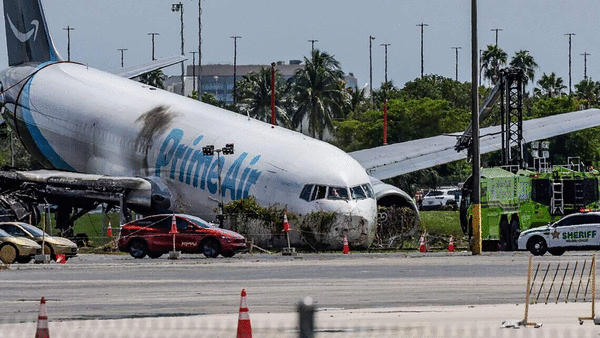
MIAMI — After a cargo plane overshot a runway and killed five people outside Miami International Airport, members of the county board overseeing that facility are considering whether to spend big on a potential safety upgrade.
Some airports employ collapsible surfaces to slow or stop a plane that overshoots a runway — though that’s considered a back-up option when there isn’t space for the kind of 1,000-foot buffer that MIA has at the end of the runway. The Amazon cargo plane that sped past the end of a MIA runway collided with two vehicles, killing five and injuring three others who remained hospitalized Tuesday.
Federal aviation regulations don’t require both the buffer and the collapsible surface — known as an Engineered Materials Arrestor System, or EMAS — and no U.S. airport has both, the National Transportation Safety Board said Monday in the wake of the Miami crash. Boston’s Logan airport is spending $110 million, mostly in federal dollars, to install EMAS at an airport that ends near Boston Harbor.
At a committee meeting of the Miami-Dade County Commission, which oversees MIA, members floated the idea of being the first U.S. airport to have both a buffer zone and EMAS at the end of a runway.
“I don’t mind having a redundancy,” Commissioner Oliver Gilbert said during the morning meeting of the Aviation and Seaport Committee. “I would be willing to go the extra step, because five people lost their lives.”
Though it is part of the county’s Aviation Department, MIA and the county’s other airports don’t spend tax dollars. MIA mostly runs on fees paid by airlines and the shops and restaurants that operate inside the airport — with expenses also subsidized by federal aviation grants.
Ralph Cutié, the county’s Aviation director, told commissioners the administration under Mayor Daniella Levine Cava would be open to adding EMAS to MIA’s four runways if federal aviation regulators — led by the National Transportation Safety Board, which is investigating the Miami crash — recommended that kind of new approach.
Cutié emphasized that currently, the Federal Aviation Administration only recommends EMAS when the standard 1,000-foot safety buffer isn’t physically possible, and he said the FAA won’t provide grants for EMAS if the buffer can be employed instead.
“Now, if the NTSB comes back and says, ‘We think it’s a great idea to have that redundancy,’ we’d be happy to consider that,” he said. “Of course, anything that would make our airport safer, we’d always be into that.”
Commissioner Keon Hardemon cautioned against letting media coverage pressure Miami-Dade into seeing EMAS as something MIA needs to have. “It’s clear you have a media trying to place blame on something that was not the cause,” he said. “Pilots are professionals for a reason. They exercise their duty of care within a certain degree of certainty every time they take off and land.”
©2026 Miami Herald. Visit at miamiherald.com. Distributed by Tribune Content Agency, LLC.






Comments