Boston announces 1,600 'learn-and-earn' school year jobs for high schoolers
Published in News & Features
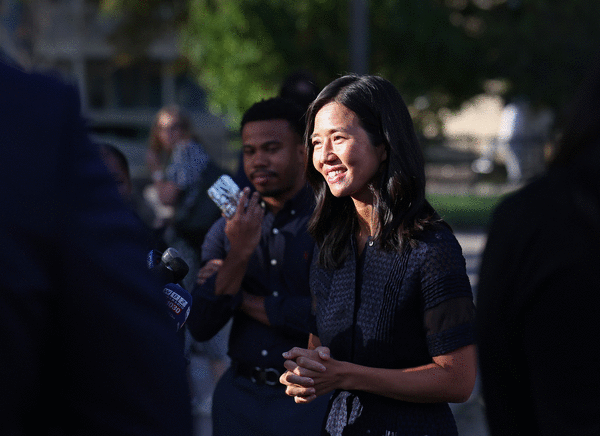
Boston high school students can apply for over 1,600 school year jobs through the city’s new public-private partnership program – as the city continues seeks additional partnerships to reach their goal of 2,000 “learn-and-earn” jobs available for teens.
“Today, I’m proud that we are now at more than 1,600 jobs for the upcoming school year, almost where we were last year, more than 80% of our goal,” Mayor Michelle Wu announced Monday morning. “And we are not going to stop until we meet and surpass that goal. But today, we are launching 1,607 jobs across the employers who are in our coalition for every working student to have access to an ecosystem of professional mentorship, leadership training, and wraparound job supports.”
In June, city officials announced an expansion and redesign of their sponsored school-year job opportunities for students ages 14 to 18, branching out to invite private sector and other partners to invest as budget constraints hit the city.
Building on the SuccessLink program, which connected over 1,700 students with school year jobs in the 2025-26 year, the city intended to provide 2,000 job opportunities in the coming year through the new partnership to reach roughly 10% of all BPS high schoolers.
On Sept. 30, students will be able to find and apply for the learn-and-earn jobs at boston.gov/futurebos, Wu announced at New Mission High School in Hyde Park Monday.
Current employer partners include the YMCA of Greater Boston, Boys and Girls Clubs of Boston, Artists for Humanity, Boston Private Industry Council, the Greater Boston Chamber of Commerce Foundation, the Federal Reserve Bank of Boston, Suffolk Construction, State Street, Eastern Bank, Citizens Bank, Bank of America, John Hancock, Dana Farber, P&G Gillette, Mass General Brigham, Liberty Mutual, Roxbury Community College, Emmanuel College, Boston Children’s Hospital, and Beth Israel Leahy Health, Wu listed.
The program currently includes 400 publicly-funded Boston City Youth Corps jobs, 340 privately-funded positions with partner organizations and 663 direct employer hires.
“If you are an employer who is still yet to join us and eager to get started, we still need your help,” Wu urged. “We need you to help us close the gap to the rest of that goal and beyond.”
The city is also reviving the Redshirts youth program, building on the old program that paid students to clean and beautify their neighborhoods. The renewed program will employ 400 young people through the Boston City Youth Corps, said City Councilor Gabriela Coletta Zapata, who sponsored the return.
“What I love about this new iteration of the program, young people will still help beautify their community, but they will have the voice in identifying what their neighborhoods need, and importantly, their jobs will connect them to actual career pathways,” said Coletta Zapata, listing examples of positions in IT at Boston Public Library; urban forestry, climate resilience, or park stewardship through the Parks Department; healthcare experience at the BCYF lifeguard program; and facilities management, business, or property management at Boston Housing Authority.
The beautification component will be youth-led, Coletta Zapata said, aiming to instill students’ “ownership” of their neighborhoods.
“When a young person can walk past a park, a library, a community center, or a neighborhood space and say, ‘I helped make that better,’ we are cultivating the next generation of people who will care for and lead the city, and hopefully future city employees,” the councilor added.
Wu said the administration has taken a “big swing” on the summer job program, tripling funding for summer youth jobs and raising overall funding for youth jobs from $11 million in fiscal year 2022 to $25 million in fiscal year 2025. In the last summer, nearly 11,000 Boston students held program summer jobs, including 6,000 funded by the city.
While the city was able to help fund the school-year jobs with “expanded budgets and federal support,” the mayor said, “this year, national fiscal pressures required us to be really creative.” The new “stronger, more sustainable ecosystem” brings in private sector, nonprofit and institution employer to provide opportunities, she added.
“It is so important that they’re getting those experiences and those impressions, getting mentors, learning tangible skills, and getting paid at the same time,” BPS Superintendent Mary Skipper said. … “We are going to have 2,000 students get these school year jobs. That is something that doesn’t happen in other cities, but it’s happening here in Boston.”
________
©2026 MediaNews Group, Inc. Visit at bostonherald.com. Distributed by Tribune Content Agency, LLC.






Comments