Costa Rica affirms break of diplomatic relations with Cuba, denies US pressure
Published in News & Features
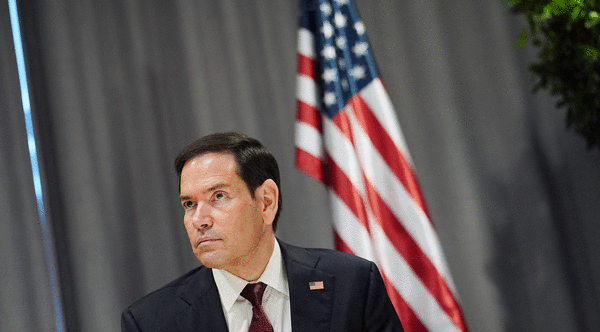
Diplomatic relations between Costa Rica and Cuba are formally severed and will remain so until the Cuban people “recover their freedom,” the Central American nation’s foreign minister, Manuel Tovar Rivera, said Thursday.
“There is a rupture of diplomatic relations,” the minister said in an interview with The Miami Herald, clarifying that it was not merely the withdrawal of diplomatic personnel and the closure of embassies, as previously understood.
The government of former Costa Rican President Rodrigo Chaves Robles announced in March the closure of the Costa Rican embassy in Havana and asked Cuba to withdraw its diplomats by the end of that month. Consular services for Costa Ricans were shifted to the embassy in Panama. Current President Laura Fernández has upheld the policy adopted by her predecessor.
Tovar framed the break within a historical line in Costa Rican foreign policy. He recalled that San José cut ties with Havana in 1961 and maintained that position until 2009, when relations were restored under the administration of Óscar Arias — something he called “a foreign policy mistake.”
Asked whether there had been a specific trigger, Tovar said the decision stemmed from a matter of principle: “Costa Rica will no longer lend itself to legitimizing a tyrannical, despotic regime that has robbed its people of the most fundamental freedom of a democracy.”
The two governments dispute how to characterize the measure. Cuba described it as a unilateral decision to downgrade relations, limiting them to consular matters. Cuba’s foreign ministry denounced what it called Costa Rica’s “servility” toward the Trump administration. The Costa Rican minister insists it was a full rupture.
Havana also attributed the decision to pressure from Washington, which Tovar flatly rejected.
“It was a sovereign decision taken by the government of the Republic of Costa Rica,” he said. “We received no advice, no guidance, no instructions, no suggestion from any government, not from the United States of America, nor from any other.” The position, he added, will hold “until Cuba recovers its freedom.”
On migration flows, the minister described Costa Rica as an open-door country that has taken in Nicaraguan, Colombian and Venezuelan immigrants over the decades. He estimated that between 600,000 and 650,000 Nicaraguans live in the country, though he cautioned that the figure is hard to corroborate given the amount of informal migration.
Tovar noted that this openness carries a cost, since the country provides universal free education and social security, which, by ruling of the country’s Supreme Court extends to irregular migrants as well. “Someone has to pay those costs, and it is Costa Ricans,” he said, while insisting that the country maintains its calling as a place of refuge.
The minister confirmed a “dramatic” reduction in the transit of South American migrants through Costa Rican territory, particularly Venezuelans who previously crossed the Darién Gap — a stretch of jungle between Colombia and Panama — on their way to the United States. Tovar attributed the decline to the deterrent effect of U.S. immigration policies.
Under the “safe third country” agreement under which Costa Rica receives people deported from the United States, Tovar said his country is receiving around 25 people per week, around 100 a month from various nationalities.
The deportation flights began in April, and by early June the country had received 149 people on seven flights, according to the Costa Rican newspaper La Nación.
Those from Latin American countries, the minister said, tend to return to their places of origin, though that is less true of people from Asia and Eastern Europe, whose cases present greater difficulties. Some, he said, have applied for asylum in Costa Rica.
According to Tovar, the arrangement, supported by the United Nations’ International Organization for Migration and the U.S. government, has worked “quite efficiently.”
Tovar called his meeting with Secretary of State Marco Rubio on Wednesday in Washington, D.C., “extraordinary.”
According to the minister, they discussed the fight against transnational crime in the hemisphere, which covers not only drug trafficking but also illegal mining, trafficking in people and weapons, and money laundering, as well as the environmental damage caused by the felling of forests and the extraction of resources that are exported to global markets with no benefit to the countries of origin.
He also said the return to a democratic path in Cuba and Nicaragua was part of the conversation, and anticipated that both issues will feature at a high-level meeting of the Shield of the Americas that, he said, will be held in New York next week on the sidelines of the United Nations General Assembly session. Shield of the Americas is security and political alliance formed by President Donald Trump on in 2026.
Costa Rica has been part of the Shield of the Americas since its launch. Trump signed the proclamation in March that set the initiative in motion and established the Anti-Cartel Coalition of the Americas, unveiled at a summit in Doral attended by then-President Chaves alongside the leaders of Argentina, Bolivia, Ecuador, El Salvador, Guyana, Honduras, Panama, Paraguay and the Dominican Republic.
Alongside the security agenda, Tovar raised an economic dimension: building regional value that would allow the United States to complement Latin American economies at a time of heavy dependence on Asian markets in sectors such as semiconductors.
Asked about the regional controversy over joint military operations with the United States to fight drug cartels — embraced by Ecuador and rejected by Mexico — the minister said Costa Rica already maintains a framework of cooperation with the DEA and the U.S. Coast Guard, including intelligence sharing and joint operations at sea. He stressed that, as a country without an army, Costa Rica needs outside assistance.
That cooperation extends to European partners and to ports through which part of the cocaine produced in South America passes. Domestically, he said, the country has installed scanners with U.S. assistance at ports, airports and land border crossings. “What we want is to make life harder for those who use Costa Rica as a transit destination” for drugs, he said.
His main complaint, however, pointed inward at the region: “It is useless for our ports in Central America or South America to share information with the main ports in the United States, in Europe, if the port of Guayaquil (in Ecuador) does not talk to the port of Colón” in Panama. Strengthening that coordination, he concluded, should be one of the items on the Shield of the Americas agenda.
©2026 Miami Herald. Visit miamiherald.com. Distributed by Tribune Content Agency, LLC.



Comments