Driver accused in fatal Metro bus crash in LA had multiple drug arrests but spent little time in jail, records show
Published in News & Features
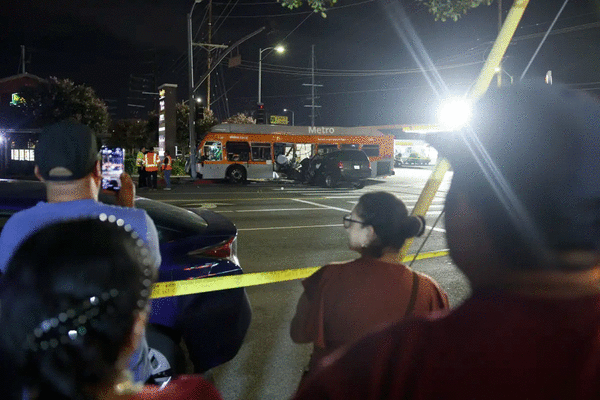
LOS ANGELES — It looked like another afternoon commute at the bustling intersection of De Soto Avenue and Nordhoff Street on Tuesday when Metro Bus Line 166 crossed into the intersection.
Cars in opposing traffic lanes were stopped. Suddenly, a 2004 Ford Expedition barreled into the intersection from the wrong direction at a high rate of speed, slamming into the middle of the bus. The impact was so powerful it hurled a passenger onto the street and lodged the front of the SUV into the bus’ frame. There were no signs the driver braked in the moments before the collision, video footage of the incident shows.
The crash began an evening of death in Chatsworth. Two passengers aboard the bus were killed and six others were hurt. It was a big story—one that drew TV news helicopters. About two hours after the crash, an NBC4 helicopter covering the incident suddenly fell from the sky and burst into flames a few blocks away. A journalist and pilot on board and a bystander on the ground were killed.
The driver of the Expedition, Bailee Lynn Rios was charged on Thursday with reckless driving, driving under the influence and two counts of second-degree murder in the deaths of 46-year-old Daniel Castillo and 31-year-old Gage Weida, who was ejected from the bus in the crash. Rios was not charged in connection with the helicopter crash.
Court records and interviews paint a picture of Rios as a woman who has long struggled with drug addiction.
She was arrested several times but was never sentenced to jail time, Ventura County Superior Court records show. Instead, she was given probation and ordered to go into drug treatment programs on at least three occasions, records show.
Diversion programs for drug offenses were not unusual at the time under Proposition 47, which passed in 2014 and reclassified simple possession of controlled substances cases from felonies to misdemeanors, according to legal experts. The goal, advocates say, was to get individuals struggling with addiction treatment while reducing overcrowding inside state prisons.
Rios’ friend, Lanise Ward, told The Times in an interview that Rios was sober when the two met for lunch about a month ago. She had been going to Narcotics Anonymous meetings and had been clean for the longest stretch of time since she began using drugs as a teen, Ward said.
“I really thought this time she was going to do it,” Ward said. “She had been clean for a year and a half already.”
In Simi Valley, where Rios spent much of her life, she had been arrested more than a dozen times by local police mostly on suspicion of drug-related offenses, authorities told The Times. However, the majority of the arrests do not appear to have resulted in criminal charges, Ventura County court records show.
Ward said Rios told her she began using drugs at 14 and struggled with an addiction to heroin. Rios had been to rehab several times, but couldn’t seem to kick the habit long term until recently, Ward said.
Ward said if Rios relapsed she likely felt deep shame about it.
“I think she was disappointed in herself for getting high again, and I think she was trying to just end it all,” Ward said.
Rios’ mother, Cindy Rios, declined to comment to The Times when reached by phone on Thursday. But she told the Associated Press this week that she was sorry for the families involved.
“The fact that my daughter was involved and was the cause of it is just extremely disturbing,” she told the outlet. “My daughter’s alive. People lost their lives.”
In 2016, Rios was charged with possessing Xanax without a prescription and methamphetamine, both misdemeanors. The court dismissed the Xanax possession count and Rios pleaded guilty to the meth possession charge. She was placed on probation, ordered to submit to random drug tests and was referred to a drug treatment program, according to court records.
Less than a year later, she was accused of violating the terms of her probation, but was given a second chance and ordered to re-enroll in a drug treatment program. In 2018, court records show, she again violated probation and was mandated to a treatment program.
In 2019, she violated probation a third time and was granted conditional revocable release meaning if she got in trouble again she could face jail time, according to court records.
In 2022, Rios was back in court facing misdemeanor charges for being under the influence of a drugs, possession of heroin and Alprazolam, a benzodiazepine commonly prescribed to treat anxiety or panic disorders, and possession of an injection device.
She was also charged with an infraction for driving with a suspended or revoked license. The circumstances around her license suspension were not immediately available. Court records note that it was the result of an accident, but provided no additional detail.
A judge granted her diversion for four months, ordering that she enroll in a Narcotics Anonymous program, which she successfully completed, resulting in a dismissal of the drug charges, records show. She ultimately pleaded no contest to driving with a suspended license.
Prosecutors said the seriousness of the collision justified murder charges.
“What is particularly tragic about this case is that this is a preventable tragedy,” Dist. Atty. Nathan Hochman said. “Ms. Rios did not have to get behind the wheel while impaired. She did not have to drive on the other side of the road. She did not have to blow through the red light at full force and drive her SUV right into a Metro bus.”
Investigators gathered video from a matrix of security cameras that surround the busy intersection to support their contention that Rios’ actions amounted to murder with implied malice, according to law enforcement sources.
Authorities are also reviewing the SUV’s event data recorder to determine Rios’ speed, braking and acceleration in the seconds before the deadly crash.
Rios has not yet entered a plea and could not be reached for comment. If convicted, she faces a maximum sentence of life in prison, Hochman said.
Prosecutors can prove murder charges based on someone’s intent to kill or through a defendant’s conscious disregard for human life, known as implied malice, legal experts told The Times.
“If you voluntarily behave in a manner that is so obviously and inherently dangerous to human life...a jury could say you’re acting with a wanton and malignant heart,” said Matt Murphy, a former Orange County homicide prosecutor.
While Rios has no history of receiving a warning from a judge, called a Watson advisement—commonly issued after a driving under the influence conviction—L.A. County prosecutors have used warnings given by officers or others during traffic stops or other incidents to prove defendants showed a disregard for human life.
During high-profile hit-and-run trial of Rebecca Grossman, a California Highway Patrol officer testified that he stopped her for speeding and warned that her that driving above the speed limit could have fatal consequences.
In that case, prosecutors said Grossman was impaired by alcohol and Valium when she recklessly sped her Mercedes through a residential neighborhood, chasing her ex-Dodger boyfriend before killing two young boys in a crosswalk.
While prosecutors don’t need a Watson advisement to prove second-degree murder it “is a very powerful piece of evidence if they have it,” said defense attorney, Glen Jonas.
“Where there is no record of a court advisement, prosecutors scour prior reports and body cam footage to prove the defendant received a prior warning that her illegal conduct is in inherently dangerous to human life,” Jonas said.
©2026 Los Angeles Times. Visit at latimes.com. Distributed by Tribune Content Agency, LLC.






Comments