St. Mary's Glacier melted away. Will Colorado's iconic snowfield ever return?
Published in News & Features
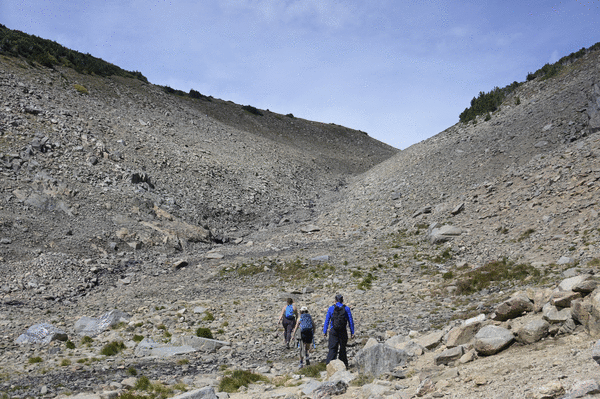
DENVER — St. Mary’s Glacier is gone.
And it may never return to its glory days as an iconic snowfield above 10,000 feet in Clear Creek County, where it drew year-round skiers and graced postcards mailed home by thousands of tourists who visited Colorado’s mountains.
The remaining bits of snow and ice melted away this past week, leaving hikers, skiers and tourism officials mourning the loss of one of the state’s most accessible and beloved glaciers — even if it’s technically not a glacier.
Colorado’s ongoing drought and record-hot summer, which scientists attribute to global warming, caused the snowfield to completely vanish for the first time in at least 100 years.
“St. Mary’s is a bit of the culture of Colorado,” said Dan McGrath, a Colorado State University associate professor of geosciences, who specializes in glaciers. “People ski and go see snow that persists through the summer. It is that loss that is the impact of this event. Glaciers are a bit of our identity.”
St. Mary’s is well known because it is a 90-minute drive from Denver and just 10 miles off Interstate 70 on Fall River Road. It is accessible for most people because the trail is not too long or too steep, making it a destination for those who do not want to climb in extreme conditions. Year-round skiers trek to the site to bag some runs in August and September to keep their consecutive-month streaks alive.
Despite its name, St. Mary’s is a “perennial snowfield” rather than an actual glacier, McGrath said. That does not make its disappearance any less significant, he said.
This winter’s record-low snowpack and 2026’s hottest average summer temperatures devastated it, and those conditions are also shrinking the state’s actual glaciers, including the Arapaho Glacier in the Indian Peaks Wilderness in Boulder County and the Andrews Glacier in Rocky Mountain National Park.
Weather patterns that dump a lot of snow and bring cooler summer temperatures could make conditions favorable again for year-round snow in the coming years at St. Mary’s. But scientists do not expect snow and cooler temperatures to be consistent enough to see the return of the thick, white snowfield where people could have snowball fights during the summer.
“This is a significant event, that it completely melted out,” McGrath said. “It would take multiple years of above-average snow to survive the summer and rebuild itself.”
Outdoor enthusiasts who regularly visit St. Mary’s began reporting its decline as early as July, but the snowfield’s complete disappearance went viral Thursday when Jonathan Ingraham of Lakewood posted pictures on Seth’s Weather Group, a Facebook page devoted to weather with more than 80,000 members.
“It was late July when it dawned on me this thing might melt out completely by Labor Day or mid-September,” Ingraham said Friday. “I was really hoping it would hang on to that first snow next month.”
McGrath flew over St. Mary’s for an aerial survey on Sept. 9. He also viewed the Andrews and Arapaho glaciers. All were contracting, he said.
The Andrews Glacier lost 11 feet in the past year, according to McGrath’s measurements.
“It’s very much part of a larger trend here in Colorado but also in the western United States, Canada and globally that glaciers are thinning and retreating,” McGrath said.
The World Meteorological Organization, which monitors worldwide climate and weather patterns, reports that glaciers lost an estimated average mass of 273 billion tons per year between 2000 and 2023, which is the most recent data available. The lost mass is equivalent to 0.75 millimeters per year of global sea-level rise.
In places such as the Andes Mountains in South America and the Himalayas in Asia, glaciers are a source of drinking water and sustain agriculture and other industries. In Colorado, they are not relied upon as a critical water source, but they support the overall ecosystem by feeding streams. Insects, fish and plants need the water, McGrath said.
Colorado’s glaciers are not just formed by snowfall but also rely on wind and avalanches to fill shaded basins with additional snow, said Matt Siegfreid, an associate professor at the Colorado School of Mines who teaches a class on the polar cryosphere. He described them as “quirky” when compared to other glaciers.
The state’s glaciers had shown growth between the 1950s and 2000, he said. But that changed about 15 years ago.
“These things have been shrinking for the past decade or two for a variety of reasons, and this was the last gasp,” Siegfried said.
Scientists are reluctant to pin blame for a single event on climate change, but Siegfried and McGrath agreed St. Mary’s disappearance is an indicator of a changing climate in Colorado.
“Climate is warming in Colorado,” Siegfried said. “That’s not controversial. The data shows that. Warmer temperatures melt glaciers.”
The warming is caused by greenhouse gas emissions such as carbon dioxide and volatile organic compounds, which mix in the atmosphere on hot days to form a blanket that traps heat closer to the Earth. The heat raises temperatures across the globe, causing more extreme weather such as heat waves, hailstorms and hurricanes.
The only way to slow the melting of glaciers is to change public policy and behavior to reduce carbon emissions, the scientists said.
“It needs to happen at regional, national and global scales to reduce our carbon use that is going into the atmosphere,” McGrath said. “The only way to fix this is to reduce those emissions and eventually stop those emissions.”
Colorado is working to reduce its greenhouse gas emissions with plans to eliminate coal-fired power plants and to promote less driving and electric lawn and garden equipment. But it’s working upstream as the Trump administration denies that climate change is real and rolls back federal policies that could reduce carbon emissions.
“Hopefully this wakes up parts of our community that haven’t been paying attention to our climate problems,” Siegfried said.
Meanwhile, those who loved St. Mary’s hope that it can recover.
Jordan Lipp, who has skied somewhere at least once a month since September 2009, said the loss of St. Mary’s will make it hard for him to keep his streak alive. It’s the “beloved, local little glacier” where he takes his children to play.
“Everyone is talking about that and wondering what they’re going to do to keep their streaks going. Do we go down to South America to keep our streaks going?” Lipp said. “Maybe next September it will be skiable, but five years from now what are we going to do?”
Locals and visitors talk about the times they have “shredded St. Mary’s Glacier,” said Jess Jones, director of the Clear Creek County Tourism Bureau.
“You skin up that thing and you ski your way down,” she said.
She hopes people still visit the area for its quiet, alpine beauty and respect the land.
“We just want people to love it the way we love it,” Jones said. “Environmentally, it would be a tragic loss. In regards to tourism, there is so much to enjoy in that area. I don’t think people would stop coming.”
©2026 MediaNews Group, Inc. Visit at denverpost.com. Distributed by Tribune Content Agency, LLC.






Comments