Mayor Brandon Johnson proposes Chicago data center moratorium: 'We can't wait'
Published in News & Features
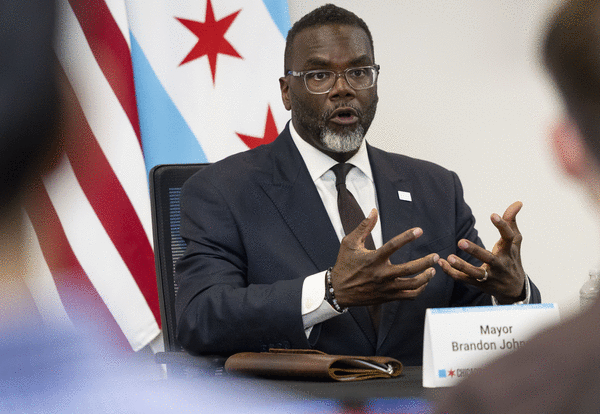
CHICAGO — Mayor Brandon Johnson proposed a data center moratorium ordinance Wednesday aimed at blocking the controversial developments from popping up in Chicago for one year.
He described the ordinance, now in aldermen’s hands, as a temporary pause that would give the city time to develop long-term policies regulating concerns around pollution, water use, and electricity costs. The city is “open for business,” Johnson said in a statement, but “not for sale.”
“We welcome innovation, investment and the jobs and opportunities that come with it, but growth must be done responsibly and in a way that protects the health, safety and quality of life of Chicago residents,” he wrote in a statement before the measure was introduced in the City Council. “We are taking a thoughtful approach that will allow Chicago to embrace innovation while continuing to make our city safer and more affordable.”
Johnson’s moratorium push comes after he signed an executive order early last month directing city departments to intensify scrutiny of new data centers. With his August order, Johnson established a city task force assigned with crafting new regulations.
At the time, the mayor also urged aldermen to pass a moratorium, but did not present moratorium legislation. With his new ordinance, Johnson is now trying to take the local mantle of an increasingly pressing political issue as he heads into his re-election campaign, while adding pressure on aldermen.
The 12-month ban would give Johnson’s administration time to research and establish new regulations, said Ald. Maria Hadden, 49th, City Council Environmental Committee chair. It’s “a year safeguard,” she said.
“Regulation takes time, and we’ve got to work on kind of catching up a little bit,” said Hadden, who is cosponsoring the legislation alongside Alds. Lamont Robinson, 4th, and Leni Manaa-Hoppenworth, 48th,
Hadden added that she does not believe data centers should be flatly banned from Chicago, even as popular sentiment mounts nationwide against the increasingly widespread infrastructure key to cloud computing and artificial intelligence.
“If we do this right, this moratorium doesn’t even have to last the year, right? Let’s get together, let’s get industry to the table, let’s get organizations to the table, and let’s get our regulatory framework together so that we don’t have to impede progress,” Hadden said. “We’re looking for sustainable data centers. We’re not looking to stop infrastructure. We’re not looking to stop economic growth.”
Hadden also sponsored legislation set to face a final vote Wednesday that would spur data centers to report annual water and energy use to the city. The city currently collects such information from large commercial buildings, but not the 39 data centers that already exist in Chicago, she said.
Some in the City Council criticized Johnson when he announced his August order, arguing the measure did nothing to immediately address the rise of data centers.
Meanwhile, several of Johnson’s top opponents in the race for mayor already staked out their own positions following the mayor’s August call for a moratorium.
Illinois Comptroller Susana Mendoza told the Tribune last month she does not support a moratorium. She argued the conversation surrounding data centers must be more truthful. Many already exist in the state, and economic development must be considered as a “whole plan for the city,” said Mendoza, who has championed the potential of artificial intelligence in campaign speeches.
“I don’t know if the average person knows that the average data center uses less water than a golf course,” she said. “I don’t think that we should be quick to say, ‘no, no, no,’ to everything without fully studying the issue.”
And Illinois Secretary of State Alexi Giannoulias did not take a clear stance when asked in late August if Chicago should implement a data center moratorium. The data centers that are built “need to be done responsibly,” he said, citing water usage and electricity rates.
“If they do it in an environmentally friendly way, if they do it by not using a lot of water, and if they cover theirs and other electric rates, I’d be open to having a conversation,” he said. “But the way it’s being handled right now is not what’s best for Chicago communities.”
Johnson’s moratorium push is the start of a conversation on making data centers environmentally friendly, said Jared Policicchio, first deputy commissioner at the city’s Department of Environment, which was eliminated in 2011 by Mayor Rahm Emanuel in a consolidation push and reestablished by Johnson in 2024.
The regulations Johnson’s administration is crafting would still require aldermanic approval, Policicchio said. The ordinance is “really just a way to give the mayor and his team time” to craft policy and get it in front of aldermen, he said.
“We can’t wait until our work is done with new policy to ensure that folks are protected,” he said. “We know what we have to do. We just need some time to do it.”
Policicchio said that technology like data centers is a part of daily life in Chicago. It will continue to be, but the city still needs modernized regulations, and it’s not an “either-or” choice, he added.
“I don’t think the mayor sees this as a ban. I think this is a temporary pause,” he said. “It’s truly designed to let us catch up to just a completely changed landscape.”
____
©2026 Chicago Tribune. Visit at chicagotribune.com. Distributed by Tribune Content Agency, LLC.






Comments