US-China truce extended as Xi gets rare welcome from Trump
Published in News & Features
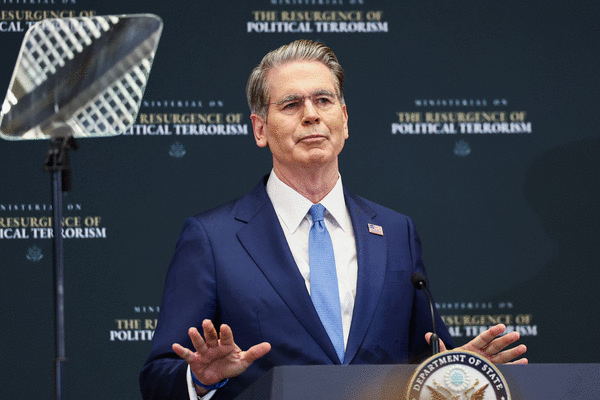
U.S. Treasury Secretary Scott Bessent announced the U.S. and China have agreed to extend their trade truce by two months, as President Xi Jinping landed in America for his first state visit in eleven years.
Xi and his wife Peng Liyuan, a celebrated soprano, touched down at Joint Base Andrews outside Washington shortly before 6 p.m. local time on Wednesday. Donald Trump shook hands with the couple, becoming the first U.S. president in around six decades to receive a foreign counterpart at that airport, excluding visits by the Pope.
Around the same time, Bessent unveiled a new Jan. 10 deadline for the trade deal struck last year to keep down tariffs between the world’s largest economies. “I don’t know whether a bigger deal can be done,” he told Fox News.
Xi said he was “confident” the trip would produce “fruitful results,” in a written statement released by the Chinese Foreign Ministry shortly after he landed.
An extension of the trade truce combined with Trump’s gesture of courtesy at the base in Maryland, home to Air Force One, sets a positive tone for Xi’s meetings. Trump will host the Chinese leader Thursday morning with a state arrival ceremony, according to an itinerary released by the White House, which called the event “a significant milestone” in ties.
“It’s remarkable that Trump is going so out of his way to accord this kind of respect for America’s chief geopolitical rival,” said Jonathan Czin, who served as China director at the National Security Council during the Biden administration, and is now with the Brookings think tank. “It is not clear what, if anything, Trump is getting from Xi in exchange for these many gestures of respect.”
Typically, presidents meet foreign counterparts at the White House for a formal arrival ceremony. During Xi’s state visit to the capital in 2015, his plane was met by then Vice President Joe Biden. Trump is the first American president to greet a Chinese leader on the tarmac in recent memory.
That break from protocol gives Beijing a powerful visual opportunity to present China as an equal peer to the U.S. for domestic audiences.
Xi is visiting Washington having used China’s stranglehold on rare earths to extract concessions from Trump during last year’s tariff war. The U.S. president, meanwhile, is seeking to advance commitments on purchases of agricultural goods and aircraft, as well as establish a line of communication on artificial intelligence.
Expectations for major breakthroughs remain low. Deep divisions remain between the superpowers on issues from trade and Taiwan to their race in AI. Xi is no longer expected to bring an entourage of Chinese executives, dimming prospects for the kind of headline business deals favored by Trump.
Underscoring the tensions, the Chinese government has taken possession of potentially sensitive F-35 stealth aircraft parts that were inexplicably diverted to Hong Kong, people briefed on the matter said — an incident that might come up in summit talks.
Airport etiquette
The last time a U.S. president welcomed a world leader besides the Pope at Joint Base Andrews was in 1962, when John F. Kennedy greeted then U.K. Prime Minister Harold Macmillan, a longstanding ally that fought alongside America in two world wars. A better parallel may be the reception given by Dwight D. Eisenhower to Soviet leader Nikita Khrushchev in 1959 during the Cold War.
“The contrast in ambition is stark,” said Bloomberg Economics’ Adam Farrar. “Eisenhower welcomed Khrushchev hoping to change the trajectory of the Cold War. Trump is rolling out the red carpet for Xi for a summit focused more on managing tensions than resolving them.”
When Trump visited Beijing in May, he was greeted at the airport by Chinese Vice President Han Zheng, as well as a military honor guard and hundreds of flag-waving children. The next day, Xi waited for him on the forecourt of the Great Hall of the People off Tiananmen Square.
On Wednesday, the two presidents walked down a red carpet lined by an honor cordon made up of U.S. military personnel. An Air Force Band played the Chinese and U.S. national anthems amid a cannon salute, while two U.S. B-2 bombers flew overhead.
“This to me seems like a clear case of the White House breaking past customs to get the summit started with a powerful gesture of respect to Xi Jinping to set the mood,” said Joseph Torigian, a China scholar at American University in Washington and author of a biography of Xi’s father. “It fits with President Trump’s belief that much of international politics is about personal relationships.”
In recent years, Xi has received a similar airport welcome from leaders including North Korea’s Kim Jong Un and Kazakh President Kassym-Jomart Tokayev. Last year, Trump greeted Russian President Vladimir Putin on the tarmac of an air base in Alaska for a high-stakes summit focused on the war in Ukraine.
Julian Gewirtz, a former Biden administration official who’s now at Columbia University, said Trump was displaying “extraordinary deference” toward Xi.
“In the history of U.S.-China relations, a state visit to Washington was traditionally something Beijing sought, and which the U.S. used as leverage,” he added. “The dynamic almost seems reversed: Xi is giving Trump the spectacle he wants, while the substantive gains for America remain entirely unclear.”
____
(With assistance from Colum Murphy and Jacob Gu.)
©2026 Bloomberg L.P. Visit bloomberg.com. Distributed by Tribune Content Agency, LLC.




Comments