Hurricane Isaias intensifies, forecast to strike Florida as Category 2, NHC says
Published in News & Features
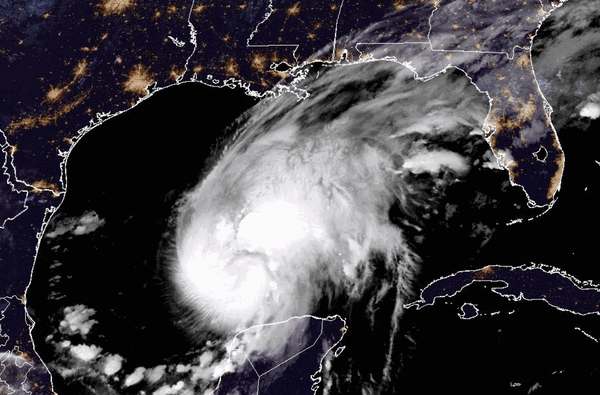
ORLANDO, Fla. — Hurricane Isaias intensified overnight Thursday with a forecast it will threaten Florida as it targets the Gulf Cosat. The storm just before midnight had become the first Atlantic system this year to reach hurricane strength, according to the National Hurricane Center.
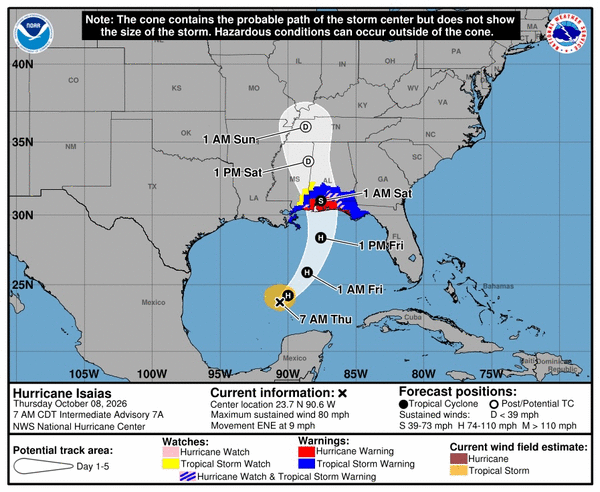
As of the NHC’s 8 a.m. advisory, Isaias was still a Category 1 hurricane with sustained winds of 80 mph located about 385 miles south-southwest of the mouth of the Mississippi River and 175 miles north-northwest of Progreso, Mexico moving east-northeast at 9 mph.
“Additional strengthening is expected through early Friday, and Isaias should remain a strong hurricane as it approaches the northern Gulf Coast on Friday night,” said NHC senior hurricane specialist Phillipe Papin.
A hurricane warning is in effect from Florida’s Bay-Gulf County line west to Ocean Springs, Mississippi with a tropical storm warning in Florida east of the Bay-Gulf County line to the Aucilla River and west of Ocean Springs to the Jefferson-Plaquemines Parish line in Louisiana. A storm surge warning is in effect from the mouth the Mississippi to the Steinhatchee River in Florida and a storm surge watch farther south to Yankeetown, Florida.
The forecast expects Isaias to reach maximum strength early Friday with 110 mph winds and 130 mph gusts early Friday in the Gulf, which would make it a strong Category 2 hurricane, but lose some steam before making landfall late Friday or early Saturday.
“Regardless, Isaias is expected to remain a dangerous hurricane through landfall, and gusty winds are expected well inland after landfall given the anticipated expansion,” Papin said.
For now, hurricane-force winds extend out 15 miles from its center while tropical-storm-force winds extend out 90 miles.
But that is expected to grow. Papin said the hurricane’s wind field may become broader, which could especially threaten more people hundreds of miles east of the storm’s center, currently forecast to target landfall near Pensacola.
Electric utilities were prepositioning crews to quickly repair any power outages. In Pensacola, city officials provided sand for residents to fill sandbags to protect their homes against flooding. And Pensacola Mayor D.C. Reeves urged people to check on elderly neighbors and others who might need help.
“Obviously no need to panic at this point,” Reeves told a news conference Wednesday. “This is really about preparation.”
Besides wind, the hurricane’s threats include possible tornadoes Friday night in coastal Florida and Alabama, storm surge up to seven feet on parts of the Gulf Coast, and excessive rain.
From Friday through the weekend, it’s expected to drop 3-7 inches with some areas getting up to 10 inches across the central U.S. Gulf Coast from the Florida Panhandle west to southeastern Louisiana. Another 1-3 inches with up to 5 inches could drop across much of the Southeast U.S. as far north as the Tennessee Valley and Carolinas bringing with it flash and urban flooding with some isolated river flooding.
The storm also will bring heavy swells to Florida’s Gulf Coast with life-threatening surf and rip current conditions.
Gov. Ron DeSantis on Tuesday issued an executive order declaring a state of emergency for 25 Florida counties in preparation for the storm.
“This order will allow the Florida Division of Emergency Management to stage critical preparedness resources and ensure Florida is ready to respond,” DeSantis said in a news release. “Floridians should take this time to get disaster plans in place and ensure their hurricane supply kit is stocked.”
Counties under the state of emergency are Baker, Bay, Calhoun, Columbia, Dixie, Escambia, Franklin, Gadsden, Gilchrist, Gulf, Hamilton, Holmes, Jackson, Jefferson, Lafayette, Leon, Liberty, Madison, Okaloosa, Santa Rosa, Suwannee, Taylor, Walton, Wakulla and Washington.
The system had formed as Tropical Depression Nine on Tuesday, became a tropical storm Wednesday morning and the Atlantic season’s first hurricane at 11:30 p.m. Wednesday, ending the longest stretch without a hurricane since satellite tracking began 60 years ago.
The storm formed just shy of tying a 121-year-old record as the latest arriving initial hurricane of the Atlantic season. According to the National Weather Service, the record dates to 1905, when the year’s first Atlantic hurricane formed on Oct. 8.
The hurricane season had previously seen the formation of tropical storms Arthur, Bertha, Cristobal, Dolly, Edouard, Fay, Gonzalo and Hanna.
For the first time in 60 years, however, none had developed into a hurricane in the Atlantic with less than two months left in the season.
Hurricane season began June 1 and runs through Nov. 30, but the height of hurricane season runs from mid-August through mid-October.
The reason for the lack of hurricanes has been an extremely strong El Niño weather pattern, which is warming surface temperatures in the Pacific Ocean. This generates wind shear preventing storms from strengthening in the Atlantic.
Sammy Hadi, a lead meteorologist with the National Weather Service in Miami, told the South Florida Sun Sentinel last week that the “top of these storms that are developing are being blown off.”
The National Oceanic and Atmospheric Administration in August had updated its seasonal forecast to expect between seven and 13 named storms this year. Of those, two to six would become hurricanes. It also predicted that there might not be any major hurricanes this year, or at most two.
Already, 2026 was forecast to have lower-than-average storm generation, and that has been reduced even further with the latest forecasts from the NOAA and other weather groups.
An average year would see 14 named storms and seven hurricanes, with three of those growing to Category 3 strength or higher.
©2026 Orlando Sentinel. Visit at orlandosentinel.com. Distributed by Tribune Content Agency, LLC.






Comments