Amid firings, individual immigration judges scrutinized by higher-ups on case management
Published in News & Features
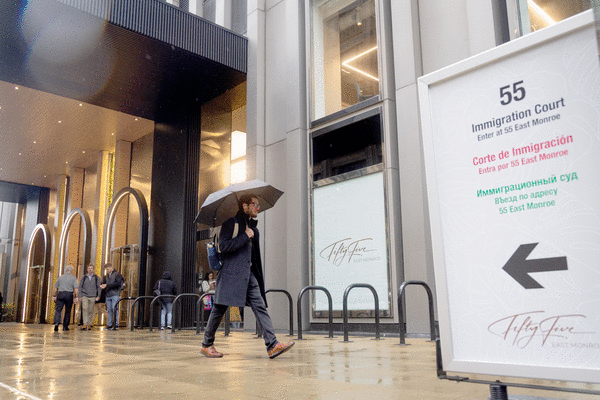
CHICAGO -- By the time one of Chicago’s immigration judges was called in to the court supervisor’s office and asked about a case they had recently shelved, the city’s immigration court had replaced Operation Midway Blitz as the main thrust of the Trump administration’s push to reshape American immigration enforcement.
The judge was asked why they had determined to suspend the case through what’s known as an administrative closure and was reminded the administration and system leadership are opposed to such decisions.
It was just one of a number of developments that raised concerns about the integrity of the courts among former immigration judges, attorneys and government scholars, according to Tribune interviews. It’s also a quieter example of the federal government’s increasingly heavy hand in the operations of immigration courts in Chicago and beyond, they said.
The questioning took place between waves of firings and shortly after Chief Immigration Judge Theresa Riley started sending out weekly emails commending judges who completed more than 100 cases in a week.
Weeks later, assistant chief immigration judges, including Craig DeFoe in Chicago, were told in a July 15 email to ensure that their judges were not terminating or dismissing asylum cases for unaccompanied minors. Instead, system officials told local supervisors to make sure judges continued those cases under a particular classification.
Spokesperson Kathryn Mattingly said in an email that the Executive Office for Immigration Review, which oversees the courts, doesn’t comment on personnel matters.
Eva Saltzmann, one of the most recently fired immigration judges from Chicago, said periodic questions and guidance about cases have long been a normal part of court operations. What wasn’t normal, she said, was the overall climate in which that questioning was taking place.
“Some of these inquiries and directives feel different when nearly a dozen (judges) have been fired,” she said. “If you’ve done something that has someone’s attention, will you still have your job tomorrow? There’s definitely that fear.”
The administration’s approach to the courts and particularly its personnel also has the potential to shape the future of the institution beyond the limits of President Donald Trump’s second term, according to professor Andrew Rudalevige.
Rudalevige, who studies executive authority and the limits of presidential power, said this administration’s approach to managing the offices and institutions within the executive branch, like the immigration courts, set a possible road map for future administrations to do the same — though perhaps not in service of the same political ends.
“Once these sort of leverage points have been unearthed, I do think you’ll see other presidents use them,” he said.
At first, the emails judges received from top officials about how they should handle asylum applications for unaccompanied minors mostly focused on things like scheduling and how to classify cases. But the July 15 email contained an explicit instruction: Judges should continue these types of cases instead of dismissing or terminating them.
The message also advised that judges should contact the assistant chief judge for vulnerable populations if they had questions about the definition of an unaccompanied minor.
Jeremiah Johnson, the vice president for the National Association of Immigration Judges, said that kind of advice was inappropriate — judges uncertain about a legal definition should review the law.
And he said that even the earlier communications, which were more procedural, added to “pressure to handle the cases a certain way.”
“You know headquarters is now watching this,” he said. “It’s putting you on alert that you’re being watched by the White House.”
Emails listing the judges who had completed more than 100 cases in a week started to go out in June, according to people who’d seen those communications. However, terminated cases — those that end without a ruling on their merits — didn’t count toward that total, according to one person who inquired about how the math was being done.
Not long afterward, the Chicago judge was brought in to discuss the administrative closure of one case that had caught the attention of national leadership. Though no one in the immigration court system has the authority to tell judges how to rule, that judge was one of a handful Johnson knew of who had decisions questioned and criticized by supervisors, whether at the local level or from higher-up officials.
Johnson and others said it wasn’t necessarily the objective of clearing cases that raised concerns about those emails. Each presidential administration brings its priorities to bear, to a certain extent, on the court system, where the immigration data clearinghouse TRAC most recently tallied the backlog of cases at just over 3 million.
The real problem, he continued, was the climate of fear the emails and the questioning created.
“(The pressure) is just turned up to 11 because you have your chief immigration judge saying, ‘Hey, the judge in New York did 200 cases this week, how many did you do? And if you don’t complete a case, maybe you and I should have a chat. Oh, and by the way, 120 judges have been fired.’”
Saltzmann, the recently fired judge, said that “anything like asking for justification of a legal decision would be out of the ordinary” and was the appropriate role of an appellate court.
She observed that many of the changes and directions given in Chicago’s court and elsewhere were tied together with a common thread of streamlining the court’s operations, another longtime goal for court administrators.
The question, she continued, is whether “this much efficiency creates due process concerns.”
Sheila McNulty, the former chief immigration judge who was one of the very first to be let go as Trump returned to the White House, said it was completely inappropriate for an assistant chief judge to raise questions about a line judge’s decision.
“That’s the role of the appellate court,” she said. “If you inject yourself into the process as an (assistant) chief judge then the process loses integrity.”
If that kind of questioning became more routine across the nation’s courts, she continued, then “what does that portend for due process? And what does that mean for that judge and their professional integrity in hearing these cases?”
In the view of immigration attorney Nicole Halllett, it doesn’t bode well.
“A judge cannot feel personally invested in the outcome of a case,” she said. “They need to feel independent in order to fulfill the role they’re supposed to be fulfilling,”
But the the firings, the messaging around case completion and obvious scrutiny from top officials created that investment, she said — “they will get in trouble and potentially fired if they don’t decide a case the way the administration wants them to.”
____
©2026 Chicago Tribune. Visit at chicagotribune.com. Distributed by Tribune Content Agency, LLC.






Comments