Saudi Arabia fends off more attacks in critical moment for Mohammed bin Salman
Published in News & Features
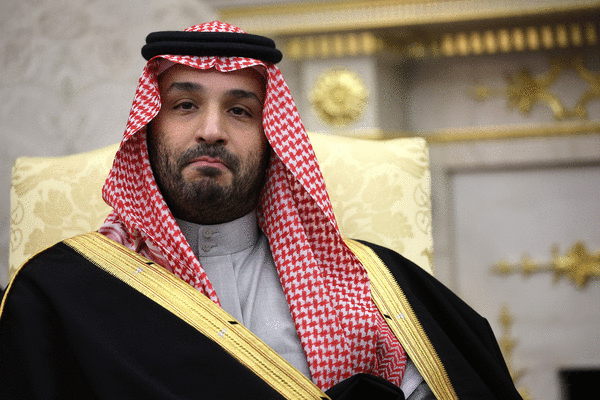
RIYADH, Saudi Arabia — Saudi Arabia’s Crown Prince Mohammed bin Salman is facing one of his most serious challenges since rising to power almost a decade ago as the kingdom grapples with the fallout from fatal attacks by Houthi militants.
For years, the de-factor ruler of the Middle East’s largest economy has been on a mission to transform the country into a center for everything from tourism to finance — and sell Riyadh as a city that can compete with the likes of New York and London.
But now, after a barrage of Houthi drone and missile strikes that have forced the suspension of operations at Riyadh’s main airport, the kingdom is starting to feel the impact of regional unrest on those ambitions.
Saudi Arabia said it had detected and was responding to fresh hostile threats on Monday, while the capital’s King Khalid International Airport remains at a near stand-still. Two separate attacks on the transport hub over the weekend killed at least 14 people and wounded more than 300, many critically.
Those were the deadliest strikes for Saudi Arabia since the United States and Israel first attacked Iran at the end of February, triggering the ongoing conflict.
U.S. aviation authorities cautioned against flying to or over parts of Saudi Arabia, and the flare up presents a difficult choice for President Donald Trump’s administration about whether to intervene in Yemen, where the Houthis are based. The United Kingdom government suggested British citizens depart via land to neighboring countries.
Business executives have pulled out of events in Riyadh, including the World Petroleum Congress happening this week. The city is also due to host the Future Investment Initiative, Riyadh’s flagship investor gathering, later this month.
That event usually draws Wall Street titans from BlackRock’s Larry Fink to Citigroup Inc.’s Jane Fraser and is used by the kingdom as a platform to pitch itself as one of the region’s best investment opportunities.
Saudi Energy Minister Prince Abdulaziz bin Salman, one of the most senior Saudi officials to speak publicly about the strikes, on Monday sought to project resilience and confidence in the kingdom’s ability to protect itself, its visitors and its agenda.
“The events of recent weeks are serious,” he said at the WPC. “Our response must be equally serious, while remaining focused on the decades ahead.”
“Investment must continue,” he added.
That message underscores the delicate balancing act that lies ahead as Saudi-led forces in Yemen seek to “eliminate” the Houthis, while MBS looks to protect against security threats and keep his economic diversification on track. The resurgence in fighting follows years of Saudi efforts to disentangle itself from conflict in Yemen, including through a United Nations-brokered truce in 2022.
Saudi Arabia recently increased its budget-deficit projection for the year in light of additional defense spending and said its economy will probably contract 3.6% — similar to the height of the COVID-19 pandemic in 2020.
Any potential damage to foreign confidence, business and local events risk adding to the strain and complicating efforts to advance Prince Mohammed’s so-called Vision 2030 economic transformation agenda.
As the violence in Saudi Arabia stretched into Monday, the Saudi-backed coalition of forces battling the Houthis said they were dealing with threats from both drones and cruise missiles. Earlier, they vowed a “decisive” response to recent events.
King Fahd International Airport in Dammam in the Eastern Province was targeted on Sunday, along with Riyadh’s main hub, less than a week after Saudi-led forces in Yemen launched a new offensive to retake Houthi-held areas in Yemen.
“The attack last night is very emblematic,” former White House Middle East coordinator Brett McGurk said in an interview with Bloomberg Television, referring to the deadly assault on Riyadh’s airport. “A very advanced, sophisticated ballistic missile, very accurate, targeting a commercial airport and now a number of civilian casualties,” he said. “It’s an act of terrorism. I think there has to be a response.”
A senior United Arab Emirates official urged a revival of regional security arrangements.
“It has become evident that we are all targets and that our security is indivisible,” Anwar Gargash, senior adviser to the United Arab Emirates president, said in a post on X.
For now, Saudi Arabia is projecting that business — and its plans to attract both tourists and investors — will continue to go ahead.
The World Petroleum Congress was livestreamed Monday from the capital, while organizers of FII have said they’re preparing to “welcome thousands of delegates to Riyadh” later this month.
Riyadh has been in conflict with Houthi militants ever since they took control of the Yemeni capital, Sanaa, in 2014 and forced the internationally recognized government backed by Saudi Arabia to resign the following year.
_____
(With assistance from Salma El Wardany.)
©2026 Bloomberg L.P. Visit bloomberg.com. Distributed by Tribune Content Agency, LLC.



Comments