John Fetterman votes with his party less frequently since Trump took office, rarely attends meetings
Published in News & Features
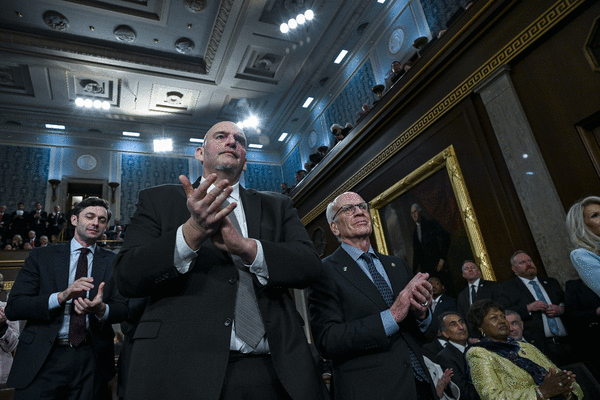
WASHINGTON — On the first full day on Capitol Hill last month after senators returned from an extended recess, John Fetterman did not show up for his first scheduled committee meeting.
Like dozens of times before, it was not clear where the Pennsylvania senator was while the top Democrat on the Senate Commerce Committee voted on his behalf and some of his colleagues amended and commented on legislation — in this case, bills about artificial intelligence, government censorship, and more.
Later that afternoon, he appeared at a Senate Agriculture Committee meeting, where he voted with Democrats and, for the first time in more than a year, spoke in the committee.
“We’ve got to find a way to pass this thing because people are coming all the way from my state saying, ‘We can’t keep waiting, waiting for this,’” Fetterman said in his brief remarks about the Farm Bill. “We have to deliver for our farmers.”
A senator’s quick, general comments about supporting a key constituent group normally would not be notable.
But as Fetterman considers running for reelection after the midterms while facing declining approval ratings from Democratic voters, he has appeared at just 16% of 158 committee and subcommittee meetings he could have attended in the current session of Congress, according to an Inquirer review of committee records.
He has missed more votes in committee and on the Senate floor than the typical senator, and he has introduced relatively few pieces of legislation, almost none of which have become law.
An analysis by The Inquirer of his voting record with the full Senate, meanwhile, shows his votes along the Democratic Party line have fallen from nearly 100% under the final years of President Joe Biden’s term to less than 80% during President Donald Trump’s first two years. Among Democrats, only U.S. Sen. Jeanne Shaheen of New Hampshire has voted with Trump’s priorities more often.
Both publicly and behind the scenes, former staffers say Fetterman — who is paid a $174,000 salary and leads a staff of more than four dozen — is not interested in the essential job of creating and passing legislation.
“He’s just completely disengaged from that component,” said Tré Easton, one of Fetterman’s former legislative directors, who has criticized him publicly.
The senator has introduced 64 bills and resolutions as the lead sponsor since entering office — 36 in his first two years and 28 in the current session.
Only one of those became law with his name on it: a 2023 bill to rename a post office in Camp Hill.
A few others he sponsored or was the lead Democratic sponsor of became law through other legislation, including the Whole-Home Repairs Act and the Whole Milk for Healthy Kids Act.
Easton described Whole-Home Repairs as Fetterman’s signature legislative achievement, but also one that Fetterman had little role in passing. Based on a Pennsylvania program that assists homeowners and small landlords with financing repairs, it became law this summer after it was incorporated into a larger bipartisan housing bill. Easton attributed the success to one of Fetterman’s legislative aides who switched roles to join the committee that hammered out the details.
Other bills have fallen short, Easton and other former staffers said, because Fetterman was unwilling to make requests and negotiate with other senators behind the scenes — a lack of lawmaking prowess that Fetterman has acknowledged in his 2025 memoir and in other public comments.
“To get any bill across the finish line, 80% is staff work but the last 20% is going to be the principal talking to folks on the floor and doing the basic glad-handing that John just does not do,” Easton said.
Increasingly voting with Republicans
Fetterman, whose office did not respond to requests for comment for this article, denounced recent criticisms of his job performance in a statement to CNN last month, calling them “lies, half-truths, innuendos, smears, and anonymous.” After a similar round of criticism in 2025, he told the New York Times he considered some Senate votes and committee meetings a waste of time.
“I am not collegial, and as a senator, you need to be to get anything real done,” he later wrote in his memoir, Unfettered. “I’m never going to be a typical senator … but legislation is a group effort, involving cajoling and arm-twisting and finding middle ground when you need to. Loners in the Senate remain exactly that — loners.”
Still, Fetterman’s record shows he has introduced fewer bills, voted less frequently with his party, made fewer public appearances, and attended fewer committee hearings as his time in office has gone on — including in the year since he wrote in Unfettered that he had to “do better.”
Fetterman has consistently traveled from his home in Braddock, outside Pittsburgh, to Washington for session weeks, though he has also missed more votes than the typical senator. Not counting his months seeking treatment for depression, he missed 9% of his roughly 1,500 votes, which is more than the 2.8% median for senators’ lifetime voting records, according to GovTrack.us.
An analysis by The Inquirer shows he aligned with other Democrats on nearly 99% of the votes that won a majority of Democratic support from 2023 to 2024. Since Trump took office, that figure fell to 80% in 2025 and less than 78% in 2026.
Fetterman, defending his role in his party, has repeatedly said that he votes with Democrats the vast majority of the time and that he would not make a good Republican.
His voting record shows he has voted against the Democratic Party line more than any other Senate Democrat. And on 134 votes where the White House position was clear, he agreed with Trump nearly 25% of the time — mostly for nominations, and more than any Democrat except Shaheen, who aligned with the president 28% of the time.
Trump said Saturday he’d “love to see” Fetterman become a Republican. The senator is “a very solid person” and has “great common sense,” though it would be difficult for him to get a Republican nomination for reelection as a Democrat, Trump told reporters.
Party leaders trying to keep Fetterman in the fold, particularly if the midterms result in a narrow Democratic majority, have praised his party bona fides.
Senate Democratic Leader Chuck Schumer of New York called Fetterman a “strong Democrat” in September. And U.S. Sen. Kirsten Gillibrand of New York, who is leading the party’s Senate campaign arm this year, said in an interview he “has been a very reliable Democratic vote.”
“He really cares about working people,” Gillibrand said. “He really cares about costs for groceries, housing, and healthcare. He’s shared a lot of his own healthcare experiences, not only authentically, but in a way that I think brings our country together.”
Rarely attends committees
Fetterman’s record in committees — where lawmakers refine bills and give them the initial thumbs-up or -down — has been marked by frequent absences.
By the time the Senate adjourned last Thursday, he had attended 26 of 158 potential hearings, voting sessions, and other meetings held by his three committees and six subcommittees in the current session of Congress, according to an Inquirer review of videos and meeting records.
Attendance at those gatherings can often be bleak as Republican chairs hold partisan hearings or quick voting sessions when many lawmakers vote by proxy. But The Inquirer found at least a few other rank-and-file Democrats were present and spoke during at least 122 of the gatherings Fetterman could have attended.
Fetterman also used his time in committees far differently from other Democrats.
He spoke during 20 total committee gatherings in nearly two years — frequently praising his own bipartisanship streak and avoiding direct questions or strong criticism of Trump administration officials who were testifying.
In one of the few instances in which he tried to put an official on the spot, for instance, he reassured a Federal Aviation Administration leader during a June 2025 meeting that it was “absolutely not a dig” as he asked him about funding for the Pocono Mountains Regional Airport that had not materialized. A month later, he told a Department of Agriculture official that he believed the agency had “walked back a little bit on [a] promise” to cover federal workers’ relocation expenses before shifting to talk about programs to rein in spotted lanternflies, the invasive species affecting Pennsylvania crops.
“I love stomping them,” Fetterman said. “I see them (and) it is like, stomp it, stomp it, stomp it.”
As Trump was building out his second administration, Fetterman did not attend hearings to question Commerce Secretary Howard Lutnick, Agriculture Secretary Brooke Rollins, Transportation Secretary Sean Duffy, or former Homeland Security Secretary Kristi Noem before voting, mostly by proxy, to confirm them.
At a hearing with tech leaders, on the other hand, Fetterman told OpenAI CEO Sam Altman it was a “highlight” and “one of the perks of being a senator” that he got to meet such an “impressive” person. Altman thanked him “for the kind words and for normalizing hoodies in more spaces.”
At another hearing, for the nominee to lead the Pipeline and Hazardous Materials Safety Administration, he held up bottles of fuel-contaminated water that a Bucks County constituent had brought to Washington after a Sunoco leak. Fetterman told the nominee he was not trying to “create theatrics” and then promised to vote for him even before he answered a question about working to fix the problem.
“It was difficult to get him to go to the hearing, but once we had the prop for him he was like, ‘I could get some clicks with this prop,’” said a former staffer who was involved in preparing the senator for the hearing. “He was like, ‘This could be like an Erin Brockovich thing.’”
Fetterman has defended his friendly approach to the Trump administration and Republicans, writing in his book that “we need to get away from the progressive and liberal notion that everything the Democrats do is right and above reproach and everything the Republicans do is wrong and evil.”
On his book tour last fall, he repeatedly said he faced different pressures as a purple-state senator than others who represent solidly Democratic parts of the country.
“Pennsylvania keeps you honest,” he said in several interviews.
He has also claimed those appeals across the aisle will pay off for Pennsylvanians. But his public record and work ethic behind the scenes, former staffers say, suggest he is not holding up his end of that bargain.
“He gives them so much, and D.C. is a very transactional environment,” one former staffer said of his attitude toward Republicans, who control Congress and the White House. “But you have to demand the things in return, and John just gives it all away for free.”
_____
(Data editor Stephen Stirling contributed to this article.)
_____
©2026 The Philadelphia Inquirer. Visit inquirer.com. Distributed by Tribune Content Agency, LLC.





Comments