'We're in crisis': The California coastal town under siege from fires, high surf, El Niño
Published in News & Features
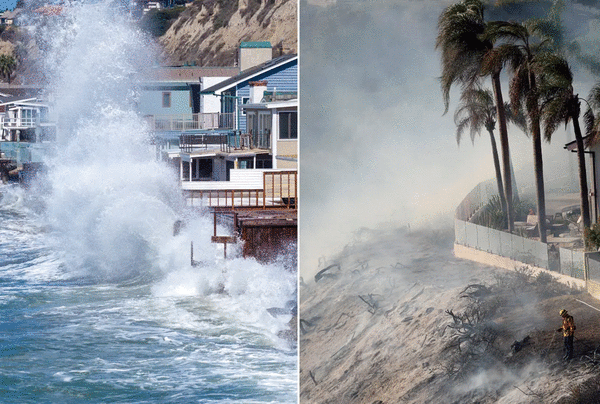
SAN CLEMENTE, Calif. -- Few cities in California last week felt the full brunt of the climate crisis more than the small coastal town of San Clemente.
The beach city at the southern end of Orange County for months has been dealing with widespread coastal erosion from El Niño-related Pacific storms that has threatened a crucial rail line and reshaped swaths of its beaches.
Then, as the waves were still pounding, a fire broke out in the city’s bushy foothills Friday, quickly burning toward hillside neighborhoods and destroying homes in nearby San Juan Capistrano.
San Clemente’s challenges demonstrate what more of California will probably face as the twin dangers of fire and coastal erosion converge this winter. Southern California is just entering its traditional fire season, and forecasters are predicting more coastal flooding and erosion from what is expected to be a severe El Niño winter.
“We’re in a crisis,” said Cameron Cosgrove, a 14-year San Clemente resident and a planning commissioner. “Our beaches are eroding and our wildfire risk is very high, especially during Santa Ana wind conditions. These are scary times and they require us to respond.”
San Clemente is a quintessential California beach town with bluff-top enclaves offering panoramic views of the Pacific Ocean and famed beaches boasting some of the best surf breaks in the country. The waves are so epic in the “Spanish Village by the Sea” that it beat out all other California beach cities to host the surfing competition in the 2028 Los Angeles Olympics.
But the factors that make it such a desirable place to live and play also bring immense risks for destruction — sometimes simultaneously.
On Monday, firefighters were working to wash streaks of pink fire retardant off the streets and finish building containment lines around the charred hills between San Clemente and San Juan Capistrano. Crows circled the blackened earth looking for seared animals to feast on. The smell of smoke lingered in the air.
“We lost our beaches and our trails within two weeks,” resident Rebecca Schwarz lamented as she stood with her partner, Todd, and their border collie, Bodie, surveying the Norte fire’s damage.
The blaze, fanned by strong Santa Ana winds, burned across 570 acres and destroyed at least six homes in San Juan Capistrano. Many residents in the rugged, shrubby hills have spent years preparing for such a fire. Few expected it Friday.
In fact, just days earlier, the remnants of Tropical Storm Rachel had slammed the coastline and dumped rain over the region — although not enough to significantly moisten the bone-dry vegetation.
“It was windy, but there were mountain bikers and there were runners up there all morning,” said Todd Schwarz on Monday, gesturing to the trails around Patriots Hill, where a flag planted long ago by a Boy Scout remained standing.
Before the Norte fire erupted, much of the city’s attention had been fixed on the coast. Residents have been bracing to see what El Niño has in store this winter after an active hurricane season that has dramatically reshaped many of Southern California’s most famous beaches, including in San Clemente and adjacent Capistrano Beach.
The National Oceanic and Atmospheric Administration’s Climate Prediction Center has said there’s virtually a 100% chance that the El Niño this season will be categorized as “very strong.” There’s also an 83% chance that this El Niño will be the strongest on record, going back to 1950.
Although many are breathing a sigh of relief with the fire under control, a new risk is emerging: mudslides. Roots that held the soil in place have burned and the vicious flames seared the dirt, limiting its ability to absorb water.
Some houses in the neighborhood already had piles of sandbags sitting on their front porches.
“Now El Niño is hitting us, and so now, what, do we have to worry about mudslides now?” said Suj Naran, a resident of about 10 years. “That’s our concern now.”
Even if it doesn’t result in torrential rain, El Niño can still wreak havoc on the coastline.
Beaches typically go through a seasonal cycle with powerful winter waves dragging sand out to sea and more mild summer waves depositing the sand back onshore. But El Niño winters generally bring even stronger waves, resulting in more sand loss and erosion.
Along San Clemente’s 4.7 miles of shoreline, coastal erosion has been a persistent and expensive predicament.
Erosion and slope damage have also caused problems over the years for one of California’s busiest rail corridors used by commuters via the Pacific Surfliner and Metrolink and freight operations.
In January 2024, a landslide above the railroad sent soil and debris crashing onto the tracks at Mariposa Point, destroying the city’s pedestrian bridge and beach trail and temporarily interrupting rail service. The Orange County Transportation Authority and Metrolink constructed a 200-foot-long wall to allow service to resume and moved ahead with a project to enhance protection along Mariposa Point.
High tides over the summer resulted in train cancellations and emergency repairs to the rail line. The transportation authority is finalizing a study in the coming weeks that evaluates strategies for protecting the seven miles of railroad through Dana Point and San Clemente for the next 30 years.
But the effects of coastal erosion have been most evident at the beach. Without natural sand reaching the beaches, high tides and large surf have resulted in entire beaches being covered with water, cutting off access.
In 2024, the city added about 200,000 cubic yards of sand near the pier and 37,000 cubic yards just up the coast at North Beach, the first step in what will be a decades-long process of restoring the beaches. The effort was successful in widening the beach and protecting infrastructure including the city’s marine safety headquarters, but it was just a fraction of what will be needed long term, according to the city’s coastal strategic plan.
Coastal engineers estimate that it’ll take millions of cubic yards of sand to fully replenish the city’s coastline. For a small city, funding for such projects remains an unanswered question, officials said.
“San Clemente doesn’t have car dealerships and Costcos and big hotels — all the nice revenue-generating entities that other cities have,” Mayor Rick Loeffler said. The multimillion-dollar replenishment project in 2024 was funded through a joint effort by the federal government, the city and the state, which stepped up to cover a portion of San Clemente’s costs.
Next month, residents will vote on whether to approve a 1% sales tax increase for 10 years to fund sand replenishment projects, beach erosion control and fire protection services. A similar ballot measure in 2024 that would have funded sand replenishment, but not fire prevention, failed to reach the two-thirds majority it needed to pass.
“We’ll see what happens,” Loeffler said of the ballot measure. “It’s kind of timely with this fire that just happened. It reminds people that the fire situation is actually going to be worse than the sand replenishment if we get a big fire that comes through our canyon.”
Much of San Clemente’s hillside communities, past the 5 Freeway, are classified as being in high or very high fire hazard zones, according to the California Department of Forestry and Fire Protection.
The city has already deployed goats to chomp away at invasive brush along the hillsides, but Cosgrove, who wrote Measure M, said more work is necessary to protect the community.
The ballot measure will provide funds for staging air assets and firefighters during high-wind events to knock down potential fires quickly, remove highly flammable nonnative vegetation from about 5,000 acres of open space and replace them with native plants. The measure would also allow for more community engagement to help residents better harden their neighborhoods and businesses, Cosgrove said.
“San Clemente was very fortunate this time because of the wind direction,” he said. “If the wind was going the opposite way, it’s unimaginable what could have happened. This needs to serve as a wake-up call to residents that we need to protect our town.”
©2026 Los Angeles Times. Visit at latimes.com. Distributed by Tribune Content Agency, LLC.






Comments